



Most shop owners only think seriously about CCTV for commercial shops after something goes wrong. A missing stock report that doesn’t add up. A till discrepancy that nobody can explain. By then, the damage is already done, and the footage you needed simply isn’t there.
You already know your shop deserves proper protection. The worry isn’t really whether you need a CCTV system; it’s figuring out which setup actually works for your space, whether you’ll end up tangled in GDPR regulations, and how on earth you manage it all without becoming a tech expert overnight. Those are completely fair concerns, and you’re not alone in having them.
This guide cuts through the confusion. We’ll walk you through exactly what to look for in a commercial CCTV system, how to stay on the right side of UK data laws, and how to get remote access so you can check in on your shop from wherever you are. By the end, you’ll have a clear, practical picture of what a secure, legally compliant setup looks like for your retail space.
Closed-circuit television (CCTV) has evolved well beyond a simple theft deterrent. For retail owners, a properly configured system is now one of the most versatile tools in your entire business operation. Yet most guides stop at “it catches shoplifters” and leave you there. The real picture is considerably richer than that.
Visible, high-quality cameras positioned at entrances and key display areas create an immediate psychological deterrent. Would-be shoplifters assess risk before they act, and a clearly mounted camera changes that calculation instantly. Beyond deterrence, many UK insurers actively reward retailers who invest in verified CCTV systems with reduced commercial premiums, so the system can offset part of its own cost over time. Customers also benefit: a well-lit, monitored shop floor signals that you take their safety seriously, creating an environment where people feel genuinely looked after.
This is where CCTV for commercial shops genuinely separates itself from what most security guides discuss. Footage from back-of-house cameras lets you verify that stock deliveries match your invoices, catching discrepancies before they quietly erode your margins. Internal shrinkage, often harder to detect than external theft, becomes far easier to identify when storage areas and stockrooms are properly monitored.
The operational intelligence goes further still. Reviewing camera footage reveals your genuine peak trading hours, where queues form, and which areas of the shop floor see the most footfall. That data helps you build smarter staff rotas and rearrange displays for better customer flow. If your kitchen runs specialist equipment, such as a Rational oven, back-of-house cameras confirm it’s being operated correctly by staff, protecting both the machinery and your investment.
Getting the hardware right is only half the job. The other half is making sure your setup is legally watertight from day one. For CCTV for commercial shops, both matter equally, and skipping either one creates problems you really don’t want to deal with later.
Resolution is non-negotiable. HD 4K cameras capture the fine detail that actually holds up as evidence — a clear face, a legible number plate, a specific item being handled. Pair that with reliable infrared night vision and your system works properly around the clock, not just during trading hours.
Remote access via a smartphone app is genuinely transformative for busy owners. You can check in on your shop floor from anywhere, review footage after a till discrepancy, and respond to alerts in real time without being physically present. Think of it the same way you’d think about investing in dependable reconditioned commercial catering equipment: the right kit, properly specified, simply gets on with the job reliably.
On storage, most UK retailers retain footage for a minimum of 31 days. That window gives you enough time to identify incidents, respond to customer complaints, and fulfil legal requests without scrambling.
UK law is clear, and the UK Surveillance Camera Code of Practice sets out exactly what responsible operators are expected to do. In plain terms, here’s what that means for your shop:
None of this is as daunting as it sounds once it’s set up correctly from the start. If you’d like a hand sorting the practical side quickly, ring us on 01983756628 and we’ll point you in the right direction.
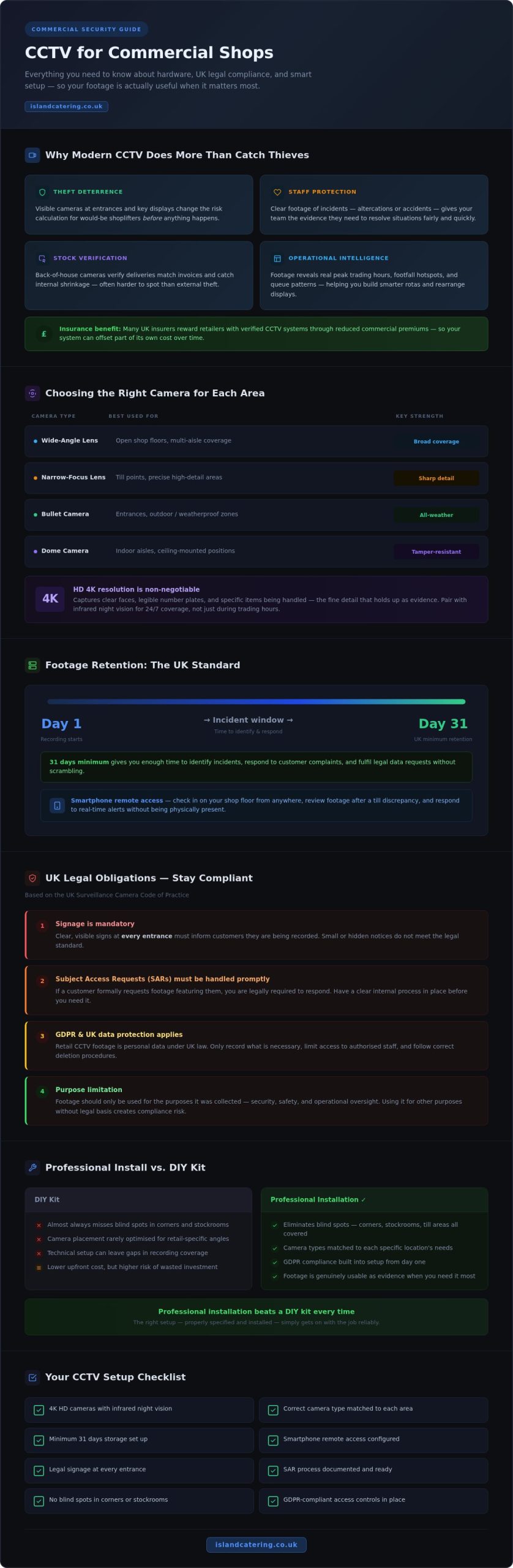
Knowing what you need is one thing. Getting it installed correctly is another matter entirely. Even the best cameras on the market will let you down if they’re mounted at the wrong angle, cabled poorly, or connected to a storage unit that quietly fails without anyone noticing. That’s where the gap between a professional setup and a DIY kit becomes very real, very quickly.
Off-the-shelf plug-and-play kits are tempting. They’re cheap upfront and promise a quick fix. But the problems tend to surface later: cables running visibly along skirting boards, cameras positioned too high to capture facial detail, and budget hard drives that fill up and overwrite critical footage before anyone realises. A professional site survey changes all of that. An experienced installer walks your space with fresh eyes, identifying vulnerable entry points, awkward corners, and stockroom blind spots that you’ve simply stopped noticing because you see them every day.
For CCTV for commercial shops, proper camera placement is everything. A till camera angled five degrees too wide misses the exact detail you need. A stockroom camera mounted above a shelving unit captures ceiling tiles rather than the door. Getting this right from the start means your footage is actually useful when it matters.
A security system isn’t a fit-and-forget installation. Lenses gather dust. Hard drives accumulate errors. Infrared LEDs degrade over time. Regular checks keep everything performing as it should, so you’re not discovering a fault the day after an incident.
Think of it the same way you’d approach your catering equipment spare parts schedule or a commercial kitchen repair plan. You wouldn’t run a busy kitchen on equipment that hasn’t been serviced; your security setup deserves exactly the same discipline. Scheduled maintenance keeps your evidence quality sharp and your storage reliable, month after month.
We’ve been helping businesses stay operational since 2004, and we know that a quick response sorts problems before they escalate. Ring us on 01983756628 and we’ll get you sorted quick.
Getting CCTV for commercial shops right comes down to three things: choosing hardware that captures genuinely useful footage, staying compliant with UK data law from day one, and having it installed properly so there are no blind spots when it counts. Cut corners on any one of those, and the whole system lets you down at exactly the wrong moment.
The good news is that none of this needs to be complicated. With the right guidance, a reliable, legally compliant setup is well within reach for any independent retailer, regardless of the size of your shop or how much you know about security systems.
Our engineers have been helping businesses like yours stay operational since 2004, and we offer nationwide UK support for all commercial infrastructure needs. We give friendly, no-nonsense advice, and we’ll sort things quick for you. Need to secure your shop or upgrade your commercial equipment? Get in touch with us today or ring us anytime on 01983756628. You’re in good hands.
No licence is required to install CCTV in your own commercial premises, but you do have legal obligations to meet before switching it on. Most businesses must register with the Information Commissioner’s Office (ICO) and pay an annual data protection fee, with the tier depending on your organisation’s size and turnover. Skipping this step can result in a fine, so register before your system goes live rather than after.
If you’re hiring a third-party security company to operate the system on your behalf, check that their staff hold a valid SIA licence. That requirement applies to the operator, not to you as the business owner installing cameras on your own property.
UK data protection law doesn’t set a fixed maximum retention period, but the principle is clear: keep footage only for as long as there’s a legitimate reason to hold it. For most retail environments, 31 days is the widely accepted standard, giving you enough time to identify incidents and respond to any formal requests without holding personal data unnecessarily beyond that window.
If an incident occurs, download and preserve the relevant clip separately before your system overwrites it. Routine footage with no evidential value should be deleted on schedule. Holding data longer than necessary without justification puts you at risk of an ICO complaint.
Yes, but you must be transparent about it. Covert monitoring of staff is only lawful in very specific circumstances, such as a formal investigation into suspected criminal activity, and even then it requires careful justification. For everyday operational purposes, employees must be informed that cameras are in use, what areas are covered, and why monitoring is taking place. This should be documented in your workplace privacy policy.
Monitoring till points and stockrooms for loss prevention is entirely legitimate when handled openly. The key is proportionality: cameras in staff toilets or changing rooms are never acceptable, and placing cameras purely to track productivity without a clear security rationale is unlikely to withstand scrutiny under UK data protection law.
Your signage needs to be visible before a person enters the monitored area, not tucked away once they’re already inside. Each sign should clearly state that CCTV is in operation, identify who is responsible for the system (your business name), and provide contact details for anyone wishing to make a data request. The ICO publishes guidance on acceptable sign formats, and following it closely keeps you compliant.
Font size and placement matter. A small sticker on a door frame at head height doesn’t meet the standard if it’s easily missed. Position signs at eye level at every entrance, and if your shop has distinct zones with separate camera coverage, consider signage at those transition points too.
Audio recording is significantly more restricted than video under UK law and should be approached with real caution. Recording conversations without the knowledge of the people involved can breach the Investigatory Powers Act 2016 and GDPR simultaneously, creating serious legal exposure. Most retail CCTV systems are configured for video only, and that’s the safest position for the vast majority of shop owners.
If you have a specific, documented reason to consider audio capture, such as a high-risk security environment, take legal advice before enabling it. The bar for justifying audio surveillance is considerably higher than for video, and the consequences of getting it wrong aren’t worth the risk.
If your system fails and no usable footage exists, your options narrow considerably. Insurance claims become harder to substantiate without visual evidence, and police investigations lose a key source of information. This is precisely why routine maintenance checks matter: a system that hasn’t been tested recently may have a failed hard drive or a degraded camera lens that nobody noticed until it was too late.
For CCTV for commercial shops, building a simple maintenance schedule into your operations, much like servicing your commercial equipment, is the most reliable way to avoid this situation. If you’re unsure whether your current setup is performing as it should, ring us on 01983756628 and we’ll help you work through it quickly.





No account yet?
Create an Account