


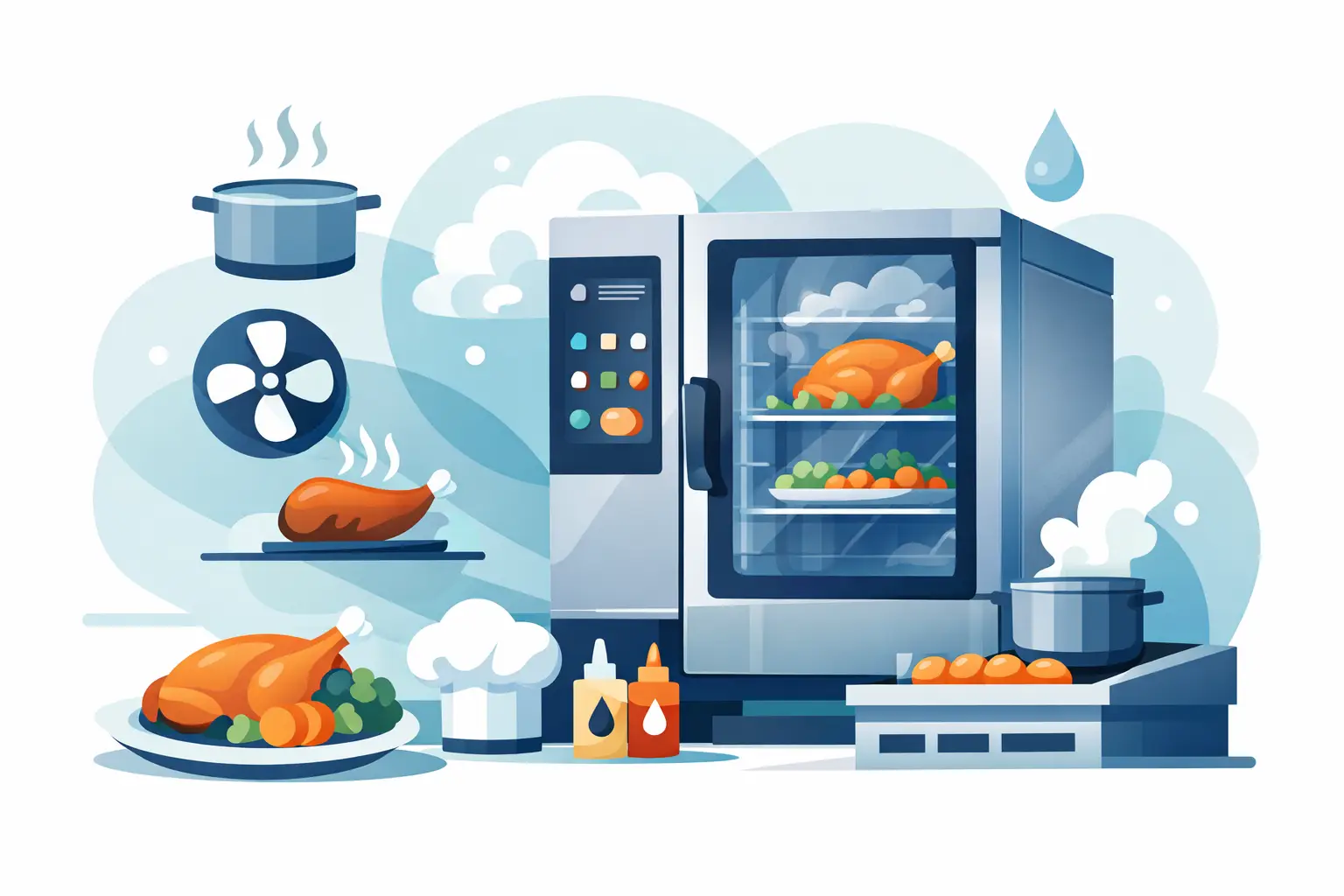
The difference usually shows up at service. One oven is holding back the pass, drying out proteins and forcing staff to keep checking trays. The other is turning out consistent results, batch after batch, with less guesswork. If you are asking what is a combi oven, the short answer is that it is a commercial oven that combines dry heat, steam, or both at the same time to give far more control than a standard convection unit.
That matters because most professional kitchens are not struggling with a lack of heat. They are struggling with consistency, labour pressure, space constraints and the cost of getting food wrong. A combi oven is designed to solve those problems in a practical way.
A combi oven is a commercial cooking appliance that uses three core modes: dry heat, steam, and a combination of the two. Dry heat works like a powerful convection oven, moving hot air evenly around the cavity. Steam mode introduces moisture for gentle cooking, regeneration and moisture retention. Combination mode blends both, giving you browning on the outside while keeping products moist inside.
In a busy kitchen, that flexibility replaces multiple pieces of equipment or at least reduces dependence on them. Roasting, steaming, baking, regenerating and finishing can all be handled in one cabinet, provided the oven is properly specified for your menu and output.
This is why combi ovens are standard equipment in many restaurants, hotels, schools, care settings and contract catering operations. They are not niche machines. They are workhorses built for volume, repeatability and control.
The principle is straightforward. Heating elements or a petrol-powered system generate heat, fans circulate it, and the oven introduces steam into the cooking chamber as required. The operator selects the cooking mode, temperature, time and, on more advanced models, humidity levels, core probe settings and automated cooking programmes.
That extra control is where the value sits. In a conventional oven, if a product starts losing moisture or colouring too quickly, the operator has limited options. In a combi oven, humidity can be adjusted to protect yield, improve finish or speed up cooking without hammering the product.
For example, a roast chicken can colour properly while retaining more moisture. Vegetables can be steamed without separate equipment. Bakery items can benefit from controlled humidity at key stages. Regeneration can be done without food coming back tired, dry or unevenly heated.
The main reason is efficiency, but that needs unpacking. Efficiency in a commercial kitchen is not just energy use. It is labour, yield, timing, floor space, cleaning time and how often equipment slows service down.
A good combi oven helps with all of those areas. It can reduce manual intervention, support less experienced staff with programmed cooking, and improve consistency between shifts. If your operation depends on repeatable results across breakfast, lunch and dinner, that reliability has a direct commercial value.
Space is another factor. In smaller kitchens, one combi oven can cover work that would otherwise require separate convection, steaming and regeneration capacity. That does not mean every site can remove other equipment entirely, but it often means a tighter, more productive cookline.
There is also the matter of yield. Moisture loss is margin loss, especially on proteins. Better humidity control can help protect product weight and eating quality, which matters whether you are serving plated meals, banqueting covers or school dinners.
A combi oven is one of the most versatile pieces of equipment in a professional kitchen. It can roast meats, steam fish, cook vegetables, bake pastries, regenerate plated meals, finish casseroles and handle large batch cooking with far more consistency than basic ovens.
That said, versatility is not the same as replacing every appliance. A combi oven will not make a chargrill redundant if chargrilled flavour and branding are central to your menu. It will not fully replace a fryer in a pub kitchen. The real advantage is that it takes on a large share of daily cooking tasks and does them with control.
For sites with changing menus or multiple service styles, that flexibility is particularly useful. Hotels, event venues and institutional caterers often need equipment that can switch quickly between breakfast production, lunch regeneration and evening service. Combi ovens are well suited to that kind of demand.
Compared with a standard convection oven, a combi oven gives you moisture control. That changes the result as much as the process. Food is less likely to dry out, reheating is more effective, and operators have more scope to fine-tune cooking conditions.
It also tends to improve consistency. Even heat circulation, programmable cooking and automated controls reduce the variation that creeps in when different staff members handle the same dishes. In operations where staffing is tight or skill levels vary, that is a serious advantage.
Cleaning can also be easier on many modern units, especially higher-end models with automatic wash systems. That saves labour and helps with hygiene standards, though only if the oven is maintained properly and cleaning routines are followed.
The trade-off is cost. A combi oven is a more advanced piece of equipment, so the purchase price is higher than a basic oven. For many operators, the question is not whether a combi oven costs more upfront. It is whether the gains in output, consistency and labour justify that spend. In most medium to high-volume professional kitchens, they do.
Not always. If your menu is very limited, your covers are low, or your kitchen rarely needs steam, regeneration or batch cooking, a combi oven may be more capacity than you need. Likewise, if the team will not use the programming and control functions properly, some of the value can be wasted.
The right choice depends on your menu, service style, available space, utilities and budget. Capacity is especially important. An underspecified oven creates a bottleneck. An oversized one can tie up capital and energy unnecessarily. This is why buyers need to look beyond headline price and focus on application.
For many operators, refurbished equipment makes that decision easier. A professionally restored premium combi oven can offer strong value where the budget does not stretch to a brand-new unit, provided the machine has been tested thoroughly and supported properly after sale.
Not all combi ovens are equal. Build quality, controls, cleaning systems and service support vary significantly across the market. For a professional buyer, the important question is not just what features are available, but which ones will make a measurable difference in day-to-day operation.
Programmable cooking is high on the list because it reduces training pressure and improves consistency. A reliable core temperature probe matters for meat and precise finishing. Automatic cleaning can save time, but only if the system is dependable and the chemistry is readily available. Easy-access service parts and strong technical backup are also critical, especially in high-output sites where downtime is expensive.
Brand reputation matters here for good reason. In commercial kitchens, proven performance and serviceability count for more than gimmicks. That is why many operators continue to favour Rational units when they need reliability, control and strong long-term support.
This comes down to budget, expected lifespan, and how quickly you need return on investment. A new oven gives you the latest specification, full manufacturer support and a clean operational start. For some sites, especially new openings or high-volume kitchens, that is the right route.
A refurbished oven can be the smarter commercial decision when capital is tighter. The key is refurbishment standard. A properly refurbished unit should not be a quick clean-up and resale job. It should be inspected, restored by trained technicians, tested thoroughly and supplied by a specialist that understands the equipment and can support it after installation.
That support matters as much as the machine itself. Buying from a specialist supplier such as Island Catering Equipment Co. gives operators access not only to stock, but to servicing, parts and technical backup when the oven is in use.
A combi oven earns its place by making service more controlled. It helps kitchens produce food consistently, protect yield, simplify processes and make better use of labour. That does not mean every model suits every site, and it does not remove the need for good training and maintenance. But where the oven is properly matched to the operation, the impact is obvious.
If you are weighing up your next equipment purchase, the better question is not simply what is a combi oven. It is what your kitchen could produce with one that is correctly specified, properly maintained and built to keep up with service.





No account yet?
Create an Account