


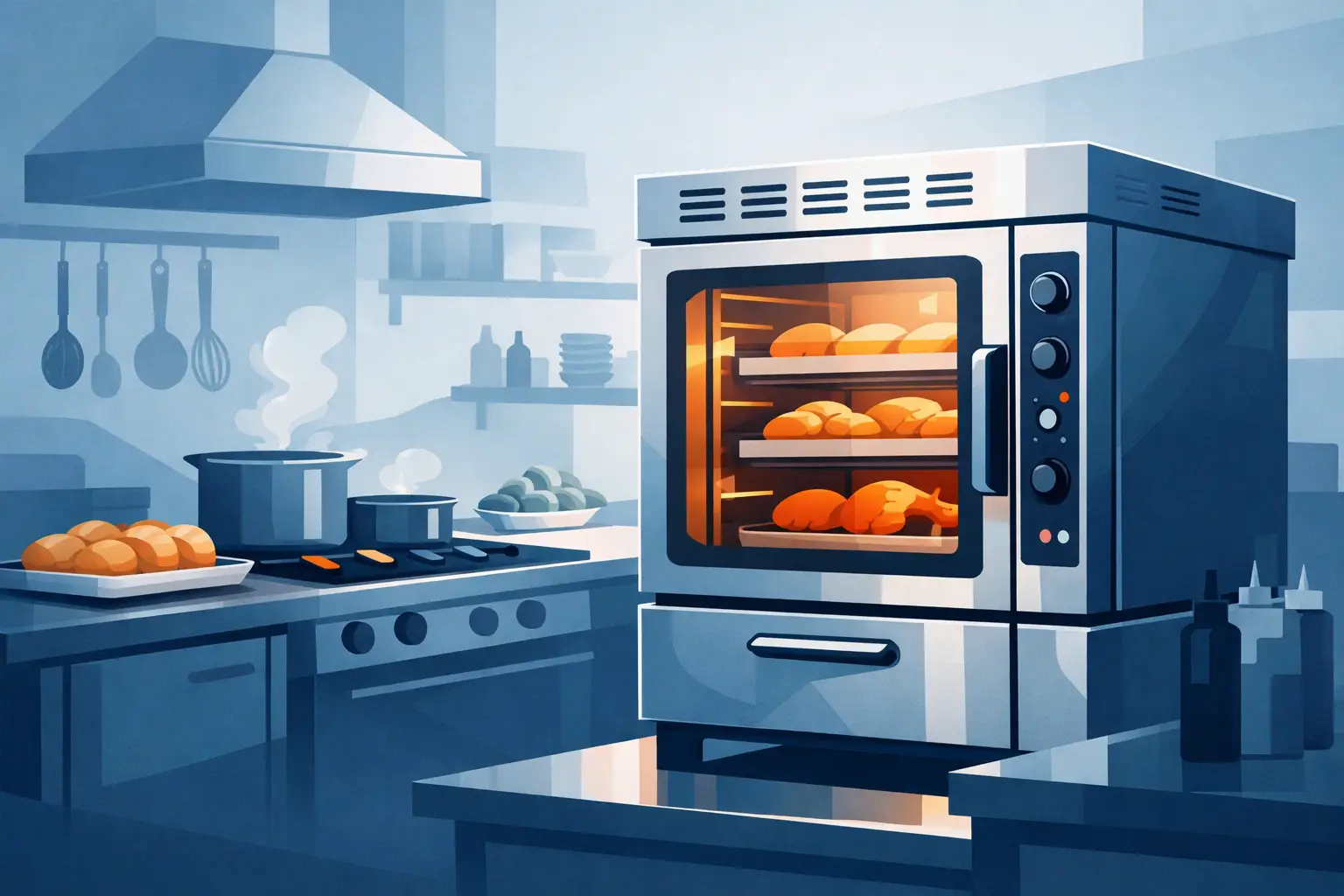
A busy service exposes weak equipment fast. If you are choosing the best oven for commercial kitchen use, the right answer is not the model with the longest feature list. It is the oven that matches your menu, output, labour profile and maintenance expectations without creating bottlenecks during service.
For most professional kitchens, that points in one direction – a combi oven. Not in every case, and not for every budget, but in restaurants, hotels, schools, care settings and contract catering, a combi oven usually gives the best balance of flexibility, consistency and throughput. The question is less whether a combi makes sense, and more which type, size and condition make commercial sense for your site.
If your kitchen handles mixed production across roasting, steaming, baking, regenerating and finishing, a combi oven is usually the best oven for a commercial kitchen. It combines dry heat, steam and mixed cooking in one unit, which means fewer separate appliances, tighter control and better use of space.
That matters because most commercial buyers are not shopping for a single cooking function. They need one oven to cover multiple day-to-day tasks, maintain consistency across staff shifts and reduce the risk of overcooking, drying out or uneven results. In kitchens with staff turnover or high-volume service, those gains are operational, not cosmetic.
That said, the best choice depends on what you actually produce. A pizza operation may get more value from a deck oven. A bakery focused on pastry and bread may prefer a dedicated bake-off or deck solution for the finish and chamber characteristics they need. A pub kitchen with a broad menu, however, will often gain more from a combi than from a single-function oven.
A commercial combi oven earns its place because it solves several problems at once. It improves consistency, speeds up production, reduces shrinkage and gives kitchen teams more control over varied menu items. Instead of managing separate steamers, convection ovens and reheating equipment, operators can centralise a large part of production in one machine.
In practical terms, that means better roast yields, more reliable regeneration, controlled humidity for delicate items and improved repeatability across different users. For group catering, education, healthcare and hospitality, that level of control is often the difference between smooth service and avoidable waste.
There is also a labour benefit. Programmable cooking lets teams standardise output, which is especially useful where skilled labour is tight or training time is limited. A strong combi oven reduces dependence on one experienced chef standing over every batch.
Not every kitchen needs the cost or capability of a premium combi. A convection oven can still be the best oven for commercial kitchen setups with a narrower menu and lower moisture-control demands.
If your operation mainly bakes, roasts and reheats straightforward items, a convection oven may offer enough performance at a lower entry price. It is mechanically simpler, often easier for smaller teams to operate and can make sense in cafés, smaller pubs and prep kitchens where the cooking profile is predictable.
The trade-off is flexibility. You lose the steam and combination modes that help with yield, regeneration and cooking control. Over time, that can limit menu development and reduce efficiency, especially if the site grows or service gets busier.
Deck ovens remain a strong option for specialist operators. Pizzerias, artisan bakeries and sites that rely on a particular bake quality may still prefer a deck oven over a combi or convection model.
That preference is usually about end product rather than convenience. Stone baking, chamber heat retention and the way deck ovens handle certain doughs can justify the dedicated footprint. If the oven is central to one category and that category drives sales, a specialist machine can be the right investment.
The limitation is range. Deck ovens are less adaptable for mixed-menu commercial kitchens, so they work best where the menu is focused and the output justifies the dedicated equipment.
For many buyers, this is where the decision becomes commercial rather than technical. A new oven gives you the latest controls, maximum lifespan ahead of it and, in many cases, manufacturer-backed reassurance. If the budget is there and the site needs current-generation features, new equipment is an easy case to make.
But a professionally refurbished premium oven can be the smarter buy. In many kitchens, especially independent restaurants, pubs, care facilities and cost-conscious catering operations, refurbished equipment opens access to higher-grade cooking technology without the full cost of buying new.
The key point is refurbishment quality. A used commercial oven only represents value if it has been restored properly, tested thoroughly and supported after sale. Cosmetic clean-up is not refurbishment. What matters is technical inspection, replacement of worn parts where required, proper testing and confidence that the unit is ready for commercial use.
That is why buyers should put as much weight on the supplier as the oven itself. An oven is not simply a box with a price tag. It is an operational asset that needs stock availability, parts access and competent engineering support if anything goes wrong.
Capacity mistakes are expensive. Buy too small and you create a production bottleneck that affects every service. Buy too large and you waste energy, floor space and capital on capacity you do not use.
The right size depends on service style, not just cover count. A 60-cover restaurant with staggered ticket flow may have different needs from a school kitchen producing large-volume batch meals in fixed time windows. Likewise, a bakery doing repeated tray loading all morning has a different oven demand from a hotel finishing banqueting service in concentrated bursts.
Think in terms of peak output, tray compatibility, available extraction, loading access and the physical workflow around the oven. Doors, stands, racking and drainage all affect how well the equipment will actually fit the kitchen. On paper capacity can look fine. In practice, layout often decides whether the oven improves service or gets in the way.
Some features genuinely improve commercial performance. Programmable controls help standardise output. Automatic cleaning saves staff time and makes regular maintenance more realistic. Accurate humidity control matters for product quality, particularly in mixed cooking environments. Core temperature probes support consistency and food safety.
Other features depend on the operation. If your menu is simple and your team is experienced, you may not need the most advanced touchscreen interface or the broadest library of cooking programmes. Paying for technology you will not use is not efficient buying.
It is usually better to spend on reliability, serviceability and the right cooking capacity than on optional extras with limited day-to-day benefit.
Commercial buyers often focus on purchase price and overlook what happens afterwards. That is a mistake. Even the best oven for commercial kitchen environments needs servicing, cleaning discipline and occasional parts support.
Downtime costs far more than a line on an invoice. Lost service, disrupted prep and emergency callouts all have a direct impact on margin. That is why aftersales support should sit near the top of the buying criteria, especially for high-output sites.
Look for a supplier with technical knowledge, parts availability and engineering capability, not just sales stock. If you are investing in a premium combi oven, support infrastructure is part of the product. At Island Catering Equipment Co., that combination of stock, refurbishment expertise and ongoing service is a major reason buyers choose specialist supply over general equipment retail.
For restaurants and pubs with broad menus, a combi oven is usually the strongest all-round option. For hotels and institutional catering, the case is even stronger because consistency, volume and regeneration all matter. Schools and care facilities benefit from controllable batch cooking and simplified operation. Bakeries and pizza sites may still favour deck solutions where product finish is the priority.
Smaller operators with tighter budgets should not assume that cheaper means better value. A lower-cost oven that struggles with consistency, cleaning or reliability can quickly become the more expensive choice. In many cases, a quality refurbished premium unit offers a better balance of output, control and capital cost than a brand-new entry-level machine.
The best buying decision usually comes from matching oven type to menu and service pattern, then choosing the strongest specification your budget can support from a supplier that can back it up.
The oven that works hardest in a commercial kitchen is rarely the one with the flashiest sales pitch. It is the one that turns out consistent food, handles pressure without complaint and can be supported properly when the kitchen needs it most.





No account yet?
Create an Account