


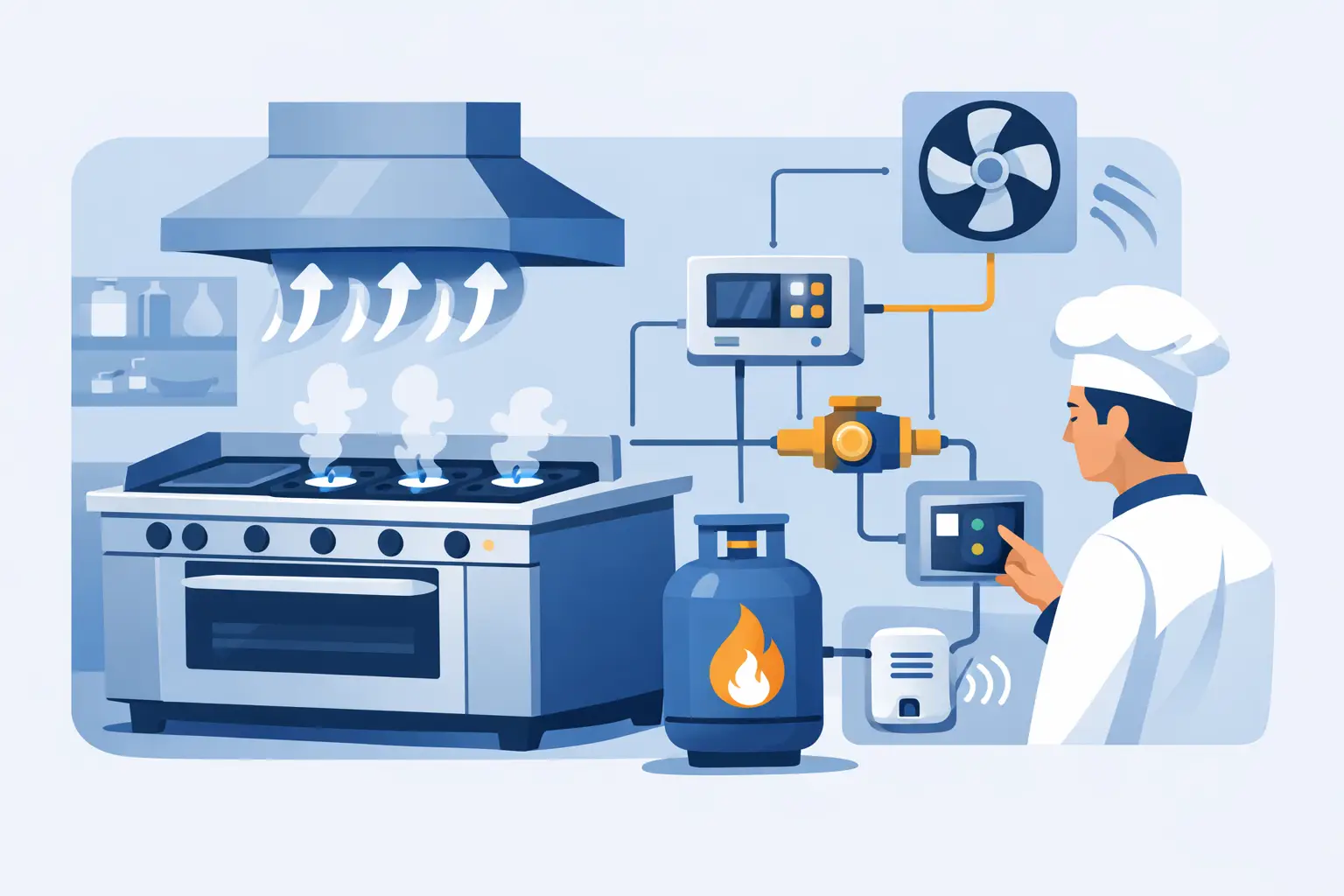
A gas appliance that will not fire because the ventilation is off is not a fault. In a commercial setting, that is exactly what a gas interlock system for kitchen safety is designed to do. It prevents gas from flowing unless the extraction system is running properly, reducing the risk of unsafe combustion, gas build-up and avoidable shutdowns.
For restaurants, pubs, schools, care homes and production kitchens, this is not a box-ticking extra. It is part of how a professional kitchen is made safe, compliant and fit for service. If you are installing new gas cooking equipment, replacing a canopy, or bringing an older kitchen up to standard, understanding the interlock matters because it affects layout, commissioning, daily operation and ongoing service.
A gas interlock system is a safety control panel connected to the kitchen extract system and gas supply. Its job is straightforward. It monitors whether the ventilation is operating, and only then allows gas to be supplied to appliances.
In most commercial kitchens, the system works with airflow proving devices, fan current sensors or pressure switches. If the extract fan fails, or if there is not enough airflow through the canopy system, the panel keeps the gas valve shut or cuts the supply. Many systems also include an emergency stop button and links to gas detection where required.
That means the interlock is not just watching whether a fan switch has been turned on. A proper setup is proving that the ventilation is actually doing its job. That distinction matters. A fan can be energised and still not move enough air if there is a fault, a blockage or poor commissioning.
Any kitchen using gas appliances produces heat, combustion products and grease-laden vapour. Without effective extraction, that environment becomes unsafe quickly. The interlock is there to stop operators using gas equipment when the ventilation system is not capable of controlling those conditions.
There is also a practical side. Kitchen managers want equipment that starts when needed and keeps service moving. But reliable operation depends on the whole system working together – appliances, extraction, make-up air and controls. If one element is weak, the kitchen becomes harder to run, not easier.
This is where many projects go wrong. Buyers focus on the oven, chargrill or fryer and leave the controls until late in the process. In reality, the gas safety arrangement should be considered alongside the cooking line and ventilation design. A well-specified interlock helps avoid failed inspections, delayed openings and costly remedial work.
A typical sequence is simple for staff. The ventilation is switched on, the interlock checks for airflow or fan status, and only then does the gas solenoid valve open. Once proved, gas appliances can be used as normal.
If airflow drops below the required level, the system reacts. Depending on the setup, it may trigger an alarm, close the gas valve, or both. Emergency stop buttons allow staff to isolate the gas supply quickly if there is a problem.
In a busy kitchen, that automatic response is valuable because it removes guesswork. Staff do not need to decide whether the extract is running well enough before using gas equipment. The system makes that decision for them.
That said, no interlock removes the need for routine maintenance. If canopies are loaded with grease, filters are clogged, or fans are neglected, nuisance shutdowns become more likely. The best control panel in the world cannot compensate for poor ventilation upkeep.
The right specification depends on the kitchen, not just the appliances. A small prep kitchen with limited gas demand is different from a high-output restaurant line with fryers, solid tops and chargrills under one canopy.
Start with the appliance load and the ventilation arrangement. The interlock needs to suit the number of fans, the method of airflow proving and the gas valve requirement. It should also be compatible with any existing fire suppression, emergency shut-off and building management controls.
You should also check whether the kitchen has adequate make-up air. This point is often missed. If extract is strong but replacement air is poor, the room can become unbalanced. Doors become harder to open, combustion can be affected, and extraction performance may suffer. In that scenario, an interlock may expose the issue rather than cause it.
Control panel location matters as well. It needs to be accessible, clearly labelled and positioned for safe use. Emergency stop buttons should be easy to reach without staff crossing the cooking line in an incident.
For refurbishment projects, there is another consideration. Older kitchens may have gas appliances and canopy systems that have been altered over time. Before adding a new interlock, it is worth checking the full gas train, fan controls and wiring arrangement. Retrofitting can be straightforward, but assumptions are expensive.
A gas interlock is safety-critical equipment. It should be specified, installed and commissioned by competent professionals familiar with commercial catering environments. In practice, that means using qualified gas engineers and ventilation specialists who understand how the complete system is meant to operate.
Commissioning is not a formality. The installer should verify that the fans run correctly, the airflow proving devices respond as intended, the gas valve closes on failure, and emergency shutdown functions work properly. If the kitchen includes multiple canopies or mixed-use areas, those interactions need testing too.
Documentation matters for the same reason. Operators should have clear records of installation, commissioning and any subsequent service work. When a kitchen is audited or a fault needs diagnosing later, good paperwork saves time.
There can be site-specific differences in what is required, particularly on larger developments or where local authority input is involved. That is why a one-size-fits-all approach rarely works. The correct answer is usually the one based on the actual kitchen design and intended usage, not the cheapest panel available.
Most interlock problems are not caused by the panel itself. They tend to come from poor airflow proving, dirty ventilation components, wiring faults or lack of maintenance. When the gas cuts out intermittently, the root cause is often elsewhere in the system.
A common mistake is choosing a panel without thinking about future expansion. If the menu changes and more gas equipment is added later, the original control arrangement may no longer be suitable. Another is fitting an interlock to an underperforming extract system and expecting the panel to solve the issue. It will not. It will simply keep shutting gas off because the ventilation is not meeting the required condition.
Buyers also sometimes underestimate the value of support. In a commercial kitchen, downtime costs money. If an interlock trips repeatedly on a Friday afternoon, you need a supplier or engineer who can diagnose the wider system quickly, not just replace parts at random.
That is where specialist catering equipment suppliers with gas and service capability offer a real advantage. The issue may be the fan, the sensor, the valve, the control sequence or the appliance setup. Treating those elements in isolation usually wastes time.
If an interlock is obsolete, poorly installed or has been modified repeatedly, replacement can be the better option. The same applies where a kitchen layout has changed and the original system no longer reflects the appliance line or ventilation design.
A new panel is not a major cost compared with the disruption of repeated shutdowns, engineer visits and failed compliance checks. For operators investing in new gas cooking equipment or a canopy upgrade, replacing the control system at the same time is often the cleaner solution.
It also gives you the chance to standardise labelling, emergency controls and service documentation. In multi-site operations, that consistency makes training and maintenance easier.
For commercial buyers, the key is to see the interlock as part of the kitchen infrastructure, not an accessory. It protects people, supports compliance and helps equipment operate in the right conditions. If you are planning a new installation or correcting problems in an existing kitchen, get the gas, ventilation and controls looked at together. That approach is usually faster, safer and cheaper than fixing the same fault twice.





No account yet?
Create an Account