


A combi oven that is too small creates a queue at the pass. One that is too large ties up capital, floor space and energy while running half empty for much of the week. This Rational oven capacity planning guide is designed to help professional kitchens choose a unit around real output, service patterns and production methods – not just the largest oven the budget will allow.
Rational capacity is commonly discussed in grid numbers, but grid count alone does not tell you whether an oven will cope with your operation. A 10-grid oven may be the right choice for a busy restaurant with staggered cooking, while a 20-grid unit can be essential for a school, care home or banqueting kitchen producing large batches at fixed times. The difference lies in how, when and what you cook.
Capacity planning should begin with the period when the kitchen is under most pressure. For many restaurants, that is a concentrated lunch or dinner service. For hotels, it may be breakfast followed by conference breaks and plated banqueting. For education and healthcare catering, production often centres on a defined meal window with substantial volumes leaving the kitchen together.
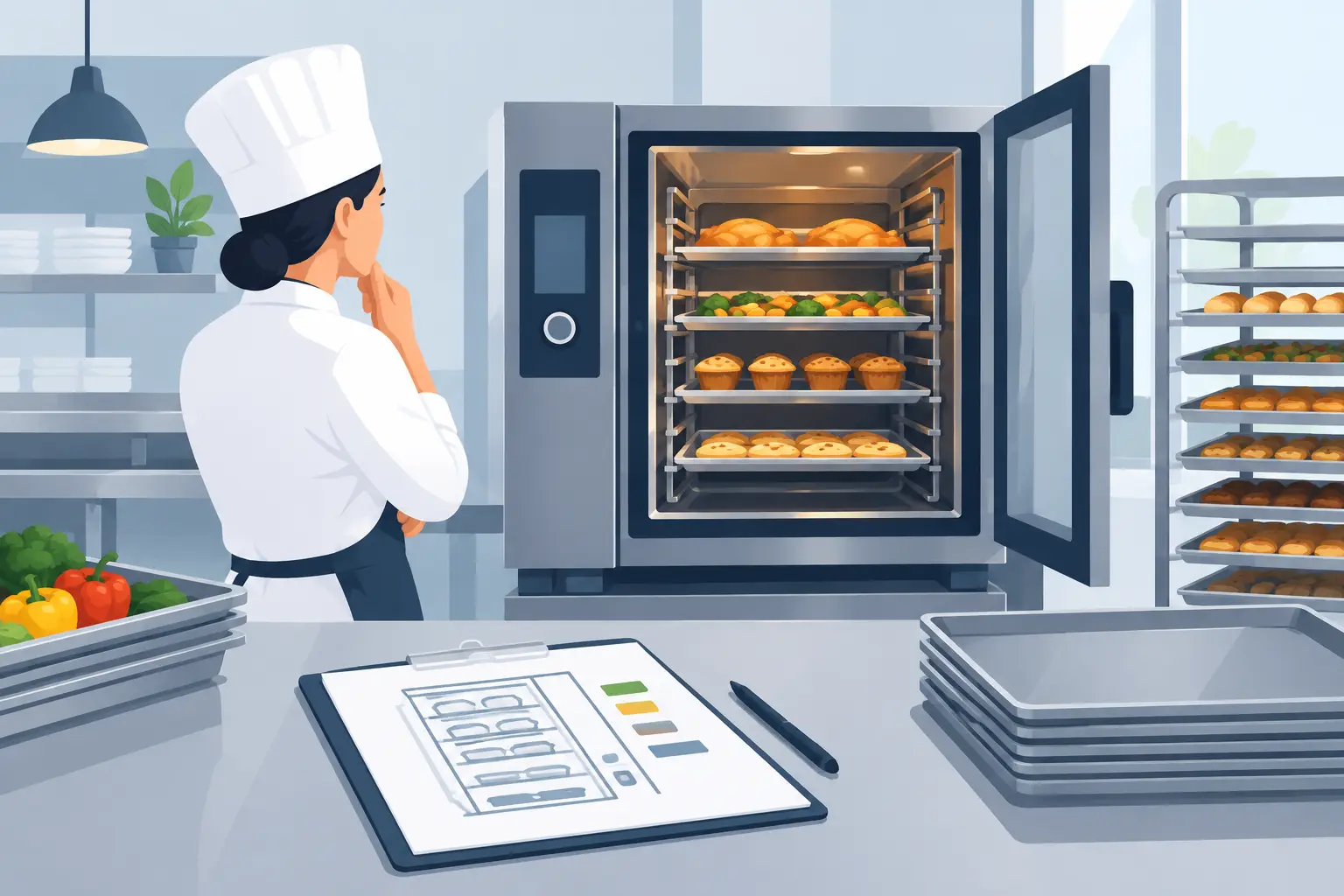
Record the number of covers served during that peak period, then separate dishes by the oven work they require. Roasted proteins, baked potatoes, vegetables, regeneration, bakery items and finishing work all compete for the same chamber. An oven may have sufficient nominal tray capacity but still become a bottleneck if every item needs to be loaded at the same time.
A useful question is not simply, “How many covers do we serve?” It is, “How many portions must this oven produce in the busiest 30 to 60 minutes?” That figure gives a far more realistic starting point for specifying a Rational combi oven.
Rational ovens are available in a range of capacities, commonly from compact 6-grid units through to 10-grid and 20-grid formats. The right configuration depends on whether the oven is mainly supporting a la carte service, handling prep production, regenerating plated or bulk food, or delivering high-volume batch cooking.
A 6-grid unit can suit smaller restaurants, pubs, cafés, satellite kitchens and operations where space is restricted. It is often capable of replacing several individual appliances because it can roast, steam, bake, grill and regenerate in one footprint.
The trade-off is limited room for overlap. If the oven is occupied with a full load of roast potatoes, there may be little space left for fish, vegetables or a last-minute tray of desserts. A compact oven works best where the menu is controlled, prep is well organised and service volumes are moderate.
For many independent restaurants, hotels, pubs and professional catering businesses, a 10-grid Rational offers the most flexible balance of capacity and footprint. It provides useful batch capability without necessarily requiring the space, extraction provision and purchase budget of a larger floor-standing unit.
It can also provide operational headroom. That matters when trade rises, menus change seasonally or the kitchen needs to cook ahead for functions. Headroom should be sensible rather than excessive: buying for one exceptional Christmas function each year can be less cost-effective than using additional production planning or supplementary equipment for those dates.
A 20-grid unit is generally suited to high-output sites where batch production is central to the operation. Schools, hospitals, care facilities, large hotels, event venues, central production kitchens and contract caterers often need this level of capacity to maintain timing and consistency across substantial volumes.
At this scale, the decision is not only about the number of trays. Consider access around the oven, trolley handling, loading height, cleaning routines, power or gas supply, drainage and the route from preparation to service. A large oven installed in a poorly planned production area can slow the team down rather than improve output.
Covers are useful, but tray loading gives the clearer answer. Start with your core menu items and establish realistic portions per gastronorm tray. A tray of chicken portions, for example, will hold a different quantity from a tray of baked vegetables or individual plated components. Product size, spacing, cooking method and desired finish all affect capacity.
Then calculate how many trays are required for a typical peak. If 180 covers require six trays of protein, four trays of potatoes and three trays of vegetables, that is 13 trays before allowing for bakery, regeneration or contingency. The key is whether those trays must cook concurrently, or whether they can be produced in timed waves without affecting quality or service speed.
Mixed loads can increase utilisation, particularly when programmes and cooking conditions are compatible. However, planning on the assumption that every shelf will always run at maximum density is risky. Food needs proper airflow, and kitchens need room for unexpected orders, dietary requests and recovery when service timings change.
Two kitchens serving the same number of covers can require very different oven capacities. A carvery with a predictable menu may work efficiently with long, planned cooking cycles. A high-end restaurant with frequent firing, multiple proteins and individual finishing requirements may need more available oven space despite lower overall volume.
Consider cycle length as well as tray count. A 25-minute regeneration cycle can be repeated several times within a service period. A slow roast, overnight cook or baked product occupies capacity for much longer. If long-running programmes are scheduled during prep periods, they may not affect service capacity. If they overlap with the pass, they must be included in the calculation.
Menu changes deserve attention too. Adding Sunday roasts, breakfast pastries, conference catering or a delivery offer can alter the oven load significantly. Choose a Rational configuration that supports your normal operation with enough flexibility for the services that generate the strongest revenue.
A capacity decision is only sound if the site can support the chosen equipment. Confirm the available width, depth and height, including door clearance, access for cleaning and safe movement of trays or trolleys. Measure delivery routes as well as the final installation position. A unit may fit on the plan but prove difficult to bring through a narrow doorway or down a basement route.
Utilities require the same level of scrutiny. Depending on the model, check electrical capacity or gas supply, water quality and pressure, drainage, ventilation requirements and any building constraints. Water treatment is particularly relevant to long-term performance. Poor water conditions can contribute to scale and avoidable service issues, regardless of oven size.
Also consider the people using the oven. A larger unit may increase output, but only if the team can load, unload, programme and clean it properly during busy shifts. Clear operating procedures, sensible tray handling and staff training are part of capacity planning, not afterthoughts.
A refurbished Rational oven can be a commercially sensible route to greater capacity, particularly where a new 20-grid or 10-grid unit would stretch the capital budget. The value depends on refurbishment quality, service history, condition and the support available after installation.
For a high-volume operation, buying from a specialist supplier matters. Island Catering Equipment Co. supplies new and professionally refurbished Rational ovens, with used units restored and tested by Rational-trained technicians. That gives buyers a clearer route to premium combi oven capability while retaining budget for installation, water treatment, servicing and other kitchen priorities.
Do not select used equipment purely on the lowest ticket price. Confirm the exact model, grid configuration, fuel type, dimensions, condition, warranty position and whether the oven suits your production method. The right refurbished oven should solve a defined capacity requirement, not simply represent a bargain.
One oven carrying the entire operation creates exposure. If it is taken out of service for maintenance or an unexpected fault, production can be severely affected. In some kitchens, two smaller ovens offer more resilience than one large unit. They allow different cooking tasks to run independently and provide partial continuity if one unit needs attention.
That approach is not always the best use of space or budget. A central production kitchen may need the straightforward throughput of a larger oven, while a compact restaurant kitchen may benefit more from one versatile 10-grid model. The decision depends on how critical the oven is, what alternative equipment is available and how quickly technical support can be accessed.
Plan servicing before the oven arrives, not after the first issue. Regular maintenance, correct cleaning and prompt replacement of worn components protect performance and help preserve the output capacity you paid for.
The most effective Rational oven is the one that matches your peak service, menu and available space without forcing the brigade into workarounds. Put real tray loads and cooking times on paper, allow for growth without over-specifying, and choose a supplier that can support the equipment long after commissioning.




No account yet?
Create an Account