


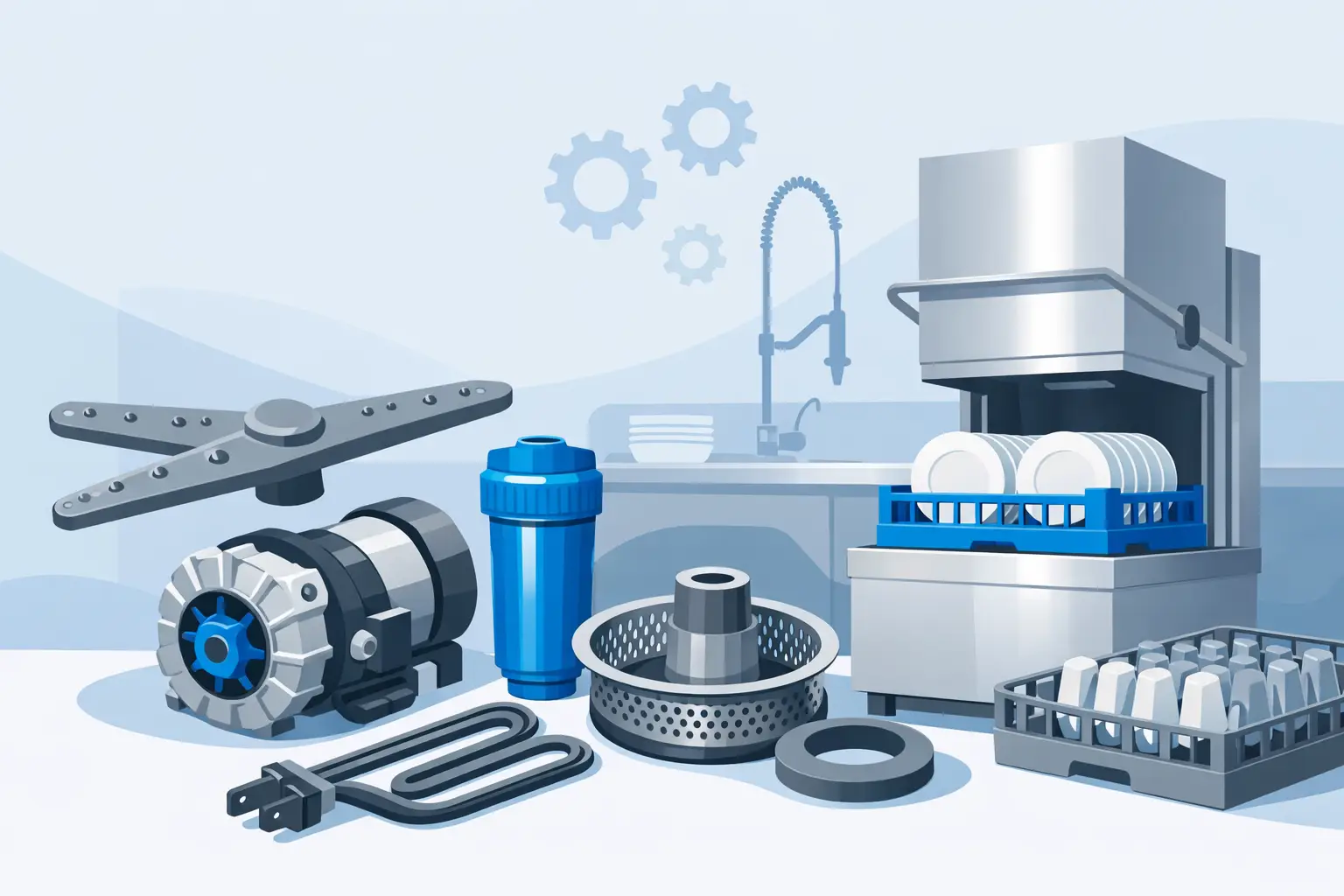
A commercial dishwasher rarely fails at a convenient time. It stops in the middle of service, starts leaving residue on glasses, or throws up a fault code just as the kitchen is under pressure. That is why buying the right Winterhalter dishwasher parts is not just a maintenance job. It is an operational decision that affects hygiene standards, turnaround times and labour efficiency.
Winterhalter machines are built for serious commercial use, but even well-maintained units rely on wearing parts, consumables and replacement components to stay at full performance. In a busy pub, hotel, school kitchen or restaurant, small faults can quickly become expensive ones. A split hose, tired wash arm, failing pump or damaged rack guide can slow the whole wash area and create knock-on problems across the pass.
In commercial catering, the issue is rarely whether a part can be replaced. The real question is whether the replacement solves the problem properly and keeps the machine running as intended. A dishwasher that technically still operates can still be costing you money if rinse results are poor, cycle times are inconsistent or staff need to rewash items.
That matters even more with Winterhalter equipment because these machines are designed around reliable wash performance, dosing accuracy and efficient water use. If one component is worn or out of tolerance, the machine may still run, but not at the standard your kitchen expects. Poor warewashing affects front of house presentation, back of house workflow and compliance.
For operators managing tight margins, parts also protect the lifespan of the machine itself. Replacing a worn wash arm bearing or drain component early is usually far cheaper than waiting until it damages a pump, motor or control assembly. Preventative replacement is not glamorous, but it is often the most cost-effective choice.
The exact part depends on the model and fault, but certain components come up repeatedly across glasswashers, pass-through dishwashers and utensil wash systems.
Wash and rinse arms are a common example. Over time, jets can block, bearings wear and spray patterns become uneven. The result is inconsistent cleaning and longer wash times. Door seals and tank seals also take regular wear, particularly in high-volume sites where machines are opened and closed constantly throughout the day.
Pumps, hoses and solenoid valves are another area to watch. When these begin to fail, the signs are often subtle at first – slower fill times, drainage issues, unusual noise or intermittent faults. Leave them too long and the machine may stop altogether.
Basket runners, filters, curtains and dosing-related parts are often overlooked because they seem minor compared with electrical or mechanical components. In practice, these smaller items can have a direct effect on wash quality and day-to-day usability. A damaged filter or poorly fitted curtain can compromise results just as surely as a larger fault.
Heating elements, thermostats, sensors and control components sit at the more technical end of the range. These parts need a more careful diagnosis because the visible symptom is not always the root cause. If the machine is not reaching temperature, for example, it could be the element, a sensor, a control board issue or scale-related performance loss. That is where supplier knowledge matters.
Ordering parts for a commercial dishwasher should be straightforward, but mistakes usually happen for one of three reasons. The model is identified incorrectly, the fault is diagnosed too quickly, or a buyer tries to match a part visually rather than by machine details.
Winterhalter has multiple model generations, and parts can vary across series, production years and configurations. A component that looks right may still be the wrong fit. That creates more downtime, more cost and unnecessary returns.
The most reliable route is to work from the machine data plate and the exact model information. If available, the serial number helps narrow things down further. This is especially useful for control parts, pumps and model-specific assemblies where compatibility is critical.
It also pays to separate symptom from cause. If a machine is not washing properly, that does not automatically mean the pump has failed. It could be blocked jets, a dosing issue, poor water treatment, low rinse temperature or worn wash arms. Buying the most expensive likely part first is not always the smart move.
For commercial operators, this usually comes down to reliability, cost control and risk. Genuine parts generally offer the best fit, expected performance and consistency. That matters in high-output kitchens where a dishwasher is not a convenience but a core piece of production equipment.
Cheaper pattern parts can look attractive on price, particularly when budgets are tight. In some cases they may be suitable, but there is a trade-off. Fit can be less precise, lifespan can be shorter, and performance may not match the specification of the original machine. If a lower-cost part causes repeat faults or shortens service intervals, the initial saving disappears quickly.
For critical items such as pumps, electronics, heating components and dosing-related parts, cutting corners rarely pays. On simpler wear items, the decision can be more flexible, but only if compatibility and quality are clear. In a commercial setting, the cheapest part is not always the lowest-cost option over time.
Many kitchens run equipment until failure because service windows are limited and there is always another job to deal with. That approach is understandable, but it can be expensive.
A dishwasher showing early signs of wear often continues to work just well enough to avoid immediate action. The problem is that performance usually drops before the machine stops. Glassware comes out marked, crockery needs rewashing, staff spend more time checking loads, and the machine starts consuming more labour than it should.
Downtime costs are rarely limited to the repair itself. There is the effect on service speed, hygiene routines, labour allocation and customer experience. In hospitality settings, poor glass and dish presentation is noticed immediately. In schools, care environments and institutional kitchens, any interruption to wash throughput can affect the whole meal service.
Replacing parts early where wear is obvious is often the best commercial decision. It keeps the machine predictable, supports hygiene standards and reduces the chance of a larger breakdown at the worst possible time.
Not every issue needs a callout. Filters, curtains, seals, baskets and some external fittings are often straightforward replacements for experienced site teams. If your maintenance staff know the machine and the fault is obvious, replacing a standard wear part can be a quick fix.
Where the issue involves heating, controls, drainage faults, electrical components or repeated error codes, a proper diagnosis is the safer route. Fitting the wrong part to a misdiagnosed fault wastes money and can create a larger repair. It may also leave the site without a working machine for longer than necessary.
This is particularly relevant where water quality or detergent dosing may be involved. Machines that are descaling poorly, leaving deposits or underperforming can sometimes point to external conditions rather than a failed internal component. Good parts support good performance, but they cannot compensate for an untreated water issue or incorrect chemical setup.
Commercial buyers do not just need stock. They need confidence that the part is correct, available and backed by technical understanding. That is the difference between buying on part number alone and dealing with a supplier that understands warewashing equipment in a working kitchen.
A specialist can help identify whether you need a complete assembly or a smaller replaceable component, whether the issue is likely mechanical or electrical, and whether it makes more sense to repair now or plan a broader service visit. That advice saves time, especially for multi-site operators and busy kitchens that cannot afford trial and error.
For businesses already managing mixed equipment estates, working with one supplier that understands servicing and spare parts across key commercial brands can also simplify procurement. Island Catering Equipment Co. supports operators who need both parts availability and practical technical backup, which is often what keeps a repair job moving.
If your site depends heavily on a dishwasher, it is worth keeping a small number of fast-moving spares on hand. This is not about overbuying. It is about reducing avoidable downtime.
Seals, filters, rinse jets, curtains and other common wear items can often be replaced quickly if they are already on site. For larger operations, especially hotels, schools and contract catering sites, this approach makes sense where service continuity matters more than shaving a small amount off a single order.
The key is to stock parts with a realistic replacement cycle, not random components that may never be used. A specialist supplier can help identify which items are worth holding based on the machine type, site usage and service history.
The right Winterhalter dishwasher parts keep a machine doing what it is supposed to do – wash properly, run efficiently and stay dependable through heavy daily use. When you buy with the model, fault and operating demands in mind, you are not simply replacing a component. You are protecting the pace and standards of the whole kitchen.





No account yet?
Create an Account