


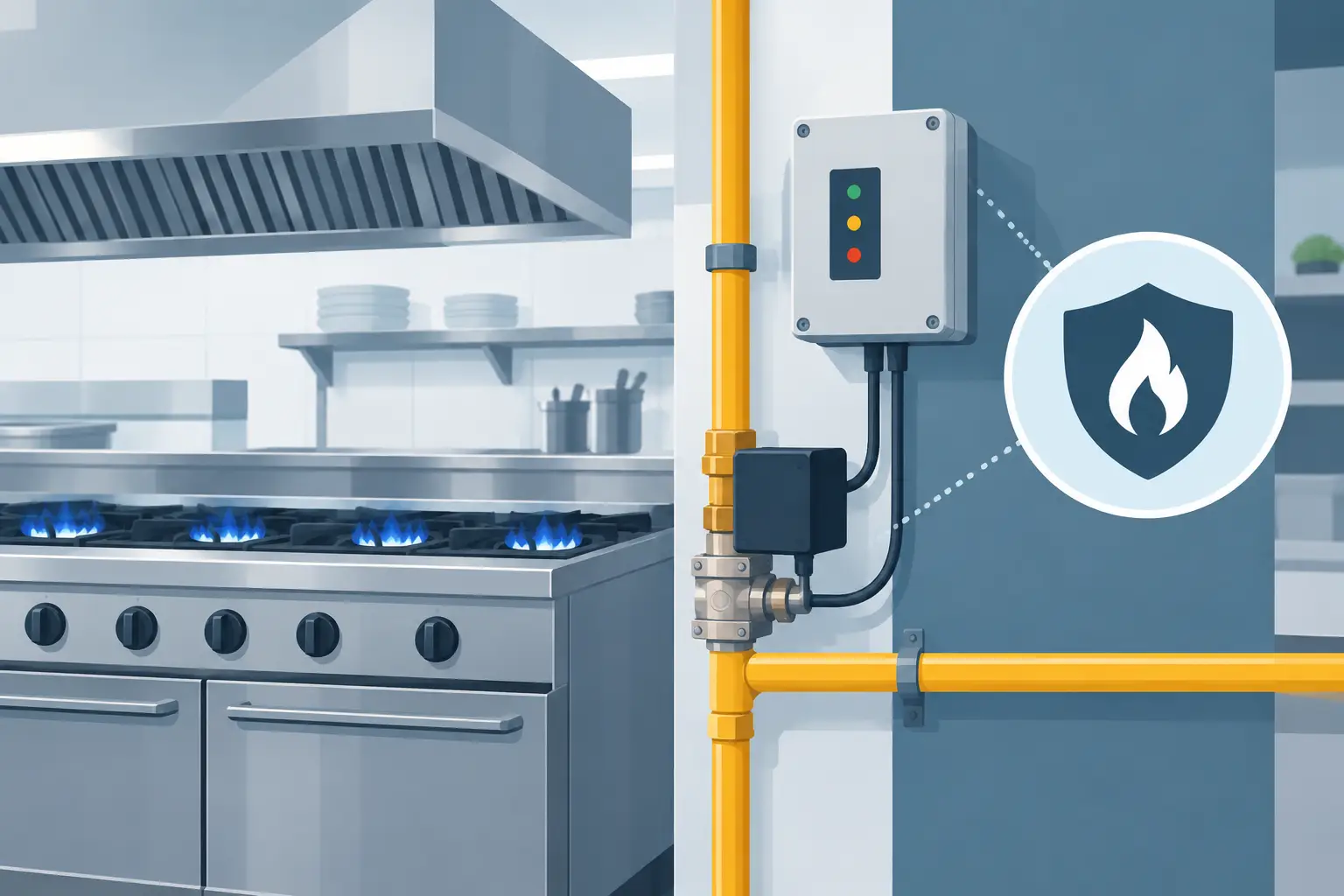
A busy cookline can produce a great deal of heat, steam and combustion by-products in a short service. Commercial gas interlock systems are designed to prevent gas appliances operating unless the extraction system is running and airflow has been proven. For restaurants, schools, hotels, care facilities and high-output catering kitchens, this is a fundamental control rather than an optional add-on.
The principle is straightforward: no effective extraction, no gas supply to the cooking appliances. The right system reduces a significant safety risk, supports compliance work and gives kitchen teams a clear, repeatable start-up process. However, specifying one correctly requires more than choosing a control panel and fitting a solenoid valve.
A commercial gas interlock system monitors the kitchen ventilation arrangement and controls the gas supply to the appliance line. When the extraction fan is switched on, an airflow or pressure-proving device confirms that the fan is moving sufficient air. Only then will the panel energise the gas solenoid valve and allow gas to pass to the cookline.
If the extraction fan stops, fails, or cannot prove airflow, the interlock should close the gas valve. This protects against operating gas-fired equipment beneath a canopy without effective removal of heat, fumes and products of combustion.
The system is normally used with appliances such as gas ranges, chargrills, fryers, griddles, ovens and wok burners. The exact arrangement depends on the appliance load, canopy design, fan configuration and the site gas installation. A small café kitchen with a single canopy has different requirements from a multi-zone hotel kitchen or a school production kitchen.
An extraction fan running is not always the same as extraction performing properly. A fan may be switched on while a belt has failed, a filter bank is heavily restricted, a damper is closed or airflow is inadequate. That is why a properly selected proving method matters.
Pressure switches and airflow sensors are commonly used to verify that the system is operating. The chosen method should suit the ventilation design and be set up by a competent engineer during commissioning. Simply linking the gas valve to the fan isolator can leave gaps in protection because it confirms a command to run, not necessarily the required airflow.
For operators, the practical benefit is certainty. Staff should not need to make a judgement call about whether a canopy is working well enough before lighting equipment. A visible panel indication and a correctly commissioned interlock give a defined operating condition: ventilation proven, gas available.
Most systems contain a control panel, a gas solenoid valve, an airflow-proving device and interfaces to the extraction fan. They may also include emergency stop buttons, remote key switches, fire alarm connections, carbon dioxide monitoring or building management interfaces where the kitchen design calls for them.
The control panel is the operating point for the kitchen team. It should be positioned where staff can see its status and access its emergency shut-off function without entering a hazardous area. Clear indicators help reduce confusion at the start of service and make faults easier to report accurately.
The solenoid valve is fitted on the gas supply line and must be suitable for the installation. Its location should allow safe access for inspection and maintenance. The proving device needs equally careful placement. Poorly positioned sensing points, damaged tubing or unsuitable settings can create nuisance shut-downs or, worse, fail to identify a loss of airflow.
Emergency gas isolation should also be considered separately from normal control. A kitchen needs an accessible way to shut off gas quickly if there is a suspected leak, fire incident or equipment fault. The exact emergency arrangements should form part of the overall gas safety design, not be treated as an afterthought once the kitchen is fitted out.
The answer depends on the appliances installed, the ventilation system and the requirements applying to the premises. Gas-fired catering equipment installed under mechanical extraction will commonly require an interlock arrangement that prevents use without effective ventilation. Insurers, local authorities, project specifications and fire risk assessments may also set clear expectations.
Do not assume an existing installation is compliant because it has been operating for years. Kitchen layouts change. A gas appliance might be added under a canopy designed for a lighter duty line, a new fan may be fitted without recommissioning the controls, or a refurbishment may alter the gas pipework and electrical supplies. These changes should trigger a review by suitably qualified professionals.
Gas work must be carried out by a Gas Safe registered engineer with the appropriate commercial catering competence. Ventilation design, electrical installation and fire safety responsibilities may involve other competent contractors. Coordinating those trades early avoids the common and expensive problem of installing a new cookline only to find that extraction controls, power supplies or gas pipework need further alteration.
Start with the cooking line, not the panel. Record every gas appliance, its gas rating, position and expected service pattern. A compact bistro line with a six-burner range and fryer will place different demands on extraction from a charcoal chargrill, high-volume wok suite or several heavy-duty fryers.
Then assess the ventilation system. Establish whether there is one canopy and fan or several zones, whether make-up air is present, and how the fans are started. Multi-canopy kitchens may need separate interlock zones so that a breakfast line can operate without unnecessarily running extraction for an unused banqueting section. That can reduce energy use, but only where the gas pipework and control design properly support zoned operation.
Consider how the kitchen will be used day to day. A straightforward panel with clear on, off and fault indicators may be ideal for a small independent operator. A larger site may need interfaces with fire suppression, a building management system or remote monitoring. More features are not automatically better. Every additional interface should have a defined safety or operational purpose and be tested as part of commissioning.
For projects involving Rational combi ovens alongside gas cookline equipment, it is worth checking the ventilation and control strategy as a whole. Electric combi ovens do not require a gas interlock, but their heat and moisture output still affect canopy selection, extraction rates and the practical workflow around the cookline.
A quality panel cannot compensate for poor installation. The gas solenoid must be correctly sized and installed, electrical supplies should be properly protected and labelled, and the ventilation proving device must be set to reflect genuine operating airflow. Control cabling needs to be routed and terminated to withstand the demanding conditions of a commercial kitchen.
Commissioning should prove the full cause-and-effect sequence. The extraction starts, airflow is proven, the gas valve opens and appliances can be operated. If airflow is lost, the valve closes. The engineer should also test emergency isolation, restart behaviour after a power interruption and any linked fire alarm or suppression interfaces.
Kitchen managers should receive a clear handover. That includes the normal start-up sequence, panel meanings, emergency shut-off location and the action to take if the system will not prove. Staff should never bypass an interlock fault to get through service. If the gas is unavailable, treat it as a safety issue and call a competent engineer.
Commercial kitchens are harsh environments for controls. Grease, heat, vibration, cleaning chemicals and accidental knocks all take their toll. Planned maintenance should therefore include the interlock system as well as the gas appliances and ventilation plant.
A competent service visit can check operation of the solenoid valve, condition of proving switches and tubing, panel indicators, emergency stops, fan control interfaces and shutdown response. The extraction system itself must also be maintained, including filter cleaning and ductwork cleaning at an appropriate frequency. An interlock can only prove the condition it is designed to monitor; it does not replace ventilation hygiene or gas safety inspection.
Pay attention to recurring nuisance trips. They may indicate a dirty filter, weak fan performance, a loose sensing tube or a proving threshold that needs investigation. Repeatedly resetting the panel without finding the cause creates downtime and can mask a developing fault.
When replacing a gas range, adding a chargrill or refurbishing a complete kitchen, review the interlock system before equipment arrives. It is more cost-effective to plan gas isolation, electrical controls and ventilation changes during the project than to interrupt trading later for remedial work.
Island Catering Equipment Co. supports commercial kitchen projects with equipment supply, gas safety work, servicing and engineering expertise, helping operators consider the cookline and its supporting services together. The aim is not simply to get appliances installed, but to ensure the kitchen can operate safely and reliably through every service.
The best commercial gas interlock systems are rarely noticed during a normal shift. They start the kitchen safely, respond correctly when conditions change and give staff confidence that the gas cookline is operating as intended. That quiet reliability is exactly what a professional kitchen needs.





No account yet?
Create an Account