



A commercial kitchen equipment checklist is only useful if it reflects how your site actually trades. A 40-cover bistro, a school kitchen and a high-volume takeaway do not need the same battery of kit, and buying on guesswork usually leads to bottlenecks, wasted spend or equipment that never quite earns its floor space.
The right approach is to build your list around output, menu, service style and utilities first, then choose equipment that can handle demand without making cleaning, servicing and staff training harder than they need to be. That sounds obvious, but it is where many projects go wrong.
Start with the menu, not the catalogue. If most of your volume comes from roasted proteins, regeneration, batch cooking and mixed service periods, your cooking line should look very different from a pizza-led operation or a grab-and-go bakery. Capacity matters, but so does flexibility.
Think in terms of workflow. Goods come in, ingredients are stored, prep moves to cooking, cooked food moves to pass or holding, and everything dirty goes back through wash-up. If your equipment list does not follow that path, your kitchen will work against itself.
You also need to separate must-have equipment from nice-to-have equipment. Core production kit, safe refrigeration, extraction and warewashing come first. Secondary items can be phased in once the kitchen is trading and you can see where the pressure points are.
For most professional kitchens, the main cooking platform is the biggest decision. This is where output, consistency, labour use and energy efficiency all meet.
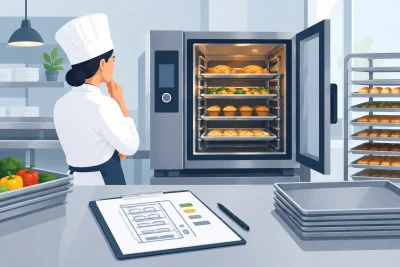
A combi oven is often the most valuable piece of equipment in a modern kitchen because it can steam, roast, bake, regenerate and handle overnight or programmed cooking in one footprint. For sites that need versatility and repeatable results, a Rational combi oven often replaces several separate appliances while improving control over finished product.
The key question is size. An underspecified oven creates service pressure and forces awkward batch timing. An oversized unit takes up room, uses more energy than necessary and may not be the best use of budget. New units suit operators who want the latest features, warranty cover and maximum lifespan, while professionally refurbished ovens can make commercial sense where capital spend is tighter but performance still matters.
Not every kitchen can rely on a combi alone. If your menu includes pan work, chargrilled items, breakfast service or heavy frying, you may need a solid prime cooking line. That could include a six-burner range, chargrill, griddle, fryer or salamander.
This is where menu detail matters. A pub kitchen producing steaks and grills needs different heat equipment from a care setting focused on bulk cooking and regeneration. Buying every possible appliance is rarely the answer. Choosing the right combination is.
Pizza ovens, bakery ovens, induction hobs, bratt pans and boiling pans all have a place, but only where they support real demand. Specialist equipment can improve speed and quality, but it also reduces flexibility if menu needs change. In smaller kitchens, multifunction equipment usually gives a better return.
Refrigeration is not the exciting part of a fit-out, but it is one of the areas most likely to cause operational problems if specified badly. Your checklist should cover undercounter refrigeration, upright storage, freezer capacity and any specialist cold prep stations needed for your menu.
Undercounter units work well on the line where speed matters. Upright cabinets are better for back-of-house storage and stock separation. Walk-in cold rooms make sense for larger sites, but not every kitchen needs one.
Look beyond litres on paper. Consider ambient kitchen temperature, door opening frequency, shelving layout and how quickly stock turns over. A cheap cabinet that struggles in a hot kitchen will cost more in stock risk, engineer visits and downtime than a properly specified unit from the outset.
Prep equipment should match labour levels as much as menu style. If your team is small or turnover is high, labour-saving kit becomes more valuable.
A practical checklist may include planetary mixers, food processors, slicers, stick blenders, vegetable prep machines and vacuum packers. For butchery-heavy or bakery-heavy operations, prep requirements become more specialised, and hygiene considerations become even more important.
Bench space matters here as much as machinery. Stainless steel tables, sink units, shelving and racking are not secondary purchases. Without enough organised prep and landing space, even good equipment becomes awkward to use.
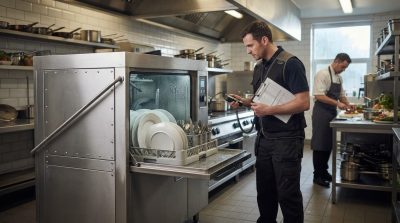
A kitchen can survive with many things less than perfect for a short time. It cannot function for long with poor warewashing. If plates, pans and utensils are backing up, service follows quickly.
Your checklist should account for glasswashers, passthrough dishwashers or undercounter dishwashers depending on site type and volume. Pot wash arrangements also need proper thought, especially in production kitchens where gastronorms, trays and heavy pans build up quickly.
Machine choice should reflect basket throughput, rinse performance, water treatment needs and available space. The wrong dishwasher often shows up as labour inefficiency first, then hygiene and maintenance issues later.
Ventilation is often treated as a building issue rather than an equipment issue, but the two are linked. If your cooking line includes fryers, chargrills or petrol appliances, your extraction system needs to be designed around that load.
A proper checklist should include canopy extraction, make-up air, filtration and any fire suppression requirements relevant to the site. This is not an area for shortcuts. Poor ventilation affects comfort, safety, equipment performance and compliance.
Utilities must also be checked early. Petrol supply, electrical load, drainage, water pressure and access for delivery all affect what can realistically be installed. A good equipment plan that ignores site services is not a good plan for long.
Some of the most expensive oversights are not major appliances. They are the smaller operational essentials that make the kitchen usable from day one.
That includes stainless steel tabling, wall shelving, ingredient bins, mobile racking, hand wash stations, sinks, grease management, water softeners and suitable storage for chemicals and cleaning tools. For sites using premium warewashing or combi oven systems, water quality should be addressed early. Hard water shortens equipment life and increases service requirements.
It is also worth planning for spare parts availability and aftersales support when choosing major equipment. Price matters, but so does keeping the kitchen running. A cheaper machine with poor parts access can become the more expensive option the first time it goes down in service.
For many operators, this is the point where budget and specification meet. New equipment gives you current-generation features, full manufacturer support and the longest service life ahead. Refurbished equipment can reduce capital expenditure significantly, particularly on premium combi ovens, if the refurbishment standard is genuinely high and the unit has been properly tested.
The trade-off is straightforward. Refurbished equipment needs to come from a supplier with technical credibility, access to parts and a clear process for inspection and restoration. If that standard is met, it can be a smart way to buy proven equipment without stretching budget unnecessarily. Island Catering Equipment Co. has built its position in this area by supplying both new and professionally refurbished Rational ovens backed by specialist support.
If you are finalising a project, it helps to sense-check your plan by zone. Goods-in and storage should cover shelving, refrigeration and freezer space. Prep should include tables, sinks and labour-saving machines. Cooking should reflect menu demand, peak output and extraction. Service should account for pass, holding and hot or cold display where needed. Wash-up should deal with crockery, cookware and workflow back to clean storage.
If one zone looks light on equipment compared with the pressure it will face, that is usually where the problem will appear once trading starts.
Before signing off any order, ask five simple questions. Will this equipment support peak service, not just average trade? Can staff use it properly with realistic training? Is cleaning straightforward enough to maintain standards every day? Can it be serviced quickly if something fails? And does it earn its footprint?
That last point matters. Floor space is expensive in any commercial kitchen. Every appliance should justify its position through output, flexibility or labour saving. If it does none of those, it probably does not belong on the final list.
A good commercial kitchen is not built by buying more equipment. It is built by choosing the right equipment, in the right order, for the way your kitchen actually works. Get that right, and the whole operation becomes easier to run, easier to maintain and far better placed to grow.



No account yet?
Create an Account