


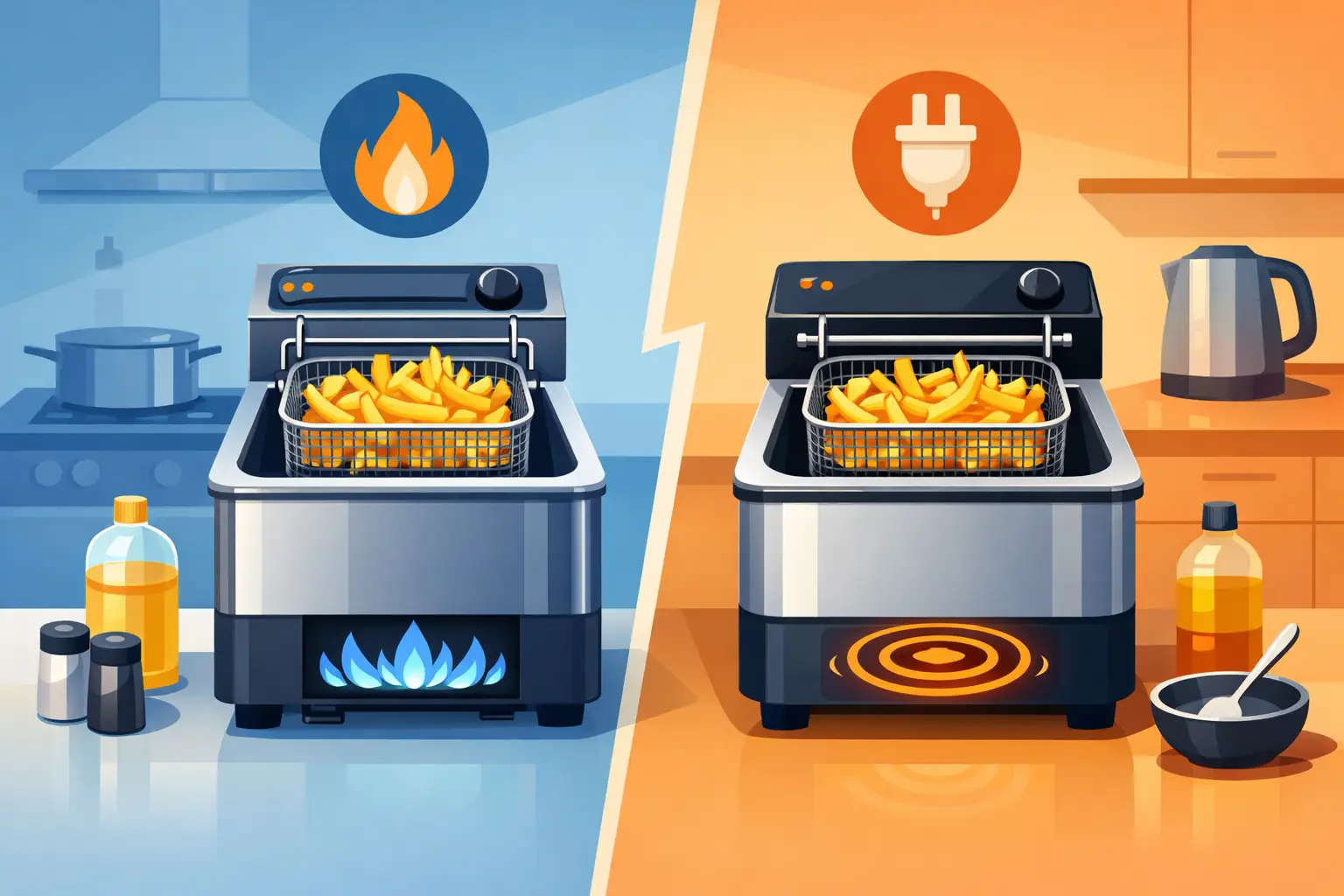
A fryer that cannot recover temperature during the Friday evening rush will cost far more than its purchase price. When weighing up a gas fryer versus electric fryer, the right answer comes down to your menu, service pattern, utility provision and the practical limits of your kitchen – not simply which fuel appears cheaper on paper.
For a fish and chip shop, busy pub kitchen or high-volume restaurant, recovery speed and basket capacity are usually the priority. For a school, care home, hotel or site with limited gas infrastructure, predictable controls and straightforward installation may carry more weight. Both types can deliver excellent, consistent frying when correctly specified, installed and maintained.
A commercial gas fryer heats oil through gas burners and a heat exchanger. It is traditionally the first choice for operations needing sustained high output, particularly where gas is already available and the kitchen has suitable extraction. Gas models are available in a wide range of tank capacities and can be an economical option for demanding service periods.
An electric fryer uses elements immersed directly in, or positioned close to, the oil. This direct method of heating can provide highly even temperature control and efficient heat transfer to the oil. Electric fryers are often a strong fit for compact kitchens, mobile or satellite food operations, and premises where installing a gas supply would add considerable cost or disruption.
The comparison is not as simple as gas being powerful and electric being precise. Modern commercial fryers in both fuel types can be built for heavy-duty work. The useful question is whether the fryer can maintain the oil temperature at your normal basket load, using the utilities and extraction already available on site.
Recovery is the key performance measure for any busy frying section. Each time chilled or frozen food enters the oil, the temperature drops. A fryer must restore the programmed temperature quickly enough to avoid pale, greasy food and slow ticket times.
Gas fryers are widely specified for high-throughput applications because powerful burners can provide fast heat-up and strong recovery. This matters when multiple baskets of chips, battered fish, chicken or frozen products are being dropped in rapid succession. A properly sized twin-tank gas fryer also gives useful menu flexibility: one tank can be dedicated to chips while the other handles fish or breaded products.
Electric fryers should not be dismissed on output alone. High-performance electric models can offer rapid recovery, particularly where the electrical supply has been planned for the required load. Their immersed elements transfer heat efficiently, and responsive thermostatic control can help operators maintain a consistent finish across smaller, frequent batches.
Capacity must be assessed alongside recovery. A large oil tank is not automatically the better choice if your team only cooks modest quantities at a time. Oversized tanks mean more oil to purchase, filter and replace. Conversely, a fryer that is too small will be constantly overloaded, shortening oil life and compromising product quality.
Consider the food being fried and the way it is prepared. Frozen chips and heavily breaded items create a bigger temperature shock than lighter, smaller portions. High volumes of battered fish release debris into the tank, while allergen separation may require two independent frypots rather than a single large one.
For a restaurant serving occasional sides, a compact single-tank electric fryer may be the sensible commercial choice. For a takeaway producing chips continuously over several peak hours, a high-output gas model or a larger electric battery may be justified. The specification should reflect peak demand, not a quiet lunchtime average.
A gas fryer needs a suitable gas supply, isolation valve, professional commissioning and ongoing gas safety checks. The appliance must be installed by an appropriately qualified commercial gas engineer. Combustion products, kitchen ventilation and canopy performance also need to be considered as part of the wider cooking line design.
Electric fryers remove the need for a gas connection, but they are not necessarily plug-and-play. Many commercial units require a dedicated high-load electrical supply, correct protection and installation by a qualified electrician. Before ordering, confirm the voltage, phase, amperage and available capacity at the distribution board. A fryer that needs a three-phase supply cannot be made suitable with an adaptor.
Both gas and electric fryers need effective extraction, appropriate fire safety arrangements and enough clear space for safe operation and cleaning. Frying produces heat, vapour and airborne grease regardless of the fuel source. Existing ventilation should be assessed before adding capacity to a cooking line, especially in older premises.
If a site already has a compliant gas supply and extraction system, gas may be the lower-disruption route. If gas installation would require major building work, electrical equipment may offer a more practical path. Obtain installation costs before comparing appliance prices. A lower-priced fryer can become the more expensive option once utility upgrades are included.
Gas has historically offered favourable running costs for high-volume frying, but tariff movements mean no operator should rely on a general rule. Your energy contract, annual usage, fryer efficiency, opening hours and operator habits all affect the true cost.
Electric fryers can be efficient at the point of use because heat is applied directly to the oil. Gas appliances lose some energy through combustion and flue gases, but may still be commercially attractive where gas prices are favourable and output demand is high. Energy consumption also rises sharply when a fryer is left idling at full temperature between services.
Ask suppliers for the appliance’s rated input, oil capacity and expected operating profile, then compare this against your own gas and electricity rates. Include the cost of filtration and oil replacement. In many kitchens, extending oil life through good filtering and correct temperature management has a greater effect on weekly expenditure than a marginal difference in fuel cost.
Oil management affects food quality, margin and equipment lifespan. Whether gas or electric, choose a fryer with practical access for cleaning, a reliable drain valve and filtration options suited to your volume. Built-in filtration can be worthwhile for operations frying all day, as it makes routine filtering easier for busy teams and helps remove debris before it burns.
Electric fryers with exposed elements require careful cleaning around those components. Gas fryers need their burners, combustion areas and flue paths kept clean and checked as part of planned maintenance. Neither is maintenance-free, and neglected fryer cleaning is a common cause of poor performance, excess oil consumption and avoidable downtime.
Digital controls can help standardise results across shifts by allowing programmed temperatures and timers. They are particularly useful where staff turnover is high or where several sites need consistent cooking procedures. Simpler manual controls can still be entirely suitable for experienced teams, provided the thermostat is accurate and the appliance is maintained.
Commercial fryers operate in a harsh environment of heat, grease and repeated use. Reliability is less about choosing gas or electric in isolation and more about selecting a suitable-duty appliance, installing it correctly and keeping up with servicing.
Gas equipment requires periodic inspection of gas components and safe combustion. Electric equipment needs checks on elements, thermostats, contactors and electrical connections. In both cases, safety cut-outs must work correctly. Never bypass a high-limit thermostat or continue using a fryer that shows signs of oil leaks, unstable temperatures, ignition issues or electrical faults.
When comparing quotations, look beyond the cabinet price. Check warranty terms, parts availability, access to qualified engineers and whether service support is available when the kitchen is under pressure. Island Catering Equipment Co. supplies professional kitchen equipment with the technical support and servicing expertise commercial operators need after installation.
A gas fryer is often the better fit for high-volume kitchens with an existing gas supply, effective extraction and sustained demand for fried food. It is a proven choice for takeaways, pubs and restaurants where fast recovery through peak periods is essential.
An electric fryer is often the stronger option where precise control, direct heat transfer or the absence of a gas connection shapes the decision. It can also suit sites where the electrical infrastructure is already in place and the menu requires steady, controlled batch cooking rather than continuous maximum output.
Before placing an order, confirm four points: your busiest 30-minute frying demand, the food and basket loads involved, the utilities available at the appliance position, and the condition of your extraction system. With those answers in hand, you can specify a fryer that protects service speed, oil quality and long-term operating costs from the first shift.





No account yet?
Create an Account