


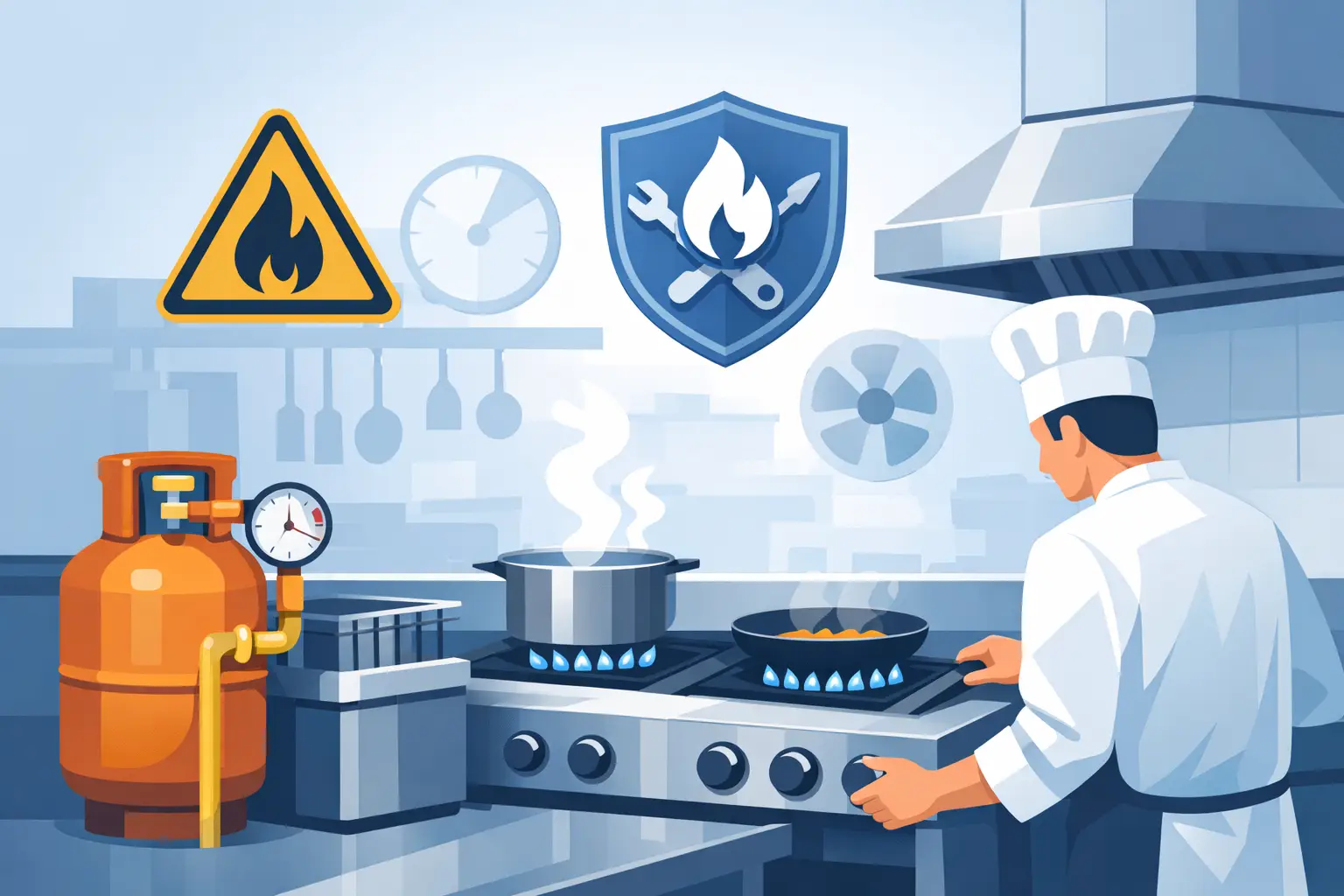
A busy service is the worst possible time to discover that a burner will not light, a fryer flame is unstable or a gas smell is coming from behind the cooking line. This guide to commercial gas safety is written for operators who need their kitchen safe, compliant and ready to trade – without avoidable downtime or costly last-minute repairs.
Gas appliances remain central to many professional kitchens. Ranges, chargrills, fryers, ovens, water heaters and combination units can deliver fast, controllable heat, but they must be installed, used and maintained correctly. Gas safety is not just a paperwork exercise. It affects staff welfare, fire risk, energy use, insurance and the reliability of the equipment your service depends on.
In the UK, commercial gas work must be carried out by an appropriately qualified Gas Safe registered engineer. This includes installation, commissioning, servicing, repair, testing and disconnection of commercial catering appliances. Do not assume that an engineer registered for domestic work is qualified for the type of commercial appliance or gas work required. Their Gas Safe ID card should show the relevant commercial categories.
Employers and those controlling commercial premises have duties under the Gas Safety (Installation and Use) Regulations 1998 and wider health and safety law. In practical terms, you must ensure gas fittings, pipework, flues and appliances are maintained in a safe condition, and that employees have suitable information and training.
There is no single annual certificate requirement that applies in exactly the same way to every commercial kitchen. However, manufacturers’ servicing schedules, risk assessments, insurer requirements and the demands of heavy daily use often make planned annual inspection and servicing the sensible minimum. High-output sites may need more frequent attention. A school kitchen used during term time has different demands from a restaurant running 14 services a week.
Keep clear records of installation, commissioning, inspections, repairs, servicing and any defects found. These records show that faults have been addressed and give engineers valuable history when diagnosing recurring problems.
Safe operation begins before the first pan goes on the hob. New equipment should be installed by a competent commercial gas engineer, sized correctly for the available supply and commissioned in line with the manufacturer’s instructions. A powerful gas chargrill or multi-burner range added to an existing line may place more demand on the gas supply than the original installation was designed to handle.
The engineer should assess the appliance connection, isolation valve, pipework, gas rate, combustion and flue arrangements where applicable. They should also confirm that the appliance is suitable for the gas type on site, whether natural gas or LPG. Never convert or reconnect an appliance on assumption alone. Incorrect jets, pressures or regulators can cause poor combustion, unreliable performance and dangerous levels of carbon monoxide.
Appliances need adequate clearance for heat and servicing access. Packing a cooking line tightly against walls or surrounding it with stored packaging can restrict ventilation, make cleaning difficult and delay emergency isolation. A kitchen layout should support output, but it must also allow safe access to valves, filters, connections and service panels.
Gas appliances need sufficient permanent air supply for safe combustion. In many commercial kitchens, mechanical extraction and make-up air arrangements are designed alongside the canopy and cooking equipment. If airflow is poor, flames can become yellow or unstable, combustion can deteriorate and heat builds up across the line.
Do not treat the canopy as separate from the gas installation. Dirty filters, blocked ductwork, failed fans and a poorly balanced ventilation system can affect how gas equipment performs. Extraction should be inspected and cleaned at a frequency that reflects the volume and type of cooking taking place. A fryer-heavy operation will usually need a more demanding regime than a light-use café.
Where a gas interlock system is fitted, do not bypass it. These systems are intended to prevent gas being supplied when the extraction system is not operating correctly. A temporary workaround may keep service moving for an hour, but it creates a risk no professional operator should accept.
Kitchen teams are not expected to repair gas appliances, but they are the first people likely to spot changes in performance. Build straightforward visual and operational checks into opening and closing routines. Staff should know where the emergency gas isolation valve is located, how to raise a fault and when equipment must be taken out of use.
Before service, look for damaged controls, loose connections, scorch marks, unusual soot deposits and signs of corrosion. Check that burners ignite promptly and produce stable, predominantly blue flames. A lazy yellow flame, repeated ignition failure, popping, lifting flames or an unusual smell should be reported immediately.
Keep burner ports, pilots and surrounding surfaces clean. Grease and food debris can obstruct burners, affect flame quality and increase fire risk. Cleaning must follow the appliance instructions, particularly around ignition components and removable burner parts. Avoid flooding controls or using unsuitable chemicals that can damage seals and electrical ignition systems.
At closing, make sure controls are off and follow the site’s shutdown procedure. If equipment is left on for a defined operational reason, that procedure should be written, authorised and understood by the responsible team. Informal habits are where costly incidents start.
A suspected gas leak needs a calm, immediate response. Do not try to locate the leak with a naked flame, and do not switch electrical equipment on or off in the affected area. Avoid using mobile phones nearby.
Turn off the gas supply at the emergency control valve if it is safe to do so. Extinguish naked flames, evacuate staff and customers from the immediate area, open doors and windows where practical, and prevent anyone from re-entering. Call the National Gas Emergency Service on 0800 111 999 for a suspected natural gas leak. For LPG, follow your supplier’s emergency instructions and move clear of cylinders or bulk storage.
Do not restart appliances because the smell appears to have gone. The cause must be investigated by a suitably qualified Gas Safe registered commercial engineer. If one appliance is isolated, make sure the rest of the kitchen can operate safely before resuming service. It may be better to run a reduced menu than force equipment back into use.
Reactive repairs are expensive because they arrive at the worst moment. Planned maintenance gives an engineer the chance to identify worn ignition leads, failing flame supervision devices, blocked injectors, deteriorating hoses, poor combustion or damaged valves before they cause a shutdown.
A proper commercial gas service is more than a quick visual inspection. The scope depends on the appliance, but it may include checking gas tightness, burner operation, flame picture, safety devices, inlet pressure, combustion, ventilation interaction and accessible pipework. The engineer should test the appliance under operating conditions where appropriate, not simply confirm that it lights.
Follow the equipment manufacturer’s maintenance guidance as well as your engineer’s recommendations. Combination ovens, for example, combine gas, water, drainage, electrical and ventilation considerations. Neglecting the water treatment or cleaning regime can affect reliability, while poor gas combustion can compromise both performance and safety. One maintenance plan should cover the whole operating system, rather than treating each issue in isolation.
For refurbished equipment, commissioning and a documented condition check are particularly valuable. A professionally refurbished oven can offer excellent value, but only when the refurbishment standard, testing process and future servicing support are clear. The purchase price is only one part of the cost of ownership.
Every kitchen should have named people who know how to isolate the gas supply and respond to an emergency. New starters, agency staff and temporary team members need the same clear instruction as permanent chefs. Put the emergency procedure somewhere visible, but do not rely on a poster alone. Talk through it during induction and revisit it after layout changes or equipment upgrades.
Staff should also understand the difference between normal wear and a safety concern. A burner that needs more frequent cleaning may be a maintenance issue. A burner that will not stay lit, produces an abnormal flame or triggers a carbon monoxide alarm is a stop-use issue. Clear escalation prevents a team from improvising repairs during a pressured shift.
The cheapest callout is not always the lowest-cost option. A specialist engineer who understands commercial catering equipment can diagnose faults accurately, carry common parts and identify underlying installation or ventilation issues. That reduces repeat visits and protects the availability of your cooking line.
When arranging service support, ask whether the engineer is qualified for your appliance type, whether gas safety testing is included, what report you will receive and how urgent faults are handled. For operators with a mix of Rational ovens, fryers, chargrills and warewashing equipment, a provider with broad commercial kitchen knowledge can simplify maintenance planning.
Island Catering Equipment Co. supports professional kitchens with commercial gas safety work, engineer callouts and specialist equipment maintenance, helping operators keep essential appliances safe and productive.
A well-run gas safety regime should feel routine: clean equipment, trained staff, planned servicing and fast action when something changes. That routine gives your team confidence to focus on service, while protecting the equipment investment behind every plate.





No account yet?
Create an Account