


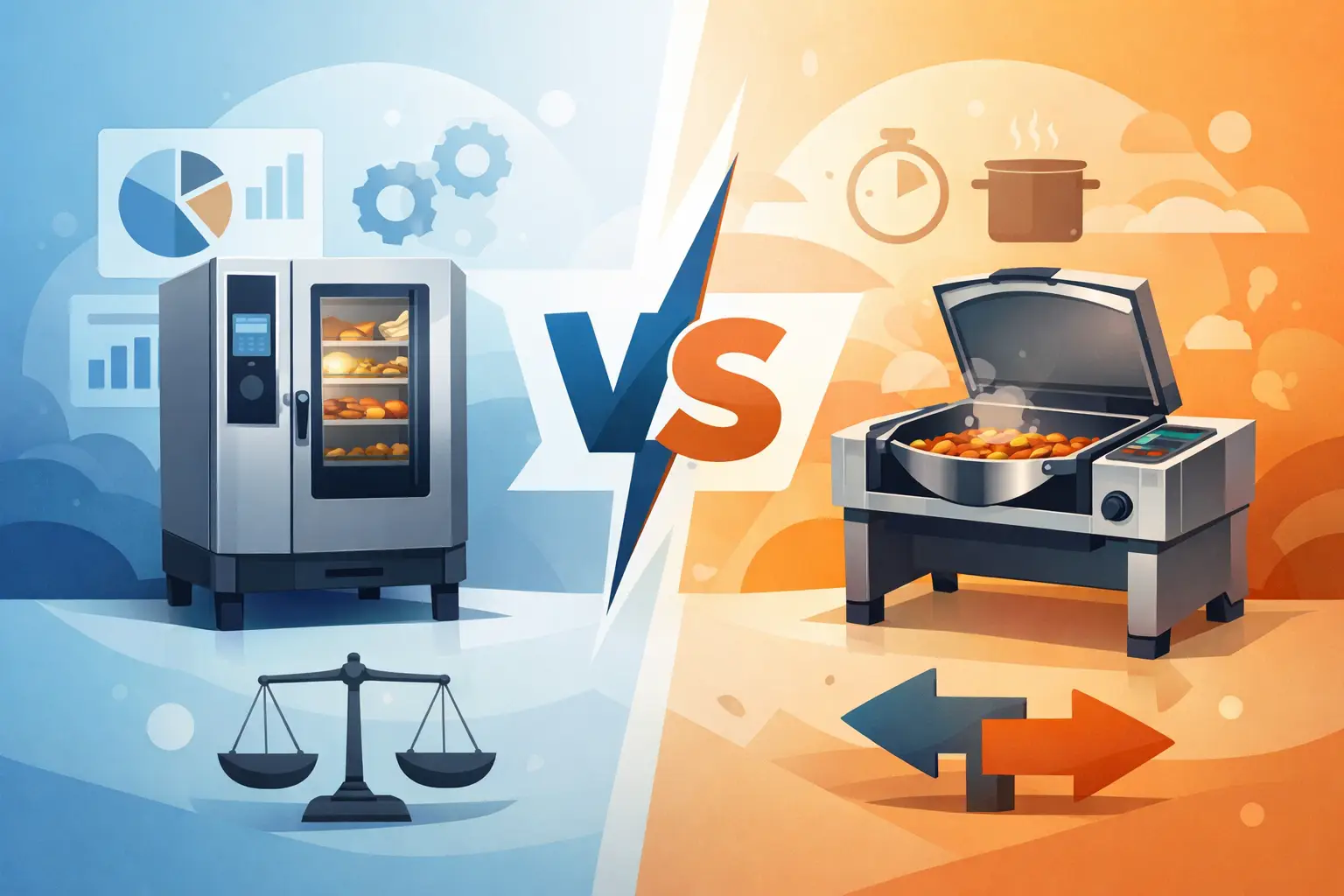
If you are weighing up Rational iCombi vs iVario, the real question is not which machine is better. It is which one solves the pressure points in your kitchen. A high-volume restaurant, school canteen, hotel breakfast service and production kitchen can all buy Rational equipment, but they will not all benefit from the same platform in the same way.
This is where many buyers get caught out. They compare capacity, headline features or price alone, when the better decision usually comes down to menu mix, service pattern, staffing and available space. The iCombi and the iVario are both designed to improve consistency, reduce labour pressure and increase output, but they do it by very different methods.
The iCombi is a combi oven. It uses dry heat, steam, or a combination of both to roast, bake, steam, regenerate and finish food with a high level of control. If your kitchen relies on oven-based cooking across multiple product types, this is usually the more familiar and versatile choice.
The iVario is best thought of as a replacement for several pieces of traditional cooking equipment at once. It can pan fry, boil, deep cook, poach and braise in a single unit with fast heat-up and precise temperature control. In many kitchens, it takes the place of bratt pans, boiling pans, stockpots and even some hob work.
That means the comparison is not oven versus oven. It is oven intelligence versus multifunctional pan cooking. For some sites, they complement each other. For others, one will clearly deliver a better return than the other.
If your menu depends on roasting, baking, steaming and regeneration, the iCombi usually makes the strongest case. It is built for kitchens that need reliable results over repeated service, whether that means finishing plated meals in a hotel, baking pastries in a café operation, roasting meats for a carvery or regenerating prepared dishes in healthcare and education.
One of the iCombi’s biggest advantages is range. You can cook different products with a high degree of consistency, and intelligent cooking programmes help reduce reliance on individual chef judgement. That matters in kitchens dealing with staff turnover, split shifts or less experienced operators. The more your business depends on standardised output, the more value that control delivers.
It also suits kitchens where vertical cooking capacity matters. A combi oven gives you tray-based production and strong use of footprint, which is often critical in tighter back-of-house layouts. If your current pressure point is getting more food out of limited space without compromising consistency, the iCombi is often the cleaner answer.
There is also a clear commercial case for regeneration. Sites serving in waves, such as care homes, schools, event venues and transport catering, can use the iCombi to keep service controlled and repeatable. That helps with portion quality, waste reduction and labour planning.
The iVario tends to make the most impact in kitchens doing large volumes of boiling, braising, frying or one-pot cooking. If your operation produces soups, sauces, curries, stews, pasta, rice dishes or batch-cooked menu items every day, the speed and accuracy of the iVario can change workflow significantly.
Traditional boiling pans and bratt pans are dependable, but they are not always efficient. They can be slow to heat, slower to recover temperature and harder to control precisely. The iVario is designed to deal with those weaknesses. It heats quickly, responds fast and gives operators more control over delicate or high-volume production.
That speed has practical value. A kitchen making regular batch sauces or bulk catering meals can turn around production faster, reduce waiting time between stages and make better use of labour. It can also reduce the need to move products between appliances, which is helpful from both efficiency and safety points of view.
The iVario is particularly strong where pan-based cooking drives service. Pubs with stew and sauce-heavy menus, staff canteens producing bulk meals, schools, hospitals and central production units often see the most obvious benefit. In those settings, it is not just a cooking appliance. It is a way to replace older, slower equipment with one platform that gives better control and better throughput.
Both units are built to save time, but they do it differently.
The iCombi saves labour by automating cooking processes that would otherwise need closer supervision. Load mixed products correctly, select the right cooking path and the machine does much of the control work for you. That is valuable when chefs are covering multiple sections or when training time is limited.
The iVario saves labour through speed and reduced handling. It gets to temperature quickly, reacts fast when product is added and allows operators to cook, reduce, simmer and hold in one place. In practical terms, that can mean fewer transfers, fewer delays and less standing over equipment waiting for it to catch up.
If your bottleneck is oven capacity and repeatability, the iCombi usually wins. If your bottleneck is pan work, batch cooking and slow traditional boiling equipment, the iVario often offers the bigger operational gain.
Commercial buyers often focus on specification first and layout second. In reality, the two should be judged together.
The iCombi is usually the easier fit for kitchens already structured around tray racks, prep-to-oven workflow and plated or tray-based output. It suits operations where product moves from prep benches to oven to pass with minimal interruption.
The iVario changes the dynamic more noticeably because it can replace several traditional heat sources. In the right kitchen, that can free space and simplify production. In the wrong kitchen, it can be underused if the menu does not justify its strengths. Buying an iVario for a site that mainly roasts, bakes and regenerates is rarely the most efficient use of budget.
This is why a menu-led assessment matters. The best piece of equipment on paper is not always the best piece of equipment for that service environment.
A straight purchase price comparison rarely tells the full story in Rational iCombi vs iVario decisions. What matters more is where the return comes from.
With the iCombi, the return often shows up in consistency, reduced waste, stronger cooking control and better use of kitchen space. It can also support menu expansion because one unit can handle a wide range of cooking tasks.
With the iVario, the return is more often tied to production speed, reduced labour input in batch cooking and replacing several legacy appliances with one system. For bulk catering or pan-heavy operations, that can be a strong commercial argument.
For cost-conscious buyers, refurbished equipment can also shift the equation. A professionally refurbished Rational unit gives access to premium cooking technology at a lower capital outlay, provided refurbishment standards are high and the machine has been properly tested and prepared for service. That is often the sensible route for operators who need performance but still have to protect cash flow.
Restaurants, hotels, bakeries, cafés and mixed-service venues often lean towards the iCombi because of its flexibility across roasting, steaming, baking and regeneration. It is usually the safer all-round investment where menus change and service formats vary.
Schools, care environments, hospitals, staff dining and production kitchens often see more value in the iVario if batch cooking forms the core of daily output. It is particularly effective when consistency and speed are needed across soups, sauces, rice, pasta and braised dishes.
There are also kitchens that should consider both. Larger operations with varied menus and high throughput can use the iCombi for oven work and regeneration, while the iVario handles bulk wet cooking and pan-based production. Where budget and space allow, that combination can create a very efficient workflow.
The best way to approach Rational iCombi vs iVario is to ignore brand familiarity and focus on production reality. What are you cooking most often? Where does service slow down? Which jobs still rely too heavily on manual judgement? Which existing appliances are costing you time, consistency or maintenance?
Those answers usually point clearly in one direction. If your kitchen lives and dies by oven performance, the iCombi is the stronger fit. If your output depends on fast, controlled pan cooking at scale, the iVario is hard to ignore.
For buyers who want straight advice rather than a generic sales pitch, that is the point worth holding onto. Good equipment should match the way your kitchen actually works, not the way a brochure says it should. Get that part right, and the rest of the investment starts to make sense.





No account yet?
Create an Account