


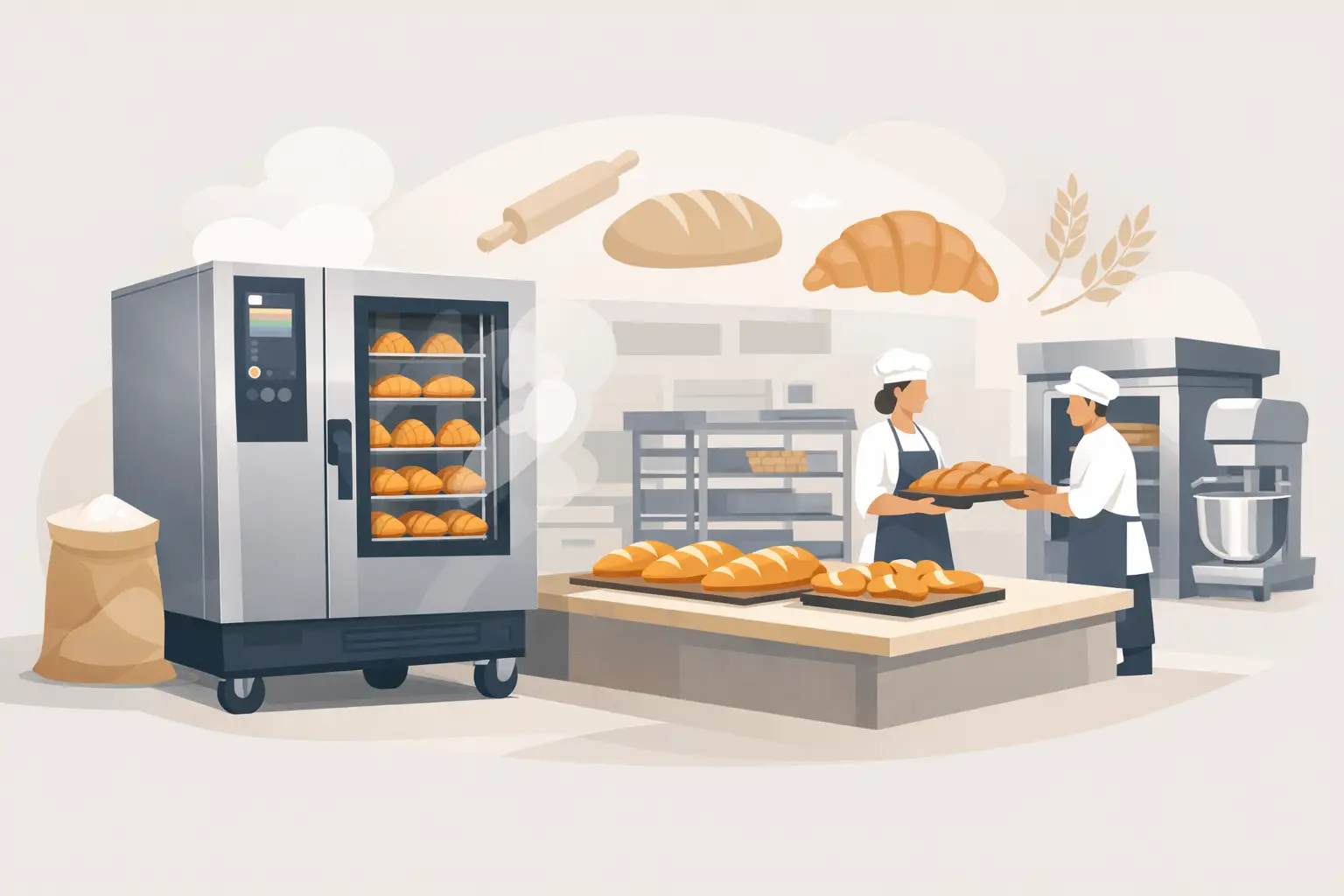
A Rational SelfCookingCentre for bakeries earns its place when the bakehouse needs to produce more than bread. One unit can handle pastry, savouries, breakfast items, traybakes, proving support, roasting, regeneration and finishing – all with repeatable settings that reduce reliance on constant operator judgement. For bakeries supplying cafés, hotels, schools, retail counters or contract catering, that flexibility can make a direct difference to output and labour planning.
It is not a replacement for every specialist baking oven. A high-volume artisan bread operation may still rely on deck ovens for the particular bake, base heat and crust it requires. But where product range is broad, space is limited and teams need dependable results across multiple shifts, a SelfCookingCentre can be one of the most productive items in the kitchen.
The SelfCookingCentre is a commercial combi oven built around controlled heat, steam and air movement. Rather than asking staff to manage every cooking variable manually, it allows operators to select or programme processes suited to the product and desired result. That matters in a bakery where small variations in moisture, temperature or timing can quickly affect colour, rise, finish and shelf appeal.
For everyday production, the practical benefit is consistency. Croissants can be baked with a controlled finish, filled pastries can be brought through evenly, and savoury slices can be produced at scale without one tray colouring too quickly while another lags behind. The oven also gives a bakery a useful production fallback when a separate appliance is out of action or demand changes at short notice.
Its value is often strongest outside the early-morning bake. Once core bakery products are complete, the same oven can cook hot food for an in-store café, regenerate pre-prepared dishes for lunch service, roast fillings, cook breakfast items or finish grab-and-go products. That wider use can improve the return on a high-value piece of equipment.
A Rational SelfCookingCentre for bakeries suits businesses that need controlled, repeatable output over a varied menu. Independent bakeries with a café offer, central production kitchens, supermarket concessions, hotel pastry sections and wholesale bakehouses can all benefit, provided the chosen oven size matches actual tray volumes and workflow.
Products such as Danish pastries, croissants, muffins, brownies and sponge trays depend on an even bake and reliable colour. Programmed cooking processes help teams reproduce a proven result, particularly when production is shared between experienced bakers and broader kitchen staff.
The ability to manage humidity is useful during different stages of baking. Too much moisture or insufficient extraction can compromise a crisp finish, while carefully controlled conditions can support more delicate products. The correct programme still needs to be developed for each recipe, tray type and loading level. A combi oven gives control, not a universal setting for every item.
Sausage rolls, pies, pasties, quiches, pizzas, filled baguettes and hot counter products are often where a combi oven proves its commercial worth. These are high-turnover lines, and demand commonly peaks around breakfast and lunch. A Rational unit can help produce batches consistently while leaving staff free for packing, display, counter service and replenishment.
For bakeries selling hot food, the oven can also support a more disciplined holding and regeneration process. This helps reduce waste from overproduction and gives operators greater confidence when responding to a late rush.
When several sites need the same product quality, repeatable programmes become more valuable. A documented cooking process reduces the risk that one branch overbakes pastries while another serves under-finished savouries. It also simplifies staff training and supports better handovers between shifts.
That does not remove the need for quality checks. Ingredient changes, frozen versus fresh product, tray loading and local water conditions can all influence results. The point is to make the process more controllable and easier to repeat.
Choosing a Rational SelfCookingCentre should start with production volume, not the assumption that the largest model is automatically best. A compact six-grid unit may suit a bakery café or satellite site, while a ten-grid model can be a stronger fit for sustained batch production. Larger floor-standing units can offer serious capacity, but they need enough clear space, extraction planning and a workflow that keeps them properly utilised.
Measure the available footprint, door swing, loading route and access for delivery before ordering. Consider where trays will be racked, where finished goods will cool, and whether staff can safely load and unload during busy periods. An oven that is technically large enough but creates a bottleneck around the pass or packing bench will not improve production.
Utilities are equally important. Gas and electric versions have different installation requirements, and the site must have suitable power or gas capacity, water supply, drainage and ventilation arrangements. A professional site survey prevents avoidable installation delays and helps ensure the equipment is specified correctly from the outset.
Flour, butter, sugar, fats and fillings create a demanding environment for any oven. Built-in cleaning on the SelfCookingCentre reduces the manual burden and helps keep the cabinet in suitable operating condition, but it is not a reason to overlook day-to-day care. Trays, racks, door seals, drains and the cooking cabinet all need regular attention.
A disciplined cleaning routine protects food quality as well as the machine. Residue can affect odours, smoke levels, heat transfer and the appearance of finished products. Staff should be trained to use the correct cleaning chemicals and follow the relevant programme, rather than treating a commercial combi oven like a basic convection oven.
Planned servicing is also a sensible commercial decision. Bakery production schedules are tight, and unplanned oven downtime can mean lost sales within hours. Regular inspection by qualified Rational-trained engineers helps identify worn seals, drainage issues, probes, fans and other components before they create a serious failure. Fast access to appropriate spare parts matters just as much when an oven is central to daily output.
A new Rational oven may be the right option for a new site, a high-intensity operation or a business that requires the latest platform and warranty support. It gives a known starting point and can be specified around the exact production plan.
Professionally refurbished equipment can be a strong alternative where capital expenditure is under pressure. The key word is professionally. A used commercial oven should be inspected, tested and restored by technicians who understand the equipment, not simply cleaned and resold. Buyers should ask about the oven’s condition, refurbishment work completed, testing procedure, warranty and available aftersales support.
Island Catering Equipment Co. supplies new and refurbished Rational ovens backed by specialist knowledge, helping bakery operators compare capacity, condition and budget rather than forcing a one-size-fits-all decision. For many businesses, a properly refurbished SelfCookingCentre offers access to proven Rational performance while preserving capital for refrigeration, display equipment, extraction or additional production capacity.
The strongest reason to buy a SelfCookingCentre is rarely that it bakes one product better than every dedicated oven. The commercial case is that it can take on a wide range of tasks reliably, in a small footprint, across the whole trading day. That can reduce equipment duplication, improve consistency and give managers more options when menus or demand change.
Before purchasing, map what the oven will cook from opening preparation through to close-down. Include batch sizes, peak trading periods, staff capability, cleaning time and the cost of a breakdown. If the unit will spend most of its life baking artisan loaves at maximum volume, a specialist bread oven may be the better primary investment. If it will support pastry, savouries, café food, regeneration and flexible production, a Rational SelfCookingCentre can become the working centre of a more efficient bakery operation.
The right model is the one that fits the products you sell, the space you have and the output you must protect every day.





No account yet?
Create an Account