


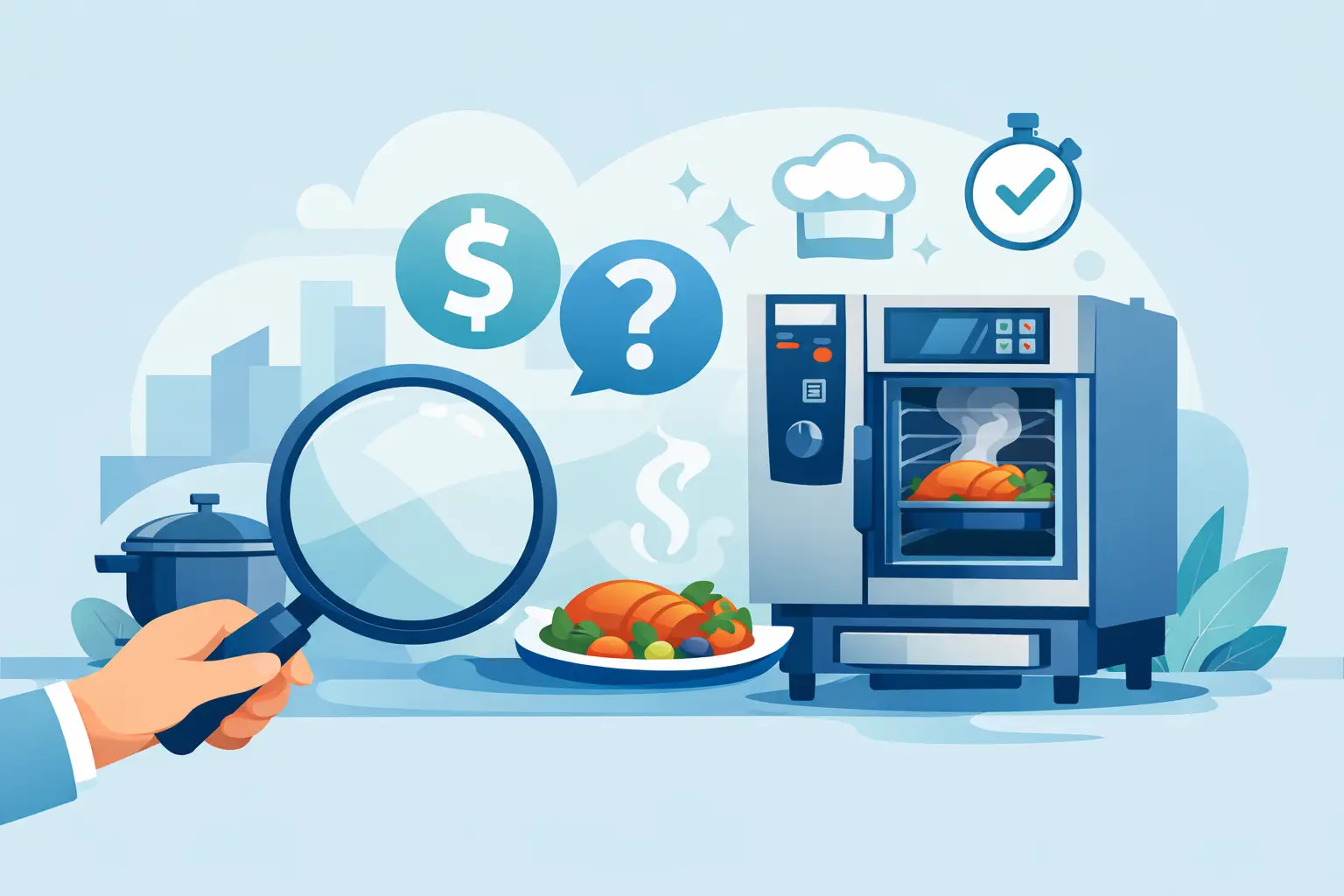
A busy service exposes weak equipment very quickly. When orders stack up, staffing is tight and consistency matters, a self cooking centre oven stops being a luxury item and becomes a serious production tool.
For many professional kitchens, the question is not whether combi cooking technology works. It does. The real question is whether the investment makes commercial sense for your menu, your output and your budget. That depends on how you use the oven, how much labour you want to save and whether you buy new or refurbished.
A self cooking centre oven is designed to automate and control a wide range of cooking processes inside one unit. In practical terms, that means it can roast, bake, steam, regenerate, grill and finish products with a high degree of repeatability. Instead of relying on manual adjustments throughout service, operators can select cooking programmes that manage temperature, humidity and cooking time far more accurately than standard oven setups.
That matters in commercial kitchens because inconsistency is expensive. Overcooked joints, uneven tray bakes, dried-out vegetables and poorly regenerated plated meals all create waste, complaints and delays. A properly specified combi oven reduces those issues while increasing usable output from the same footprint.
This is one reason Rational units remain a strong choice across restaurants, hotels, schools, care settings and contract catering. They are built for volume, control and reliability, not occasional use.
The strongest case for this type of oven is operational efficiency. One machine can replace several separate cooking processes, which helps where kitchen space is limited or where teams need to produce varied menus from a compact line.
A pub kitchen might use the same oven for overnight slow cooking, lunchtime regeneration and evening roast service. A care home may depend on it for reliable batch cooking with tight nutritional and texture requirements. A bakery or deli operation may value the consistency across multiple trays and repeated production cycles. The appeal is not theoretical. It comes from making service more predictable.
There is also a labour benefit. Skilled chefs still matter, but programmable cooking reduces the margin for error when less experienced staff are on shift. That can be a major advantage for businesses dealing with recruitment pressure or high staff turnover.
If your kitchen produces volume, works across different dayparts or needs dependable repeatability, the return can be strong. The savings usually show up in four places – reduced food waste, better labour efficiency, faster throughput and fewer pieces of equipment doing overlapping jobs.
That said, not every site needs one. A very small menu with limited covers and simple production may not use the oven’s full capability. If your operation only occasionally roasts or bakes and does very little steaming or regeneration, the payback period may be longer than expected.
The better way to assess value is to look at actual service demands. How many covers do you produce? How much batch cooking do you do? Do you need overnight cooking? Are you losing margin through inconsistency? Are staff manually checking products that should be automated? Those questions tell you more than headline price alone.
This is where many buyers can make a better commercial decision. A new unit gives you the latest specification, manufacturer-backed assurance and a full fresh service life. For some kitchens, especially high-volume sites with planned capex, that is the right route.
But refurbished can offer far better value when done properly. A professionally restored self cooking centre oven gives operators access to premium Rational cooking technology at a much lower initial outlay. The key point is refurbishment quality. There is a big difference between a used oven that has simply been cleaned up and one that has been inspected, repaired, tested and prepared by trained specialists.
That is why buyers should look closely at who carried out the refurbishment, what parts were checked or replaced and whether the unit has been properly tested before dispatch. A lower purchase price is only attractive if the oven is dependable in live service.
For cost-conscious sites, refurbished often makes the most sense. It can free up budget for extraction, refrigeration, prep equipment or service support while still delivering the performance standards expected from a premium combi oven.
Capacity comes first. Too small and the oven becomes a bottleneck. Too large and you tie up capital in output you do not need. Grid size, tray count and loading pattern should match the reality of your menu rather than best-case assumptions.
Utilities matter just as much. Petrol or electric specification, water quality, drainage, ventilation and available space all need checking before purchase. Many installation problems start with poor site assessment rather than the oven itself.
Cleaning is another practical point that directly affects ownership cost. Automatic cleaning systems save staff time and help protect the oven internally, but only if the cleaning routine is followed properly. If your team regularly skips cleaning, performance and reliability will suffer over time.
It is also worth considering service access and parts support. Any commercial oven can go down. The difference is how quickly you can get it back into operation. That makes aftersales support part of the buying decision, not an afterthought.
Buyers often focus heavily on purchase price and not enough on operating cost. A self cooking centre oven can reduce energy and labour waste when compared with running several appliances for separate tasks, but the savings depend on usage patterns.
For example, using one well-programmed combi oven for roasting, steaming and regeneration can be more efficient than juggling multiple pieces of equipment with inconsistent loading and longer recovery times. Better moisture control can also reduce shrinkage on meats and improve yield, which matters when margins are under pressure.
Water treatment should not be overlooked either. In hard water areas especially, correct filtration helps protect the oven and maintain performance. Skipping that cost at the start usually leads to more expensive problems later.
The best oven on paper is still a risk if support is weak. Commercial kitchens need access to spares, technical advice, servicing and engineer callouts when something goes wrong. Downtime during service is not just inconvenient. It hits revenue, labour planning and customer experience immediately.
That is why many operators prefer to buy from a specialist rather than a general equipment reseller. Product knowledge matters when you are comparing models, planning installation or deciding whether new or refurbished is the better fit. It matters even more after the sale, when maintenance schedules, diagnostics and repairs become part of day-to-day ownership.
For operators who want both stock availability and technical backing, Island Catering Equipment Co. supplies new and refurbished Rational ovens alongside servicing, parts and engineering support through https://islandcatering.co.uk.
If your kitchen depends on speed, repeatability and flexible production, the answer is often yes. A self cooking centre oven can help simplify service, protect food quality and reduce pressure on staff. In medium to high-output environments, those gains are usually more valuable than the headline purchase cost suggests.
If your operation is smaller or highly specialised, it may still be the right investment, but only if the specification matches the menu and the oven will be used properly. Buying too much oven is just as unhelpful as buying too little.
The strongest results come when the unit is sized correctly, installed properly and backed by reliable support. That is where commercial buyers protect their investment – not by chasing the lowest price, but by choosing equipment that will perform consistently under real kitchen conditions.
A good oven should do more than cook well on day one. It should keep pace with service, hold its standard under pressure and make the rest of the kitchen work harder in the right way.





No account yet?
Create an Account