

A Rational oven rarely fails without warning. More often, it starts with slower heat-up times, uneven results, longer cleaning cycles, or minor faults that staff work around until the problem becomes expensive. If you are asking when should a Rational be serviced, the short answer is before performance drops far enough to affect service, food quality, or compliance.
In a commercial kitchen, servicing is not just about fixing breakdowns. It is about protecting output, keeping energy use under control, and extending the working life of a high-value asset. Rational combi ovens are built for demanding use, but they still need routine attention if they are expected to perform properly day after day.
For most sites, a Rational should be professionally serviced at least once every 12 months. That is the baseline. In busier kitchens, twice-yearly servicing is often the better option, especially where the oven is in constant use, handles mixed menus, or operates in a hard water area.
Annual servicing suits lower to moderate usage patterns, such as smaller pubs, cafés, or sites with more limited production windows. Twice-yearly servicing is usually more appropriate for hotels, schools, care homes, production kitchens, event caterers, and high-volume restaurants where the oven is central to daily output.
The right interval depends on workload, water quality, cleaning discipline, and the age of the unit. A newer oven in a well-run kitchen may comfortably stay on a yearly service schedule. An older unit, or one used heavily across breakfast, lunch, and dinner, will usually benefit from more frequent checks.
That is the practical answer to when should a Rational be serviced. The better question is whether your current schedule matches how the oven is actually being used.
A calendar reminder is useful, but it should not be your only trigger. Commercial kitchens are hard on equipment. Steam generation, grease build-up, fan operation, door seals, drainage, and sensors all take a daily hit. If the oven is under pressure every shift, wear does not wait politely for the annual service date.
This is where many operators get caught out. The oven still switches on, so it is assumed to be fine. Meanwhile, limescale starts affecting steam performance, seals begin to leak, the wash system loses efficiency, or a probe reads less accurately than it should. None of these issues may stop service immediately, but they reduce consistency and push the machine closer to a breakdown.
A planned service is always cheaper than emergency downtime during a busy period. That is particularly true if the oven is carrying core production, regeneration, banqueting, or bakery work where there is little room for delay.
If you notice changes in performance, do not wait for the next scheduled visit. A Rational may need servicing earlier if cooking times are drifting, results are becoming inconsistent, or the oven is struggling to maintain steam and temperature accurately.
Door seals are a common issue. If steam is escaping or the door no longer closes firmly, efficiency drops and components are placed under more strain. Problems with the cleaning system also matter. If automatic cleaning cycles are taking longer, failing to complete properly, or leaving residue behind, the machine may need attention.
Limescale is another major warning sign, especially in hard water areas. Reduced steam output, error messages, unusual noises, and poor rinse performance can all point to scale build-up or water system issues. Ignoring it does not save money. It usually means higher repair costs later.
It is also worth paying attention to smaller faults. Intermittent sensor issues, fan irregularities, drainage problems, or patchy heating are exactly the kind of faults that tend to worsen under pressure. If your team is adapting its workflow around the oven rather than relying on it, the service is already overdue.
Two kitchens can own the same model and need completely different service schedules. A six-grid combi in a village pub working mainly at weekends does not face the same demands as the same oven in a care home or hotel kitchen running all day.
High-output environments need a more proactive approach. If the oven is used for steaming vegetables, roasting meats, regenerating plated meals, baking, and overnight cooking, parts will naturally wear faster. Frequent door opening, back-to-back cycles, and heavy cleaning demands all add up.
Water quality also changes the picture. In hard water regions, servicing becomes more important because scale can build quickly in steam systems and related components. Even with water treatment in place, regular checks are needed to confirm that everything is doing its job.
Older ovens deserve closer attention too. A professionally maintained used Rational can offer excellent value and reliable output, but mature equipment should not be left on a vague run-to-failure plan. As components age, scheduled servicing becomes even more important for reliability and cost control.
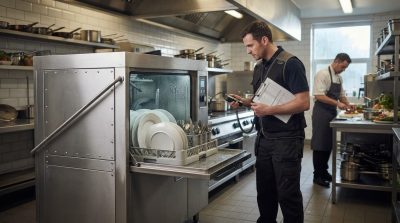
A proper service is not a quick visual check and a reset. It should involve inspection, testing, cleaning of key areas, and assessment of wear on working components. The exact scope depends on model and age, but the aim is always the same – to identify issues early and keep the oven operating safely and efficiently.
That typically includes checks on heating performance, steam generation, fan operation, door seals, probes, controls, drainage, wash functions, and water-related components. Engineers should also assess faults stored in the machine, review the condition of consumable parts, and test overall operation under working conditions.
For petrol units, petrol safety and combustion-related checks are critical. For electric models, electrical integrity and component condition matter just as much. In either case, servicing should be carried out by engineers who understand commercial combi ovens properly, not by generalists taking an educated guess.
That technical depth matters because Rational ovens are advanced machines. If servicing is rushed or incomplete, the oven may be signed off while underlying issues remain.
Operators often delay servicing because the oven appears to be coping. From a commercial point of view, that can be a false economy. A missed service can lead to more than one cost at once: lower food consistency, longer cook times, wasted labour, higher energy use, emergency callout charges, and lost revenue if service is disrupted.
There is also the issue of parts. Replacing a worn seal or addressing scale early is one thing. Waiting until the problem affects additional components is another. Minor faults have a habit of becoming major repairs when an oven is worked hard.
For sites with slim kitchen capacity, the real risk is downtime. If one combi oven is doing the work of several pieces of equipment, a breakdown has an immediate operational impact. Menus may need to be reduced, production plans changed, or external support brought in at short notice. That is why serious operators treat servicing as planned maintenance, not an optional extra.
The most effective schedule is based on actual kitchen conditions rather than guesswork. Start with annual servicing as a minimum, then review whether your usage justifies moving to every six months. If the oven is high-output, older, or working in a hard water area, that step usually makes sense.
It also helps to keep a simple internal record of faults, cleaning issues, unusual noises, and changes in cooking performance. Patterns appear quickly when they are written down. That gives both the kitchen team and service engineer a clearer picture of what the machine is doing between visits.
For businesses running multiple sites or several combi ovens, planned servicing becomes even more valuable. It is easier to manage engineering costs, reduce disruption, and keep equipment life cycles under control when maintenance is scheduled properly rather than left to chance.
A specialist supplier such as Island Catering Equipment Co. sees this regularly across restaurants, schools, care settings, bakeries, and hotels. The ovens that perform best over time are usually not the newest. They are the ones serviced at sensible intervals by people who know the equipment.
If you rely on your Rational every day, treat servicing as part of production planning, not a reaction to faults. The oven will tell you when it is being neglected, but by that point you are usually paying for the warning.


No account yet?
Create an Account