


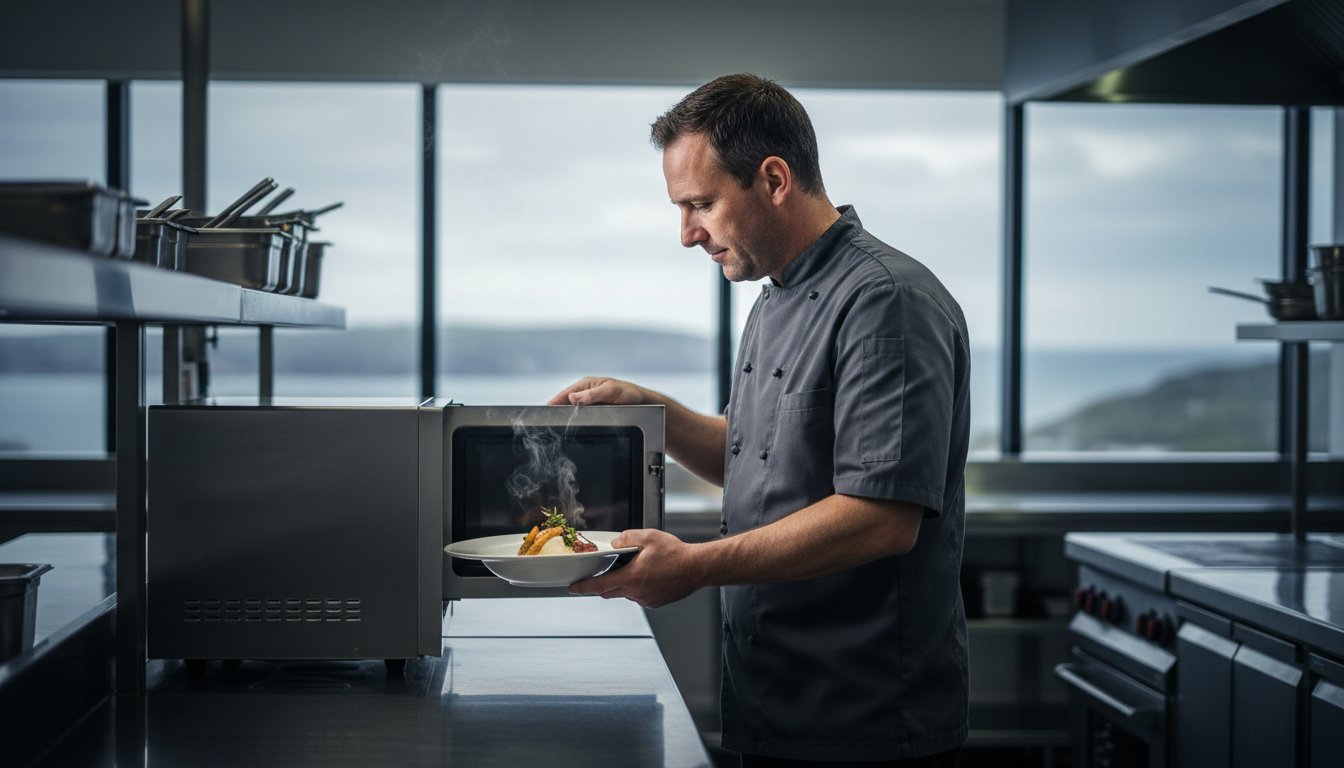
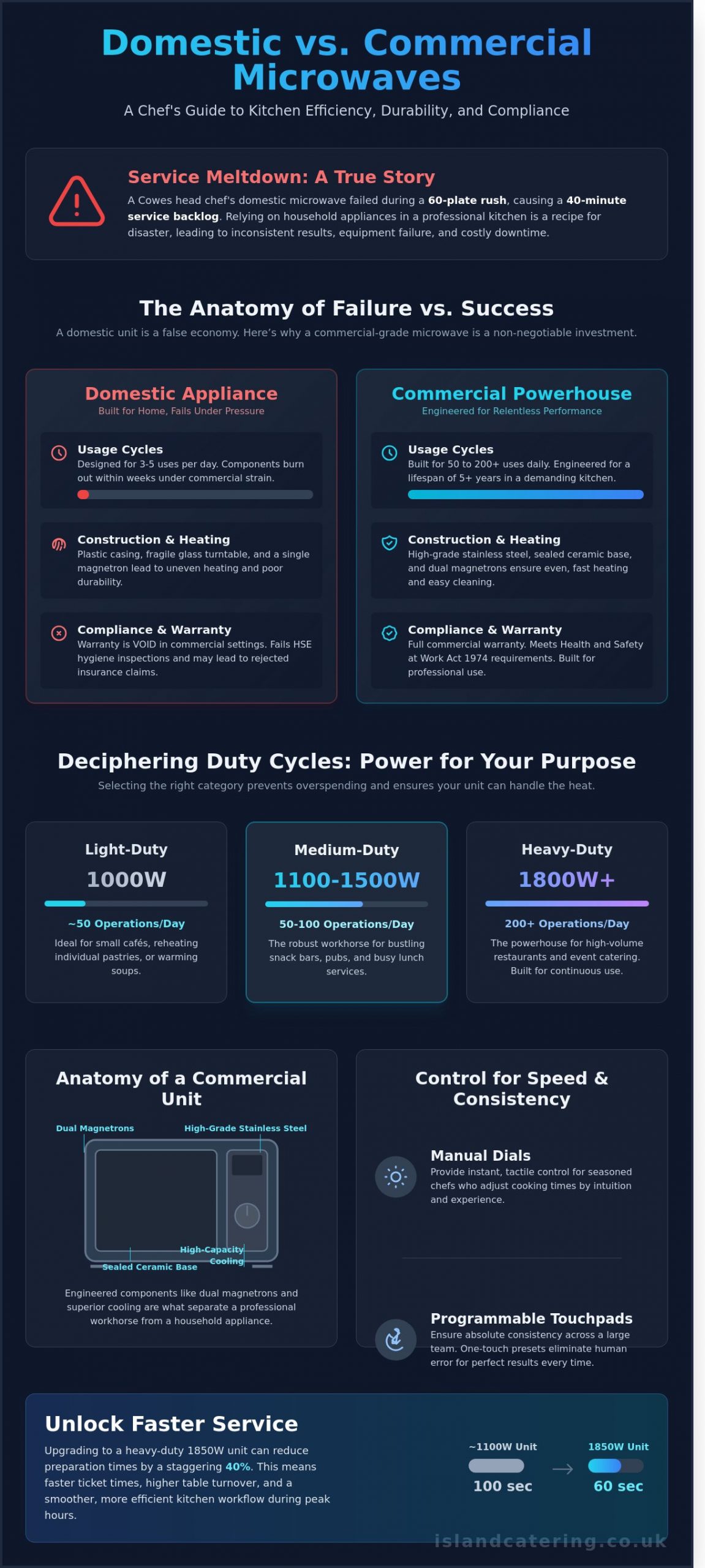
Last Saturday, a head chef in Cowes discovered that a domestic microwave simply can’t survive the 60-plate rush of a summer evening service. When that household unit failed at 7:30 PM, it caused a 40-minute backlog that rippled through the entire dining room. Selecting robust **Commercial Microwave Ovens** is vital because you already know that in a professional environment, your equipment must be as resilient as your passion for culinary excellence. Relying on domestic units often results in inconsistent heating that can diminish the textures of your exquisite seasonal produce.
We’ll show you how to select a unit engineered to endure 70 or more daily cycles while providing the precision your craft requires. By choosing the correct power level, you’ll achieve faster service times and secure equipment designed to last five years or longer. This guide details the essential shift from light-duty units to heavy-duty powerhouses, ensuring your kitchen remains a sanctuary of efficiency and artisanal quality.
In the heart of a high-pressure kitchen, the equipment you choose defines the rhythm of your service. While a domestic microwave serves a family perfectly well for three or five uses a day, the demands of professional catering are vastly different. Commercial Microwave Ovens are built to withstand the rigours of 50 to 200 daily cycles without faltering. This isn’t just about speed; it’s about the artisanal precision required to maintain the exquisite textures of your seasonal ingredients during a busy service on the Isle of Wight.
From a legal perspective, the distinction is absolute. Most domestic manufacturers explicitly state that their warranties are void if the unit is used in a business setting. Under the Health and Safety at Work etc. Act 1974, UK business owners have a duty to provide equipment fit for its intended environment. Relying on a household appliance in a commercial kitchen often leads to rejected insurance claims if a technical fault occurs during a peak dining period. These professional units are encased in high-grade stainless steel, offering a level of durability and heat resistance that domestic plastic shells simply cannot match.
Choosing a domestic unit for a restaurant is a classic false economy. A £60 household model lacks the robust cooling systems needed to survive 40°C ambient temperatures found on a professional cook line. Internal components often suffer “burn-out” within weeks, leading to unexpected downtime that disrupts your guest experience. HSE compliance also requires equipment that is easy to deep-clean; domestic units with internal crevices and moving parts often fail these rigorous hygiene inspections.
Professional grade Commercial Microwave Ovens utilise dual magnetrons to distribute energy from both the top and bottom. This technology ensures even heating without the need for a fragile glass turntable. We prefer sealed ceramic bases because they provide a flat, easy-to-clean surface that supports rapid sanitisation between orders. High-capacity cooling fans and specialised ventilation paths are standard, ensuring the magnetrons remain cool even when the kitchen reaches its most frantic pace. This engineering allows your team to focus on culinary excellence rather than equipment failure.
Choosing the correct equipment is about balancing culinary finesse with the relentless pace of a professional kitchen. Commercial Microwave Ovens are categorised by their duty cycles, a rating that dictates how many hours of service they can endure daily. A light-duty 1000W unit is a charming addition to a small cafe for reheating individual pastries or soup portions, but it lacks the stamina for a full-service dinner rush. For the bustling snack bars of the Isle of Wight, a medium-duty model between 1100W and 1500W offers a robust middle ground, capable of handling 50 to 100 operations per day without faltering.
High-volume venues require the uncompromising strength of heavy-duty machines. These 1800W+ powerhouses are built for continuous use, allowing chefs to steam delicate seafood or rapidly cook dense proteins during peak service. While a standard 26-litre capacity fits most professional plates, larger industrial units reaching 60 litres accommodate gastro-norm pans, making them vital for bulk prep in event catering. Selecting the wrong cycle often leads to a 30% increase in repair costs over the first two years of ownership.
Precision is the hallmark of any exquisite dish. Lower wattages between 1000W and 1100W provide a gentle heat, perfect for melting artisan chocolate or warming delicate brioche without toughening the crumb. Conversely, 1850W models are essential for rapid-response kitchens. Upgrading to an 1850W unit can reduce preparation times by exactly 40%, ensuring that a busy Saturday night service flows as smoothly as a calm Solent tide. If you’re looking to elevate your kitchen’s efficiency, our team at Island Catering can help tailor a bespoke equipment solution for your venue.
The interface you choose dictates the rhythm of your service. Manual dials provide instant, tactile flexibility for seasoned chefs who rely on intuition. However, programmable touchpads are the gold standard for maintaining consistency across a 12-person kitchen team. One-touch presets eliminate human error, ensuring that every locally sourced ingredient is treated with the respect it deserves. When using Commercial Microwave Ovens in high-pressure environments, these presets turn complex tasks into a single button press. This reliability is what transforms a chaotic shift into a seamless culinary experience.
Choosing the right Commercial Microwave Ovens for your establishment is a balance of culinary passion and operational logic. It’s the bridge between an exquisite recipe and a perfectly timed service. For many UK kitchens, the Samsung Heavy Duty range represents the gold standard. These units are prized for their 98% parts availability across the country, ensuring that a minor fault doesn’t derail your entire weekend service. Panasonic Pro models offer a more delicate touch, using sophisticated power delivery to ensure even heat distribution in artisanal dishes. If you’re managing a startup or a smaller community hub, Buffalo and Lincat provide exceptional value for professional kitchens, offering reliable performance without the premium price tag.
The Samsung CM1929 is a workhorse designed for the relentless pace of a busy bistro. Its 1850W output is powered by dual magnetrons, which ensures food is heated from both the top and bottom. This configuration cuts cooking times by up to 50% compared to domestic models. You can store 30 different menu items in its programmable memory, allowing your team to maintain consistency during the Saturday night rush. Its stackable design saves roughly 0.25 square metres of counter space, which is vital in compact Island kitchens where every centimetre of prep area is precious.
Simplicity often leads to the most elegant solutions. The Panasonic NE-1027 offers a compact 510mm width, making it ideal for small cafes or back-bar service. It delivers a reliable 1000W output through easy-to-use manual dials. The stainless steel interior and exterior aren’t just for aesthetics; they allow for a deep clean in under five minutes, meeting the highest hygiene standards. It’s a dependable choice for heating seasonal soups or melting chocolate for bespoke desserts without the complexity of digital interfaces.
Sometimes, standard Commercial Microwave Ovens can’t keep pace with a high-speed menu. Accelerated Cooking Technology (ACT) combines microwave energy with impingement or convection heat. While a microwave excels at reheating, a Merrychef or a Rational iCombi Pro in “Finishing” mode can crisp a pastry or brown a garnish in 60 seconds. These units are becoming the standard in 45% of new UK quick-service builds. They transform the kitchen experience by delivering oven-quality textures at microwave speeds, ensuring your guests enjoy the crunch of a freshly toasted panini in a fraction of the usual time.
Investing in high-quality Commercial Microwave Ovens is a commitment to your kitchen’s long-term efficiency. To ensure these culinary workhorses provide an exquisite return on investment over their typical seven-year lifespan, rigorous care is essential. Neglecting basic hygiene doesn’t just impact food quality; it risks catastrophic component failure. A well-maintained unit operates with the same precision on day 1,000 as it did on day one, preserving the delicate textures of your seasonal ingredients.
Food debris left inside a chamber eventually turns into carbon. This carbon absorbs microwave energy, leading to arcing and permanent damage to the ceiling plate or internal walls. To prevent this, your team should use soft cloths and non-abrasive detergents to preserve the internal stainless steel finish. Abrasive pads create microscopic scratches where bacteria can flourish. One of the most effective techniques involves placing a bowl of water inside and running the unit for three minutes. The resulting steam softens baked-on grease, making the ceiling liner, often the most neglected area, much easier to wipe clean.
Air filters require weekly inspection. A blocked filter forces the magnetron to work harder, increasing the internal temperature and potentially reducing the component’s life by up to 40%. Similarly, door seals must remain pristine. A gap of just 1mm can lead to energy loss and potential microwave leakage; a daily visual check for cracks or food build-up is vital for the safety of your brigade.
Annual inspections by a certified catering engineer are often a mandatory requirement for business insurance policies in the UK. During these bespoke health checks, engineers use specialised meters to test for radiation leakage and verify that the safety interlocks function within 0.5 seconds of the door opening. Portable Appliance Testing (PAT) remains a legal necessity under the Electricity at Work Regulations 1989, ensuring your Commercial Microwave Ovens are electrically sound for your team to operate.
At Island Catering, we believe every kitchen tells a story through its tools. Our selection process focuses on proven brands like Panasonic and Merrychef because we know that a professional kitchen requires more than just heat. It demands reliability. Since our founding on the Isle of Wight, we’ve curated a range of Commercial Microwave Ovens that meet the rigorous standards of high-end gastronomy. Whether you’re plating a delicate seasonal starter or managing a high-volume corporate lunch, our equipment serves as a silent partner in your success.
For many businesses, the choice between brand-new and reconditioned is a matter of strategic balance. Opting for a refurbished unit can reduce your initial capital expenditure by up to 50% without sacrificing the heavy-duty performance your chefs rely on. We provide a seamless delivery service across the United Kingdom, backed by a team of certified engineers who understand the pressure of a live service. Our goal is to ensure your kitchen operates with the fluidity of a well-rehearsed orchestra.
Our workshop is where technical precision meets culinary passion. We don’t just fix machines; we restore them to their former glory. Every unit undergoes a 20-point inspection. Our engineers rigorously test magnetrons, capacitors, and transformers to ensure they meet original manufacturer specifications. We follow this with a deep chemical sanitisation and aesthetic restoration. This meticulous approach ensures we remain a safe pair of hands for independent bistros and large-scale caterers alike.
Efficiency in a professional kitchen is about more than just fast cook times. It’s about the physical flow of the pass. We offer bespoke consultations to help you determine the exact power requirements for your menu and the best placement for your Commercial Microwave Ovens to minimise staff fatigue. Just as Blue Seal Ranges provide the steady heartbeat of a professional kitchen for your main cooking line, the right microwave placement ensures seamless service flow. While microwaves excel at reheating and finishing, the precision prep work that defines your signature dishes requires the consistent performance of Robot Coupe Food Processors for flawless vegetable preparation and sauce consistency. With access to over 10,000 spare parts, our relationship with you continues long after the initial installation. Explore our range of new and reconditioned commercial microwaves and find the perfect fit for your culinary vision.
Transitioning from domestic appliances to robust Commercial Microwave Ovens ensures your kitchen maintains the relentless pace required for high-end service. Selecting a unit with the correct duty cycle prevents mid-service failures, while regular maintenance preserves the bespoke quality of your menu. Since 2004, Island Catering has supported chefs across the UK by providing equipment that balances artisanal flair with industrial-grade reliability. We don’t just supply tools; we provide the operational backbone for your culinary vision.
Our team of certified Gas Safe and Electrical Engineers delivers more than just machinery. We offer a foundation for your creativity through nationwide delivery and comprehensive maintenance contracts that protect your investment. Whether you’re planning a wedding for 200 guests or a refined corporate lunch, the right equipment ensures every plate meets your exacting standards. View our exquisite range of professional catering equipment and let us help you craft unforgettable dining experiences with confidence and style.
No, you shouldn’t use a domestic model because it lacks the durability for a professional environment and will void your commercial insurance. Domestic units are designed for approximately 3 to 5 uses daily, whereas a professional kitchen requires equipment that handles 50 to 200 cycles. Using a home appliance also breaches the Food Safety Act 1990 regulations. For a bespoke culinary experience, investing in robust equipment ensures your kitchen remains compliant and operational.
This commitment to quality is what defines high-end hospitality, where the guest experience is paramount. For instance, the private chefs catering to guests in the exclusive boutique villas offered by luxury travel curators like TOM BENZON rely on this grade of professional equipment to deliver world-class dining.
A high-quality commercial microwave oven typically lasts between 3 and 7 years depending on its duty rating and usage frequency. Light-duty models are engineered for roughly 50 operations per day and usually require replacement after 36 months of intense use. In contrast, heavy-duty units are built for 200 daily cycles and offer greater longevity. With routine maintenance and professional servicing every 12 months, these exquisite machines provide the reliable precision your event catering demands.
Manual microwaves use simple dial timers for immediate flexibility, while programmable models allow you to store up to 100 bespoke cooking sequences. Programmable units ensure 100% consistency across your kitchen team, regardless of who’s behind the pass during a busy service. This precision is vital for maintaining the provenance of delicate seasonal ingredients. By reducing human error, you ensure every dish meets your exquisite standards every single time.
Yes, many heavy-duty models require a dedicated 20-amp or 30-amp electrical supply rather than a standard 13-amp UK plug. Machines with power outputs exceeding 1,800 watts often need hardwiring by a qualified electrician to ensure safety and peak performance. You must check the manufacturer’s specifications before installation to avoid tripping your circuit breakers. Proper power management is crucial, and for those interested in a comprehensive approach to kitchen efficiency, you can learn more about advanced energy management systems.
You must clean your microwave at the end of every service shift to maintain hygiene and long-term performance. Spills and grease buildup absorb energy, which reduces cooking efficiency by up to 15% and can lead to expensive component failure. We recommend a deep clean every 24 hours using non-abrasive sanitisers to protect the stainless steel interior. This simple ten-minute routine protects your investment and ensures the flavours of your Isle of Wight produce remain untainted.
The magnetron is the core vacuum tube that converts electricity into microwave radiation to heat your food. High-performance commercial microwave ovens often feature two magnetrons to provide even heat distribution and faster cooking times for complex dishes. If one fails, the second allows the kitchen to continue operating at 50% capacity until a repair is made. This redundancy is a hallmark of professional-grade engineering, providing the reliability you need for seamless event execution.
Yes, you can stack specific models using a manufacturer-approved stacking kit to maximise your kitchen’s vertical footprint. This configuration can save approximately 0.5 square metres of valuable counter space in smaller prep areas or mobile catering units. You must ensure the bottom unit is rated to support the weight, which often exceeds 30kg for heavy-duty models. Stacking allows your team to work with greater operational efficiency while maintaining an organised, professional environment.
Reconditioned units are safe and reliable provided they’ve been tested and certified by a qualified catering engineer. While you can save up to 40% compared to the price of a new unit, you should ensure the seller provides a minimum 90-day warranty for peace of mind. Every pre-owned machine must undergo a microwave leakage test to meet UK safety standards before it’s installed. Choosing certified equipment ensures your kitchen remains a safe pair of hands for every guest’s experience.





No account yet?
Create an Account