


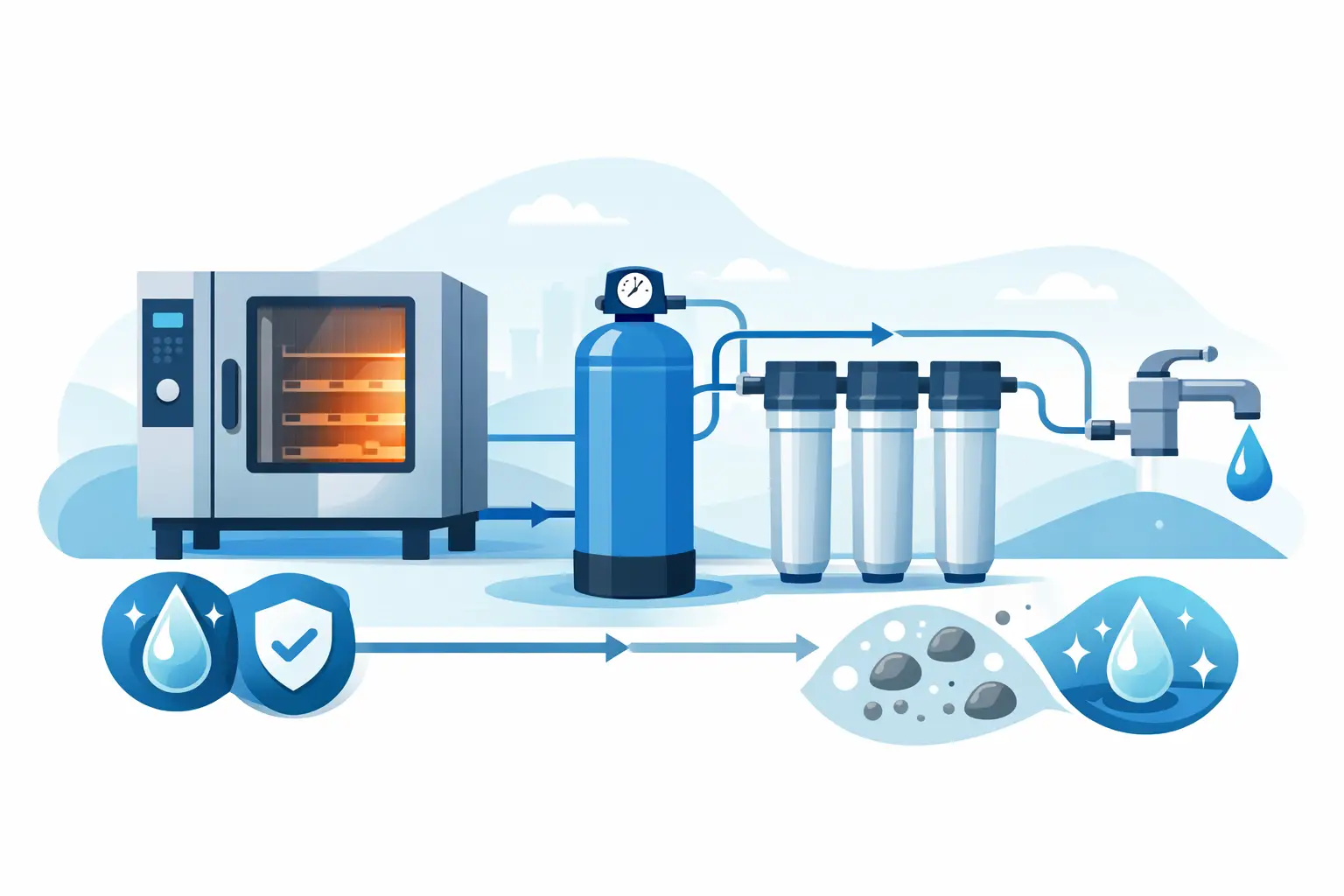
A combi oven can be running perfectly on Monday and throwing steam faults by Friday, all because of the water going into it. Commercial oven water filtration is not an optional extra in serious kitchens. It is one of the simplest ways to protect cooking performance, reduce scale build-up and avoid the kind of downtime that disrupts service and drives up repair costs.
For operators using Rational combi ovens and other high-output units, water quality has a direct effect on reliability. Hard water, sediment, chlorine and dissolved minerals all create problems over time. Some are obvious, such as limescale on internal components. Others show up more gradually through longer heat-up times, inconsistent steam generation, patchy cleaning results and higher energy use.
Most commercial kitchens focus on the oven itself – capacity, programme control, cleaning system, output. That makes sense. The oven is the major capital asset. But if the incoming water is poor, even the best machine will spend more time being descaled, repaired or recalibrated than it should.
Steam cooking depends on clean, controlled water entering the system at the right quality. When untreated water carries excess hardness, calcium and magnesium start depositing on heating elements, steam generators, solenoid valves and pipework. That scale acts as an insulator, so the oven has to work harder to achieve the same result. In busy kitchens, that small efficiency loss becomes a real operating cost.
There is also a product quality issue. Poor water can affect steam density, cavity cleanliness and even the appearance of finished food. In bakeries, hotels, schools and care settings where consistency matters every day, that is not a minor concern.
Commercial oven water filtration is often discussed as if it is one thing. In practice, it can involve several stages depending on the site and the oven model.
A basic system may remove sediment and chlorine. A more advanced setup may reduce hardness through scale inhibition, ion exchange or blended filtration media designed specifically for combi ovens. Some systems are intended to protect internal components first and improve water quality second. Others are engineered to do both.
That distinction matters because not every kitchen has the same water profile. A site in a hard water area may need more than a simple cartridge. A site with lower hardness but high particulate content may have a different requirement. The right setup depends on local supply, usage volume and the manufacturer guidance for the oven in question.
The usual pattern is familiar. An oven is installed, production starts, and filtration is treated as a box to tick later. For a while, everything appears fine. Then service calls begin.
Scale-related faults rarely arrive all at once. More often, they creep in through reduced efficiency, longer cleaning cycles, blocked injectors, drainage issues or failed components. By the time the problem is obvious, the oven may already need parts, labour and lost service time that cost far more than the filtration system would have done.
This is especially relevant for refurbished equipment as well as new. A professionally restored oven may leave the workshop in excellent condition, but its long-term reliability still depends on correct installation and water treatment on site. Refurbishment quality matters, but so does the environment the oven is operating in.
Combi ovens are particularly sensitive because they rely on steam performance and precise humidity control. Unlike equipment that uses water only for cleaning or occasional replenishment, a combi oven integrates water directly into the cooking process. That puts far more pressure on internal components if water treatment is poor.
For Rational ovens, proper filtration is part of protecting the machine’s intended performance. Whether the site is running an iCombi, older SCC units or other commercial steam-capable ovens, the principle is the same. Cleaner water helps maintain steam output, supports automatic cleaning systems and reduces the rate of scale build-up inside the appliance.
There is no universal one-size-fits-all filter for every oven and every postcode. Kitchens should be wary of generic recommendations that ignore local water hardness and machine specification. A filtration system should match the site, not just the product category.
Some water problems are hidden until an engineer opens the machine. Others show up in daily use. If the oven is taking longer to generate steam, leaving marks inside the cavity, using more chemicals in wash cycles or showing repeated service warnings, the filtration setup deserves attention.
Visible scale around water-fed components is an obvious warning sign, but not the only one. In some cases, the first symptom is simply a decline in cooking consistency. Operators notice the result before they identify the cause.
This is where specialist advice has value. Commercial kitchens do not need guesswork. They need a practical recommendation based on the oven model, site usage and water conditions.
The right commercial oven water filtration solution should be selected with the same care as the oven itself. Cheap, underspecified systems often create false economy. They may reduce some contaminants but fail to address hardness properly, or they may be too small for the volume of water the kitchen is actually putting through the machine.
Capacity is one part of the decision. Service interval is another. A filter that performs well in theory but needs constant cartridge changes may not suit a high-volume operation. Equally, an oversized system for a low-use site can be unnecessary spend. The best approach is a matched specification rather than the cheapest unit available.
Installation also matters. Even a good filter can underperform if it is fitted incorrectly, bypassed, or left beyond its service life. Kitchens should know what has been installed, when it needs replacing and what symptoms suggest it is no longer doing its job.
A surprising number of kitchens install filtration and assume the issue is solved indefinitely. It is not. Filters have service limits, and once those limits are reached, protection falls away quickly.
That means replacement schedules need to be managed properly. In high-demand kitchens, intervals may be shorter than expected, especially in hard water areas. The cost of staying on top of cartridge changes is modest compared with the cost of emergency callouts and avoidable breakdowns.
This is also why working with a specialist supplier matters. When equipment, installation advice, servicing and technical support sit under one roof, operators are less likely to miss basic but expensive details. Island Catering Equipment Co. works with professional kitchens that need that joined-up approach, particularly where Rational ovens are central to production.
For a new oven purchase, filtration should be considered part of the overall installation budget, not an add-on at the end. That gives the kitchen a better chance of protecting the asset from day one.
For an existing oven, it is still worth reviewing the current setup. If the machine has repeated service history linked to water, or if filtration was installed years ago without a clear maintenance record, there may be a strong case for upgrading. This is particularly true when an oven changes site, usage level or menu demand.
The trade-off is straightforward. Spending more upfront on the correct filtration system can feel inconvenient, especially for cost-conscious buyers. But in most cases, it is cheaper than accelerated wear, inconsistent results and unplanned engineer visits.
If you are specifying a combi oven for a restaurant, hotel, school, bakery or care facility, water treatment should sit alongside power supply, extraction and space planning. It is part of making the oven work properly, not an accessory for later.
For buyers considering used or refurbished premium equipment, this point is even more important. A well-refurbished oven can offer excellent value, but only if the site setup supports long-term performance. Proper commercial oven water filtration helps protect that investment and gives the kitchen the reliability it bought the machine for in the first place.
The useful question is not whether filtration is worth having. It is whether the system in place is actually suitable for the oven, the water supply and the workload. Get that right, and the oven has a far better chance of delivering the output, consistency and service life your kitchen expects.





No account yet?
Create an Account