


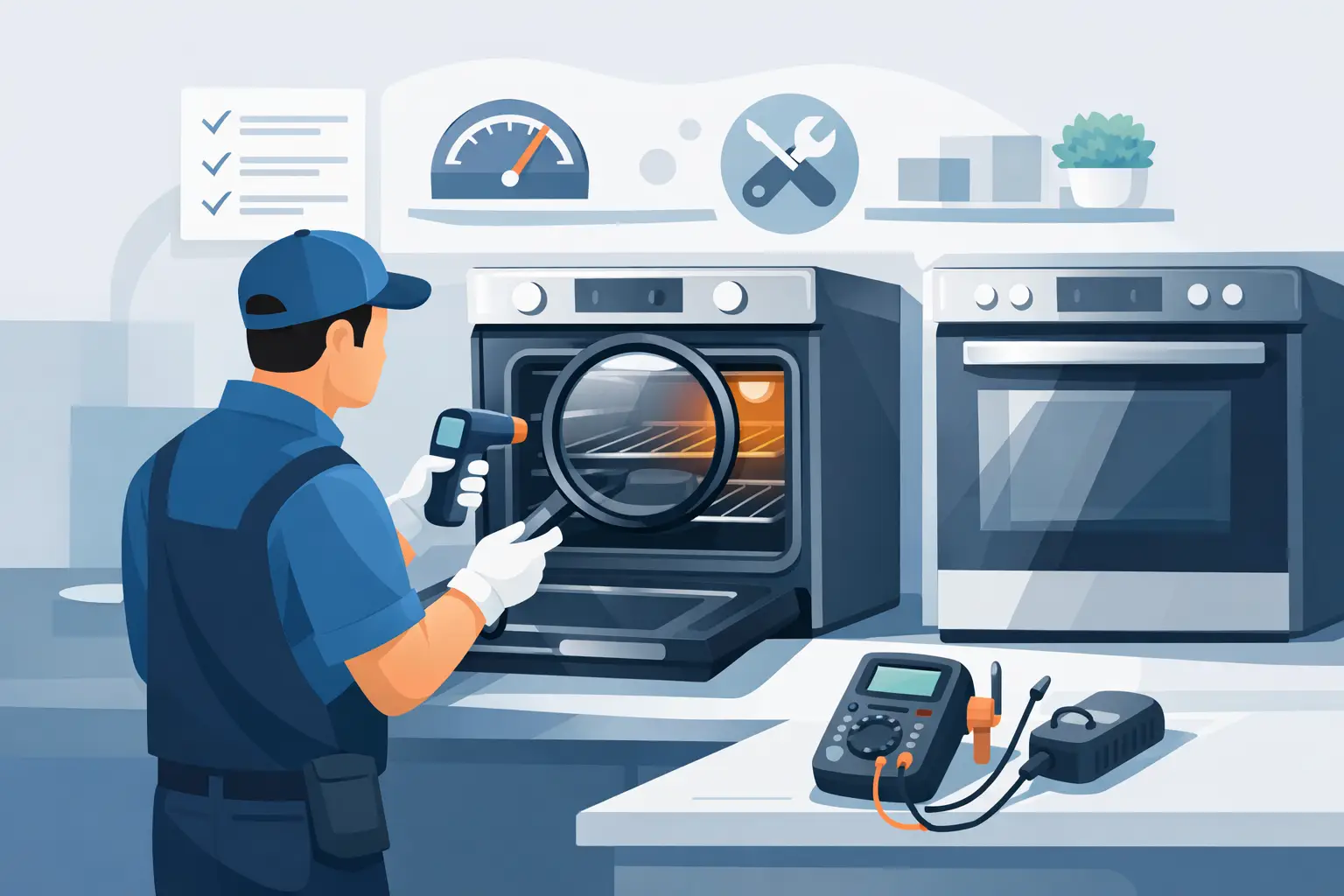
A refurbished commercial oven should be judged by what it does under load, not by how clean it looks in a warehouse. A polished exterior, new door seal and fresh decals can be reassuring, but they do not prove that the heating system, steam generation, controls and safety devices will perform through a busy service. Knowing how to test refurbished ovens protects your capital spend and helps prevent the far greater cost of unexpected kitchen downtime.
For professional kitchens, the right test process depends on the oven type, its fuel source and its intended output. A six-grid Rational combi used for pub service needs a different assessment from a larger roll-in unit destined for a care home or production kitchen. The principle remains the same: verify the machine’s condition, confirm its performance and make sure there is a realistic support route after installation.
Before powering up the oven, ask what work has actually been completed. “Refurbished” has no single industry definition. At one end, it can mean a used oven that has been cleaned and checked over. At the other, it can mean a machine stripped down, inspected by trained engineers, fitted with replacement wear parts, repaired where necessary and fully function-tested before dispatch.
A credible refurbishment record should identify the oven’s model, serial number, age and previous configuration. It should also show the work carried out, particularly replacement parts such as door seals, fan motors, probes, solenoid valves, heating elements, ignition components, filters and control boards. These are not cosmetic details. They are the components most likely to affect reliability, cooking results and future repair costs.
For a combi oven, ask whether the cooking chamber has been descaled, whether the drainage system has been checked and whether the cleaning system has been tested. Water quality has a direct bearing on the life of a commercial combi. An oven that has operated for years with poor water treatment may need more than a surface clean to be ready for a second working life.
The strongest position is to request evidence of testing before the oven leaves the supplier. A proper pre-dispatch test should not be limited to switching the display on. It should run the appliance through the functions your kitchen will rely on.
For electric ovens, this means confirming that each heating circuit operates correctly and that the machine reaches temperature within a reasonable period. For gas models, the test should include safe ignition, stable flame operation and correct response during repeated starts. Gas appliances must be handled and commissioned by appropriately qualified engineers. Do not attempt to remove panels, test gas components or alter settings yourself.
On a Rational combi oven, the test should cover dry heat, combination cooking and steam production. Each mode places demand on different components. An oven may appear to heat well in dry mode while showing weak steam output, poor humidity control or a drainage fault during combination cooking. Run each function for long enough to confirm stable performance rather than simply checking that the programme starts.
Temperature accuracy matters as much as heat-up speed. Compare the set temperature with a reliable calibrated probe or test equipment positioned correctly in the chamber. Some variation is normal, especially as fans cycle and the oven regulates heat, but large or persistent differences should be investigated. If the oven is intended for bakery work, low-temperature cookery or precise regeneration, this check becomes even more valuable.
Listen to the oven while it operates. Fan noise should be consistent, without scraping, rattling or pronounced vibration. A fan that runs but sounds rough may still be approaching failure. Check that fan speed settings respond correctly where applicable, and that airflow feels even across the chamber.
Open and close the door several times once the oven is warm. It should latch firmly without excessive force, and the gasket should seal evenly around the frame. Steam escaping from a damaged seal wastes energy, affects cooking consistency and can create an unpleasant working environment around the pass. Examine the glass, hinges and handle as well. Door repairs can be more expensive than buyers expect, particularly on larger commercial units.
Inspect the cooking chamber closely for corrosion, pitting, damaged racking supports and signs of water sitting where it should drain away. Stainless steel is durable, not indestructible. Heavy chemical use, neglected cleaning and long-term scale can leave lasting damage. Pay particular attention to the area around the drain, behind removable panels where accessible, and around the door frame.
A combi oven’s cleaning programme is an operational feature, not an optional extra. If it is unreliable, staff may avoid using it and the oven’s condition will deteriorate quickly. Run an appropriate cleaning cycle or, where a full cycle is impractical during inspection, see clear evidence that the system has been function-tested.
Confirm that detergent and rinse aid dosing work correctly if the oven uses an automated cleaning system. Check for leaks during filling, steaming, cleaning and draining. The waste water should clear promptly, with no backing up into the chamber. Slow drainage can point to a blockage, a pump issue or an installation problem, so establish whether the fault is within the oven or related to the test site’s plumbing.
Water treatment needs the same attention. Ask what filtration or scale-control arrangement the oven requires and whether it is included in your installation plan. The most reliable refurbished oven can suffer premature boiler, steam-system or valve problems if it is connected to unsuitable water. This is especially relevant in hard-water areas.
Modern commercial ovens are control systems as much as they are heating appliances. Test the display, dial, touch controls, programme selection, timers and alerts. Every button or screen area should respond reliably. Fault codes should be recorded and resolved, not cleared and ignored.
If the oven has a core probe, test it against a known temperature source and confirm it is recognised by the controller. A faulty probe can cause undercooked food, overcooked product and avoidable waste. For kitchens that use programmed cooking, check that relevant programmes can be selected, edited and saved as expected.
It is sensible to ask whether the software is current for the model and whether the unit has been reset appropriately following refurbishment. However, software updates are not a substitute for mechanical condition. A responsive touchscreen cannot compensate for poor steam production, a leaking door or a failing fan motor.
A used oven can offer substantial savings against a new equivalent, particularly when buying premium combi technology. The trade-off is that the buyer needs clarity on condition, included warranty, installation requirements and future parts availability. The cheapest unit is not always the best-value unit if it needs immediate repairs or lacks meaningful support.
Before committing, confirm the electrical supply, gas type where relevant, extraction requirements, water connection, drain position, access route and floor loading. A perfectly tested oven can still become an expensive problem if it cannot be installed correctly. For larger units, measure doorways, turns, lifts and the final kitchen position before arranging delivery.
A specialist supplier should be able to explain the refurbishment standard in plain terms, provide technical guidance and support commissioning. Island Catering Equipment Co. refurbishes and tests Rational ovens through trained technical expertise, giving operators a clearer route from purchase to productive service.
The most useful test is the one that reflects your actual kitchen. Ask for proof that the oven can heat, steam, drain, clean and control cooking as it was designed to do, then make sure installation and ongoing servicing are planned before it arrives. That approach gives a refurbished oven the best chance of delivering dependable output from its first service onward.





No account yet?
Create an Account