


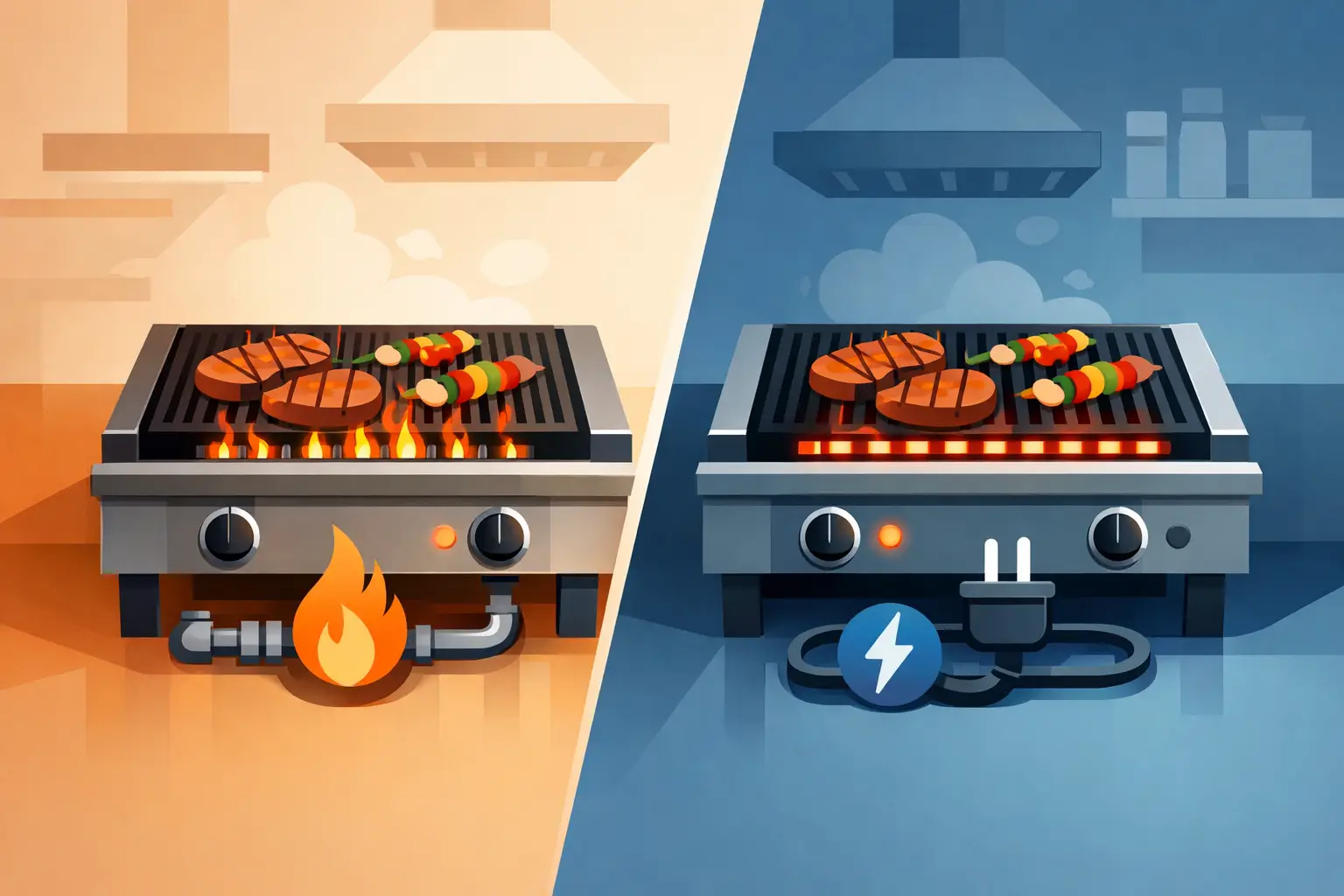
A gas or electric chargrill can produce the same menu headline – seared steaks, marked chicken, charred vegetables and burgers with real visual appeal – but the two machines place very different demands on a commercial kitchen. The right choice is not simply about fuel preference. It comes down to service volume, available utilities, ventilation, staff workflow, menu consistency and the cost of operating the appliance over its working life.
For a busy restaurant or pub, a chargrill is often one of the hardest-working pieces of cooking equipment on the line. Specify it incorrectly and the consequences show up quickly: slow recovery during the rush, uneven results, unnecessary cleaning time or an installation that costs more than expected. Start with how the grill must perform at peak service, then assess which fuel type supports that requirement.
Commercial chargrills are designed for direct, high-temperature cooking. Their open grates create the distinctive branding and caramelisation customers expect, while fats and juices contribute to flavour as they reach the heat source below. That is precisely why chargrills demand careful consideration of heat control, extraction and daily cleaning.
Gas models heat ceramic radiants or lava rock beneath the cooking surface, depending on the design. Electric chargrills use elements to heat the grill surface and, on some units, radiants or heat-retaining components. Both can deliver strong results, but their response time, operating characteristics and site requirements differ.
The key question is not which option is universally better. It is whether your kitchen needs immediate high-output heat and flexible control, or a controlled electric solution that suits the building, available services and menu.
A gas chargrill is usually the first choice where the menu is built around grilled proteins and the kitchen faces sustained peak demand. Gas burners bring the grill to temperature quickly and provide immediate adjustment at the controls. When a section of the grill is heavily loaded with steaks or burgers, that responsiveness gives experienced chefs more control during service.
Gas also makes sense for kitchens already designed around a gas cooking suite. The supply is in place, the extraction canopy has been specified for gas appliances, and chefs are comfortable managing multiple heat zones across the cooking surface. A wider gas chargrill can provide separate working areas for meat, fish and vegetables, helping to protect flavour and support a faster brigade.
For steakhouses, grill-led restaurants, hotels with busy evening covers and pubs serving high volumes of burgers, gas offers the recovery needed to keep food moving. It is particularly effective when the grill is continuously loaded rather than used for occasional batches.
That performance must be balanced against installation and compliance. A gas appliance requires a suitable gas supply, correct isolation arrangements and professional installation by a suitably qualified commercial gas engineer. The extraction system must also be capable of handling heat, grease-laden vapour and combustion products. These costs should be established before the appliance is ordered, not after it arrives on site.
Gas chargrills also need disciplined cleaning. Burners, radiants or lava rock, grease collection areas and cooking grates must be maintained properly. A neglected grill can produce uneven heat, excess smoke and flare-ups, all of which affect food quality and the working environment.
An electric chargrill is often the practical answer where gas is unavailable, restricted by the building or undesirable for the operation. It can be a strong option for smaller professional kitchens, sites in managed buildings, counter-service operations and venues seeking a more straightforward appliance connection.
Electric units provide stable, controllable heat once at operating temperature. They are well suited to menus with steady rather than relentless grill demand, including cafés, hotels, schools, care settings and kitchens using a chargrill as one station among several. Operators can often set precise zones and maintain repeatable cooking results with less variation between staff members.
Electric is not automatically lower cost to run. Electricity tariffs can be significantly higher than gas tariffs, and the true calculation depends on local contracts, appliance efficiency, hours of use and how often the grill is left idling. A lower purchase or installation cost may be offset by energy use over time, while a difficult gas installation may make electric the more commercially sensible option.
Heat-up and recovery can also be slower than on a comparable gas model, although this varies by manufacturer, power rating and grill construction. An electric chargrill should therefore be specified with realistic production demand in mind. If the grill will be expected to cook dozens of steaks in a short period, check its rated output and recovery performance rather than assuming the footprint tells the full story.
Electric equipment still creates grease, smoke and heat. It may reduce combustion-related requirements, but it does not remove the need for suitable ventilation and fire safety planning. A chargrill remains a high-heat, grease-producing appliance regardless of its power source.
The purchase price is only one part of the decision. A commercial buyer should consider the total installed and operating cost, including the appliance, delivery, positioning, utility work, canopy capacity, commissioning, cleaning and planned maintenance.
A gas chargrill may offer attractive energy economics and excellent peak output, but a new gas run, increased meter capacity or extraction alterations can change the capital cost substantially. An electric unit may be simpler to install, yet a high-powered three-phase supply could require electrical upgrades. There is no meaningful answer without checking the services available at the exact position where the appliance will sit.
Ventilation deserves particular attention. Chargrills create smoke and airborne grease, especially when cooking fatty products. The canopy, filters, ductwork and fan must be correctly sized and maintained for the duty. Inadequate extraction is not a minor inconvenience. It can lead to uncomfortable working conditions, grease build-up, poor cooking performance and issues with building management or insurers.
Start by looking at the heaviest 30 minutes of a normal service. Count the portions likely to be on the chargrill at once, identify the proteins being cooked and consider whether other menu items need a dedicated section of the grate. A compact grill may be adequate for a lunch-led café but restrictive for a 100-cover restaurant with a steak promotion.
Grate area matters, but usable heat zones matter just as much. A larger appliance gives room to move food away from the most intense area, rest products briefly and keep vegetables separate from meat. For menus with different cooking temperatures, independent controls provide greater flexibility than one large, single-zone cooking surface.
Consider the cooking surface itself. Heavy-duty cast iron grates retain heat and produce pronounced marks, but need regular seasoning and cleaning. Stainless steel alternatives can be easier to maintain in some operations, although they may cook differently and provide less heat retention. The best choice depends on the finish your menu requires and the cleaning routine your team can consistently follow.
Grease management should not be overlooked. Removable drip trays and accessible components reduce end-of-day labour and encourage correct cleaning. On a busy line, an appliance that is awkward to strip down will eventually be cleaned less thoroughly than it should be.
Before committing to a model, confirm the appliance dimensions, overall depth, weight, gas type or electrical supply, total power rating and clearances required around the unit. Measure access routes as well as the final cooking line. Doorways, stairs, tight corners and counter heights can all affect delivery and positioning.
Ask how the unit is serviced and whether key parts are readily available. Grates, burners, elements, thermostats, ignition components and grease trays are working parts, not afterthoughts. Fast access to parts and competent engineers reduces the risk that a relatively minor fault becomes extended downtime.
For used commercial equipment, condition and preparation standards are especially important. A professionally refurbished chargrill should be inspected, cleaned, tested and assessed for safe operation before dispatch. It should never be treated as a shortcut around proper installation, commissioning and ongoing maintenance.
Choose gas when you need rapid response, sustained high output and already have the right gas and extraction infrastructure. Choose electric when the site favours electric installation, demand is more controlled, or gas provision would create disproportionate cost and disruption. In both cases, buy enough capacity for your busiest realistic service rather than your quietest shift.
A chargrill earns its place by delivering consistent food quickly, every day. Island Catering Equipment Co. can help commercial operators assess the equipment specification alongside installation, servicing and long-term support, so the grill works as hard as the kitchen around it.





No account yet?
Create an Account