


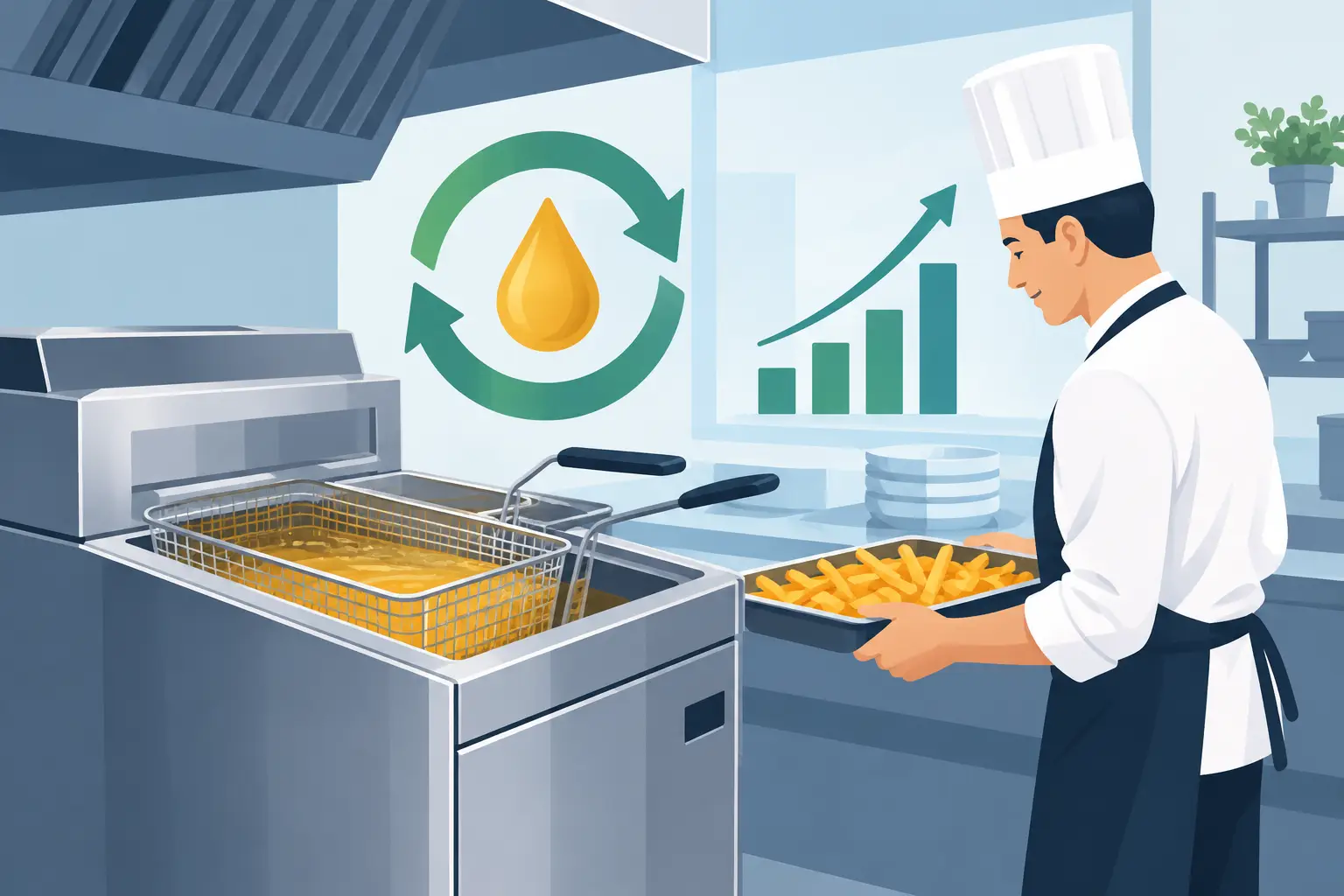
A fryer can look perfectly adequate on a specification sheet, yet become the main cause of delays during a Friday evening service. The difference is often commercial fryer recovery: the fryer’s ability to bring oil back to its set temperature after cold food is loaded. For high-volume kitchens, this is not a minor technical detail. It directly affects ticket times, product consistency, oil life and the number of covers a section can handle.
A fryer with the right tank capacity but insufficient recovery will struggle when demand peaks. Chips take longer, breaded products absorb more oil, and staff may respond by overloading baskets or increasing the thermostat setting. Neither is a reliable answer. Recovery rate needs to suit the menu, the busiest trading period and the way the kitchen actually operates.
Every time food enters hot oil, it removes heat from the fryer. Water within the product turns to steam, while the cold mass of the food reduces the oil temperature. Commercial fryer recovery is the speed at which the burner or element replaces that lost heat and returns the oil to the selected cooking temperature.
Recovery is commonly discussed in relation to power input, measured in kW, and in practical terms such as the amount of food a fryer can produce per hour. A higher kW rating generally supports faster recovery, but it is not the only measure that matters. Tank design, oil volume, heat transfer, basket loading, controls and the condition of the fryer all influence real-world performance.
A large tank contains more oil and can provide useful thermal stability, particularly where batches are substantial. However, more oil also takes longer to heat from cold and costs more to maintain and replace. A compact, high-output fryer may recover very quickly but may not offer the oil capacity needed for a broad menu. The correct choice depends on service pattern rather than headline power alone.
When oil temperature drops too far and remains low, food cooks more slowly. This gives coatings and potato products longer to absorb oil, producing a greasy finish rather than a crisp one. Colour can become uneven, while the interior may be ready before the exterior has reached the desired texture.
For operators, the problem is rarely limited to one poor batch. Repeated temperature drops place greater strain on the oil. Crumbs, starch and carbonised debris break down more quickly at unstable cooking conditions, shortening filtration intervals and increasing oil replacement costs. A fryer that maintains temperature consistently helps protect both the finished product and a significant ongoing consumable.
This matters especially for menus centred on fried chicken, fish, chips, onion rings, battered products and frozen appetisers. These products are often cooked in quick succession at peak periods, which creates a demanding recovery cycle. A pub serving occasional sides has a different requirement from a takeaway producing continuous baskets of chips, even if both use similar floorstanding fryers.
It is easy to assume that a larger fryer automatically gives greater output. In practice, the usable output is governed by how much product can be loaded without causing an excessive temperature drop, and how quickly the fryer recovers before the next basket is required.
Overloading any fryer slows recovery and compromises results. The aim is not to choose a unit that permits the biggest possible basket load, but one that maintains a stable cooking environment at the batch size your team needs during the busiest 15 to 30 minutes of service. That is the point at which equipment capability should be assessed.
The fuel type and power rating are the obvious starting points. Gas fryers are widely specified in busy commercial kitchens because they offer strong heat input and can recover rapidly. Electric fryers can also deliver excellent results, particularly models with efficient immersed elements and accurate electronic controls. The best option depends on available services, ventilation design, running costs, site restrictions and the expected workload.
Tank and heat-exchange design also make a material difference. On gas models, tube-fired and open-pot designs transfer heat into the oil in different ways. Some designs are particularly suited to heavy chip production; others make cleaning and filtering more straightforward. On electric fryers, element position and watt density influence how effectively heat is transferred and how easily the tank can be cleaned.
Controls matter because a fryer needs to respond accurately, not simply generate heat. Reliable thermostatic control limits unnecessary temperature swings, while programmable settings can help teams cook different products consistently. Safety features such as high-limit thermostats and cool zones are equally valuable, but they should not be mistaken for recovery performance. They protect the appliance and oil condition rather than increase its production capacity.
Finally, installation and maintenance affect the recovery a fryer can achieve. Restricted gas supply, incorrectly sized electrical provision, poor ventilation or a build-up of debris around burners and elements can reduce performance. A fryer should be commissioned properly and maintained by qualified engineers, particularly where gas safety checks and combustion performance are involved.
Start with the busiest realistic service, not the average day. Consider what must be cooked simultaneously, how many portions are required per hour and whether the fryer is dedicated to one product or shared across the menu. A school kitchen may see a sharp, predictable lunchtime surge. A restaurant may have intense but variable demand across several hours. A delivery-led operation may face repeated spikes driven by order platforms.
Ask suppliers for practical guidance on production capacity and recommended batch sizes for the foods you serve. A kW figure is useful, but it should be considered alongside tank capacity, basket configuration and the manufacturer’s expected output. If you are replacing an existing fryer, identify where it falls short. Is the issue slow heat-up from cold, poor recovery between baskets, insufficient oil capacity, or a filtration process that takes the unit out of service for too long?
It is also worth considering the number of tanks. Two smaller independent tanks can offer more flexibility than one large tank, allowing separate cooking temperatures or dedicated oil for allergen control. They also provide a degree of continuity if one side requires attention. Conversely, a single larger tank may be the more efficient choice for a focused, high-volume chip operation. There is no universal best layout.
The fryer should be up to temperature before the service rush begins, with oil filled to the correct level and baskets clean and dry. Wet or heavily iced product causes a sharp temperature drop and can create a safety risk, so frozen food should be handled in line with the manufacturer’s instructions.
Train staff to load consistent batches rather than adding product little and often without allowing the oil to recover. Timers and product-specific programmes help here, particularly where different team members work the section. Filtering oil at suitable intervals is equally important. Clean oil transfers heat more predictably and supports better results, while a clean tank allows burners, tubes and elements to work as intended.
Do not attempt to compensate for poor recovery by setting the fryer hotter than the product requires. This can darken coatings before the centre is cooked and accelerate oil degradation. If the fryer cannot keep pace at the correct cooking temperature and batch size, the equipment specification or operating method needs to change.
A fryer that has become slow to recover is not always beyond repair. Faulty thermostats, worn elements, burner issues, poor gas pressure and neglected cleaning can all be investigated by a competent service engineer. Repairs are often sensible where the unit is otherwise sound and downtime can be controlled.
However, repeated performance issues, rising repair costs and an inability to meet peak demand can make replacement the more commercial decision. A newer fryer with better controls, efficient heat transfer and a suitable tank configuration may reduce waiting time, protect oil quality and give the kitchen capacity to trade confidently. For operators managing capital expenditure, professionally refurbished commercial equipment can also provide a practical route to dependable performance, provided it has been tested thoroughly and backed by proper technical support.
The right fryer is the one that holds temperature through your hardest service, not the one with the lowest purchase price or the largest quoted tank. Assess recovery against your actual menu and peak output, then specify equipment that gives the brigade enough headroom to cook consistently when it matters most.





No account yet?
Create an Account