


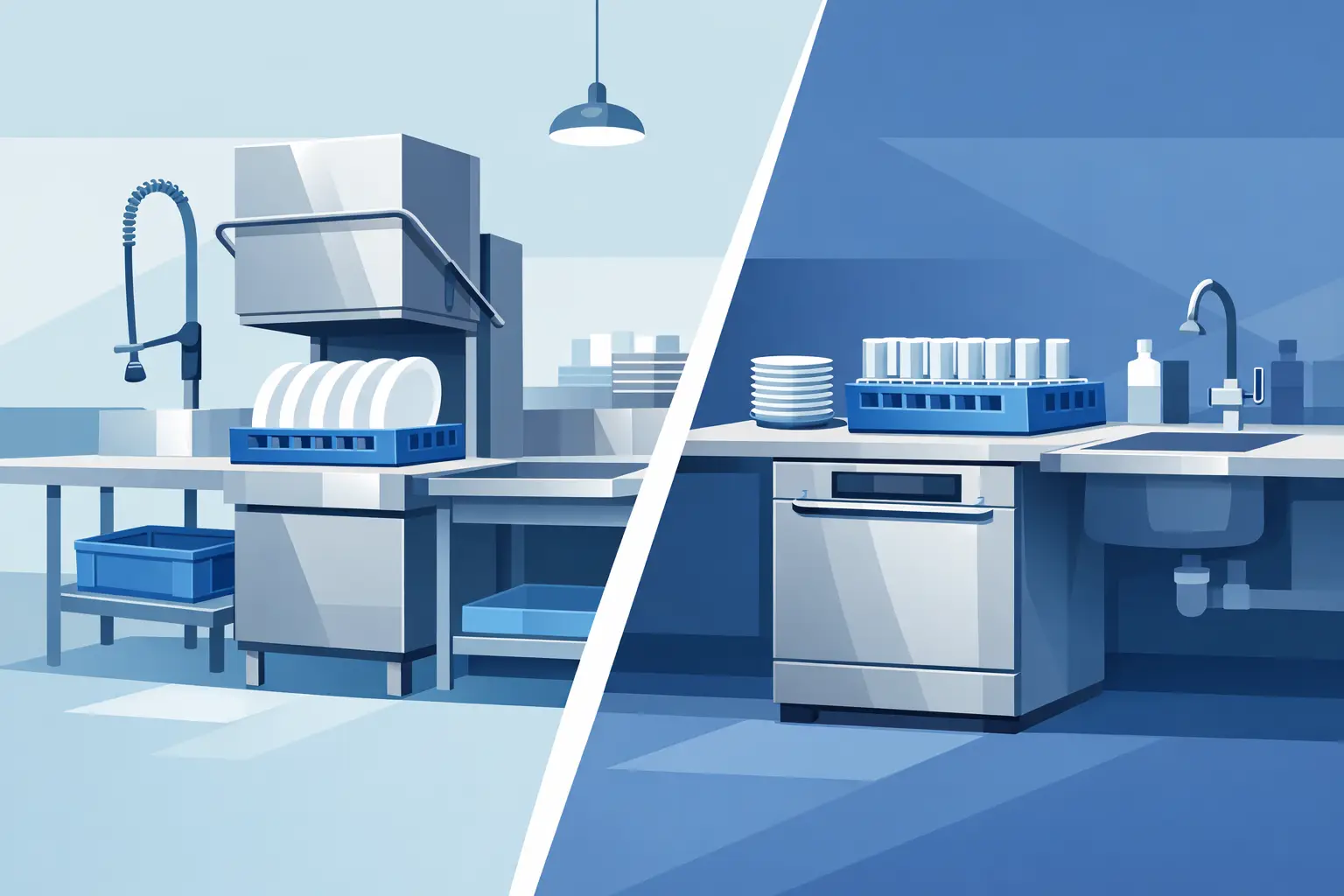
The pass through dishwasher versus undercounter decision is usually made at the point service starts to slow down. Dirty plates build at the pot wash, clean crockery is needed back on the pass, and staff are spending too much time loading small machines or carrying racks across the kitchen. The right commercial dishwasher will improve that flow. The wrong one can create a bottleneck, waste valuable floor space and add unnecessary labour to every service.
For most professional kitchens, the choice comes down to volume, available space and how the wash-up area is organised. A pass-through dishwasher is built for sustained rack washing at speed. An undercounter dishwasher is compact, accessible and often the more practical answer for lower-volume sites. Neither is automatically better. The machine must match the operation around it.
An undercounter dishwasher sits beneath a standard-height worktop and is loaded from the front, much like a domestic machine but engineered for commercial use. It normally takes a 500 mm x 500 mm rack and is suited to sites where wash-up volumes arrive in manageable batches.
A pass-through dishwasher, also called a hood dishwasher, is a freestanding machine with a lifting hood. Staff slide a rack in at one side, lower the hood to run the cycle, then raise it and move the clean rack to the exit side. This layout supports a proper dirty-to-clean workflow and is designed to keep racks moving through a busy pot wash.
The difference is not simply the number of racks a machine can wash per hour. It is the amount of handling required around each cycle. A pass-through model gives two people room to work either side of the machine, or allows one operator to maintain a consistent rhythm during peak periods. An undercounter machine asks the operator to bend, load and unload from the same position, which is perfectly workable in a smaller operation but less efficient when demand rises.
An undercounter dishwasher is often the sensible choice for cafés, small restaurants, bars, pubs, bakeries, office kitchens and satellite serving areas. It is also a strong option where the machine is mainly washing glasses, cups, side plates and light food service items rather than dealing with a continuous stream of full meal-service racks.
Its biggest advantage is footprint. A compact machine can fit into an existing counter run and may avoid a costly redesign of the wash-up area. In a tight kitchen, that space can be more valuable than the higher theoretical output of a hood machine. It also gives staff immediate access to washed items close to the bar or service point.
Capital cost is normally lower too. For operators replacing an ageing machine or fitting out a smaller venue, that can make an undercounter unit the more commercially sensible investment. Modern professional machines can still deliver short cycles, reliable rinse temperatures and good results when paired with the correct detergent, rinse aid and water treatment.
There are limits. An undercounter dishwasher can become a serious pinch point in a 100-cover restaurant, hotel breakfast operation or high-turnover canteen. If staff are stacking dirty racks on the floor while waiting for a cycle to finish, the kitchen has outgrown the machine. Buying another compact unit may help in some layouts, but it can also duplicate labour and servicing requirements rather than solving the workflow problem.
A pass-through dishwasher is intended for busy, centralised wash-up areas. Restaurants with heavy lunch and dinner turns, schools, care homes, hotels, contract caterers and event venues usually benefit from its higher throughput and clearer operating flow.
A typical hood machine can process significantly more racks per hour than an undercounter unit when fed continuously. Actual output depends on cycle selection, incoming water temperature, staff loading discipline and the time needed to clear food waste before washing. Published rack-per-hour figures are useful for comparison, but should not be treated as the number a kitchen will achieve during every service.
The practical gain is labour efficiency. A properly planned pass-through station may include a soiled landing table, pre-rinse spray, dishwasher, clean exit table and rack storage. Staff scrape and rack items on one side, then transfer clean racks directly towards storage or service. This reduces crossing paths, keeps crockery off the floor and makes the wash-up area easier to manage under pressure.
Hood machines also tend to offer a more ergonomic working height. Operators are not repeatedly bending to load a low-level door, particularly when inlet and outlet tabling is specified correctly. Over a long shift, that matters. Efficient equipment should reduce strain as well as cycle times.
The trade-off is that a pass-through machine needs a bigger commitment. It requires floor space, suitable drainage, water and electrical provision, and enough clearance above the raised hood. Steam and heat must also be considered. Depending on the model and room conditions, a type A hood, canopy or suitable extraction arrangement may be needed to manage vapour in the wash-up area.
Before comparing prices, assess what is actually being washed during the busiest 30 to 60 minutes of the day. Count the racks, not just the covers. A menu using multiple small plates, sharing dishes and dessert crockery can create far more wash-up volume than the cover count suggests. Glassware, utensils, gastronorm containers and kitchen equipment may also compete for the same machine.
An undercounter dishwasher suits a kitchen where racks can be washed in short bursts without delaying service. A pass-through model suits an operation where racks need to move almost continuously, particularly when the kitchen cannot afford to hold dirty items until after the rush.
Also consider future trade. A machine that copes only on a quiet Tuesday may be a false economy if weekends, functions or seasonal demand already push it to capacity. Conversely, a large hood dishwasher is not a good investment if it will run half-empty for most of the day and force an expensive alteration to a compact kitchen.
Commercial dishwashers are not plug-and-play purchases in every case. Electrical supply is a key consideration. Smaller undercounter machines may be available in single-phase formats, while high-output undercounter and pass-through machines are commonly specified for three-phase power. The correct supply affects heat-up time, recovery between cycles and overall performance.
Water quality is equally important. Hard water causes scale on heating elements, reduces washing efficiency and leaves marks on glassware and crockery. A correctly sized water softener or integral treatment system protects the machine and helps maintain a consistent finish. For glass-heavy venues, reverse osmosis may be worth considering where spotless presentation is essential.
Drainage, waste positioning and chemical dosing should be planned before delivery. So should access for servicing. A commercial machine needs room for engineers to inspect pumps, boilers, hoses and electrics. Boxing it tightly into a counter run may look neat but can turn a straightforward repair into a disruptive job.
For pass-through machines, table configuration deserves the same attention as the dishwasher itself. Left- or right-hand entry, tabling length, pre-rinse position and clean-rack storage should follow the natural direction of work. A poorly arranged hood machine can lose much of the productivity it was bought to deliver.
The purchase price is only one part of the decision. Water, electricity, chemicals, labour and downtime all affect the cost of ownership. Short-cycle commercial dishwashers are designed to recover quickly, but selecting the fastest setting for heavily soiled items can lead to rewashes. That wastes more time and resource than choosing the right programme first time.
A pass-through dishwasher may use more energy overall simply because it processes more ware, but it can lower labour cost per rack in a busy operation. An undercounter model generally has lower upfront and standby costs, yet may cost more in staff time if one person is continually waiting, loading and unloading during service.
Reliability comes back to specification, installation and routine care. Staff should remove food debris, clean filters daily, check wash and rinse arms, and leave the machine clean at close-down. Water treatment must be maintained, not ignored once fitted. These basic tasks protect wash quality and help prevent avoidable callouts.
When comparing new and refurbished equipment, look beyond the headline price. Confirm the machine’s condition, the work completed during refurbishment, testing standards, available warranty and access to parts and engineering support. For a business-critical item such as a dishwasher, support after installation carries real value.
Choose an undercounter dishwasher when space is restricted, volume is moderate and staff can comfortably manage batch washing without holding up service. Choose a pass-through dishwasher when the wash-up is a production line in its own right and speed, ergonomics and rack flow justify the larger footprint.
The best specification starts with your busiest service, your available utilities and the route a dirty plate takes back to the clean stack. Island Catering Equipment Co. can help professional operators assess those practical requirements, so the dishwasher supports service rather than becoming the next reason it slows down.





No account yet?
Create an Account