


When buyers ask which Rational oven size they need, they are usually asking a bigger question – how much production can one oven realistically carry without slowing service, wasting energy or taking up space they do not have. Getting that answer right matters, because an oversized unit ties up budget and floor area, while an undersized one becomes a bottleneck from the first busy shift.
For most professional kitchens, the choice comes down to output, tray format, menu mix and workflow. Rational ovens are not sized just by external dimensions. The real decision is about how many gastronorm trays or bakery trays you need to run at one time, how often the oven will turn during service, and whether the oven is supporting one core service period or multiple production tasks across the day.
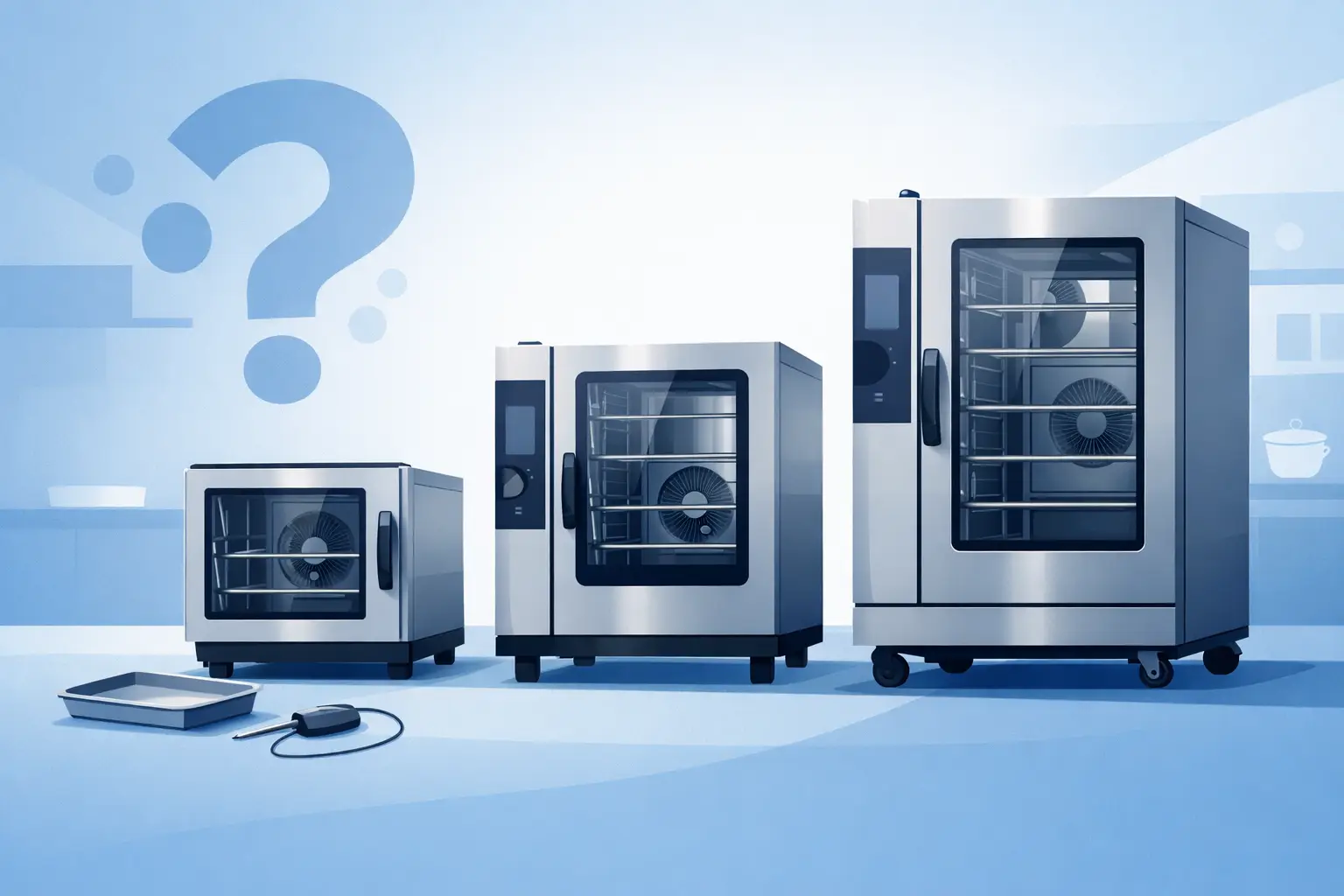
The quickest way to narrow it down is to start with tray capacity. In practical terms, most operators are choosing between compact units, standard 6-grid and 10-grid models, and larger floor-standing ovens for high-volume sites.
A smaller Rational unit is often the right fit for cafés, pubs with a focused menu, smaller restaurants, garden centres, staff dining counters and sites where the oven supports service rather than carrying the whole kitchen. These models save space and still offer the control and consistency Rational is known for, but they are not built for heavy, all-day throughput in a busy production environment.
A 6-grid oven is where many commercial kitchens land. It offers enough capacity for regular restaurant service, banqueting prep in moderate volumes, school dining, care catering and multi-function cooking without dominating the kitchen. For operators replacing older convection ovens or mixed cooking equipment, this size often gives the best balance between output and footprint.
A 10-grid oven suits kitchens that need more production headroom. Hotels, larger restaurants, contract caterers, schools with larger meal counts and sites handling breakfast, lunch and evening service from the same pass often benefit from the extra capacity. The advantage is not just more trays. It is better workflow during peak periods, fewer reloads and more flexibility when different items need to cook at the same time.
The largest floor-standing models are a different level again. These are designed for major volume: central production kitchens, large-scale institutions, high-output banqueting, transport catering and operations where the oven is expected to run hard for long periods. If your team is regularly cooking in batches because the current oven cannot keep pace, this is where larger capacity starts to pay back quickly.
The most common mistake is buying purely on cover count. Covers matter, but they do not tell the whole story. A 120-cover restaurant with a tight menu and staggered service may need less oven capacity than an 80-cover venue offering a broad menu with heavy oven dependence.
Take a pub kitchen as an example. If the oven is mainly handling regenerating, roasting joints, tray bakes and occasional vegetables, a smaller unit may be more than enough. If that same pub is also using the oven for breakfast items, à la carte service, desserts, Sunday roasts and prep for functions, capacity disappears quickly.
The second mistake is ignoring tray size and product format. Gastronorm 1/1 capacity is standard for many professional kitchens, but bakeries and pastry operations may need different tray formats. If your production relies on bakery trays, proving systems or specific loading patterns, the right oven size is the one that fits the actual way your kitchen works, not the one that looks sufficient on paper.
The third mistake is failing to allow for growth. If your current volume already stretches the team at peak times, replacing like for like may leave you with the same problem in a better-looking cabinet. It is usually more cost-effective to buy with sensible headroom than to outgrow the oven within a year.
There is no single answer to which Rational oven size is correct because service style changes the calculation.
In a restaurant kitchen, speed between batches can matter as much as total capacity. If the menu includes roasted meats, fish, vegetables, gratins and desserts, the oven needs to support varied cooking throughout prep and service. In that setting, a 6-grid model is often a practical starting point, while a 10-grid gives more breathing room for busy trading periods and functions.
In schools and care settings, volume and repeatability usually matter more than menu complexity. Consistency, ease of loading and dependable batch production tend to push buyers towards larger capacities, especially where meal times are fixed and there is little room for delay.
Hotels are more complex. Breakfast service, banqueting, room service and restaurant production can all draw on the same oven. This is where many sites benefit from stepping up a size, because the oven is rarely doing one job at a time.
For bakeries and café production, the right answer depends on whether the oven is used for finishing, baking, reheating or mixed food production. Compact or mid-size units can perform very well in front-of-house or satellite setups, but once output becomes schedule-driven, the case for more tray capacity becomes stronger.
Even if the production case points to a larger model, the kitchen still has to support it. Floor space is obvious, but access routes, door clearance, loading space and cleaning access are just as important. A bigger oven that creates congestion around the pass or blocks prep movement can reduce efficiency rather than improve it.
Utilities also matter. Power supply, water treatment, drainage and ventilation need to be checked properly before purchase. This is particularly important when replacing older equipment or moving from a smaller oven to a higher-capacity combi. A unit that looks right on output still needs to fit the practical conditions on site.
This is one reason experienced buyers do not treat oven size as a simple online tick-box exercise. The best result comes from matching production demand with the realities of the kitchen environment.
Budget affects size choice more than many operators admit. Some kitchens compromise on capacity because the preferred new model sits above budget. That can be a false economy if the result is an oven that limits service from day one.
A professionally refurbished Rational can change that calculation. For many operators, it opens the door to a larger or higher-spec model without the cost of buying new. That is especially relevant for independent restaurants, pubs, schools and growing catering businesses that need proper production capacity but still have to watch capital spend closely.
What matters here is refurbishment standard. Commercial buyers should expect work carried out by trained technicians, proper testing, replacement of worn components where needed and a clear understanding of the oven’s condition before it reaches site. Done properly, refurbished equipment is a practical route to stronger value, not a compromise.
If you are still weighing up which Rational oven size is best, start with four questions. How many trays do you need working at the busiest point of service? How much of your menu depends on the oven? How often will the oven turn across a full day? And is your business likely to grow or broaden its offer within the life of the machine?
If your answers point to light to moderate use, restricted space and a supporting kitchen role, a compact or smaller-capacity model may be the sensible choice. If the oven sits at the centre of service, a 6-grid is often the commercial sweet spot. If your kitchen runs hard, serves multiple dayparts or handles volume with little margin for delay, a 10-grid or larger model is usually the safer investment.
At Island Catering Equipment, we see the same pattern repeatedly: the right oven size is the one that protects service under pressure, not the one that only works when the kitchen is quiet. Buy for the busiest hour, allow for realistic growth, and the oven will earn its keep from the first week.





No account yet?
Create an Account