


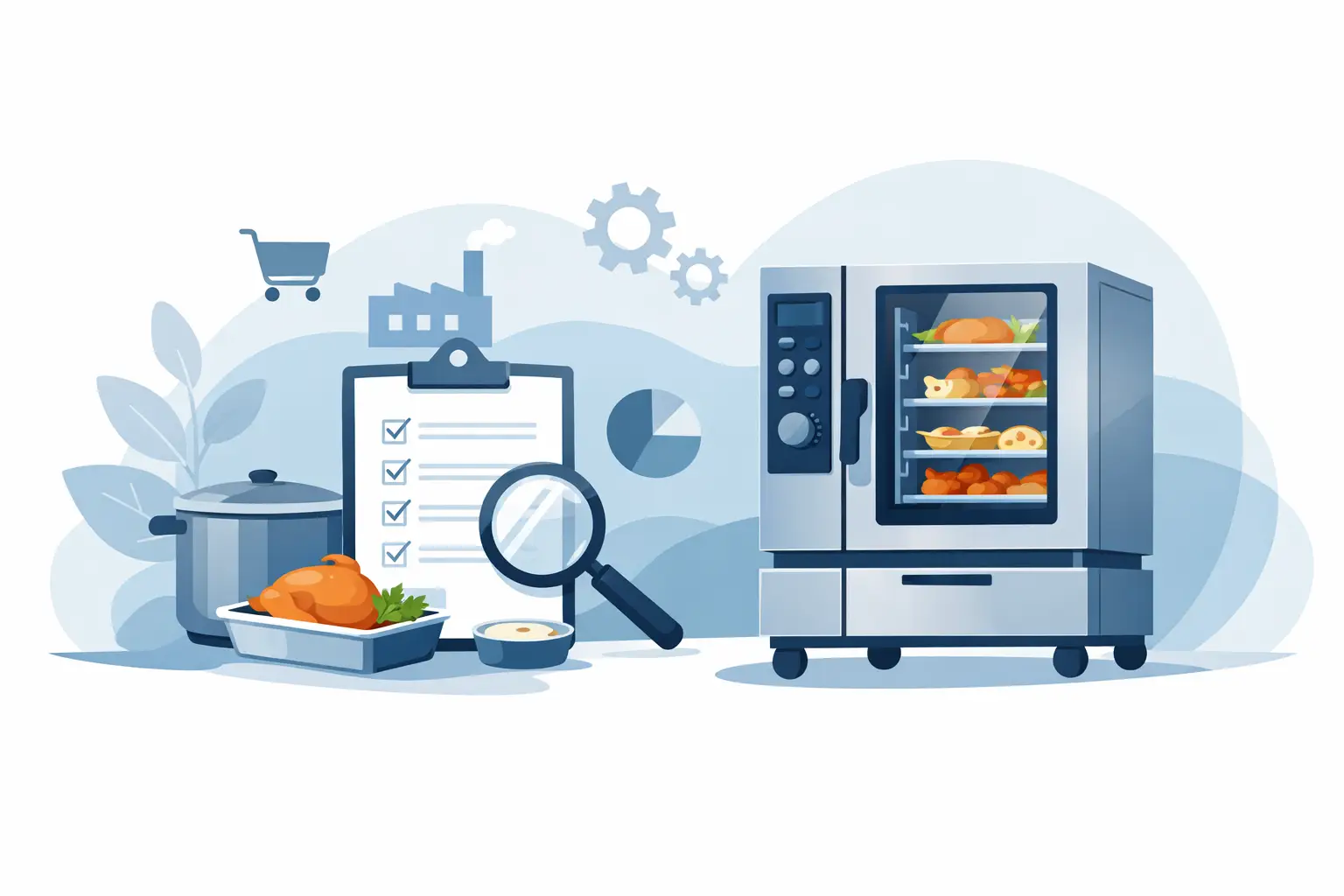
A combi oven that is too small will bottleneck service. One that is too large will waste energy, floor space and capital. That is why any commercial combi oven buying guide worth reading has to start with output, not brand badges or headline price.
For most professional kitchens, the right combi oven quickly becomes the centre of production. It handles roasting, steaming, baking, regeneration and finishing in one footprint. Buy well and you get consistency, labour savings and better control at peak times. Buy badly and you inherit avoidable downtime, slower service and an expensive piece of equipment that never quite fits the operation.
The first question is simple: what does your kitchen need the oven to do every day?
A pub kitchen serving 120 covers across lunch and dinner has a very different requirement to a care home producing regular batch meals, or a bakery using a combi for proving and bake cycles. The oven has to match your menu, service pattern and staff capability. In practice, that means looking at tray capacity, production volume, programmability, cleaning, extraction requirements and service support as one decision rather than separate ones.
Combi ovens appeal because they are versatile, but versatility can tempt buyers into over-specifying. Extra features only make commercial sense if your team will actually use them. If the oven will mainly roast joints, steam vegetables and regenerate plated meals, you may not need every advanced cooking function available. On the other hand, if consistency across multiple staff members matters, programmable cooking intelligence can pay for itself quickly.
Capacity is usually where buyers get it wrong. They either buy for the busiest single hour and overspend, or buy for average demand and struggle every weekend.
A practical way to assess size is to look at your peak production windows. How many portions need to be cooked, regenerated or held within a defined period? How many trays do you run now, and how often are staff waiting for oven space? A six-grid unit may suit a smaller site or a prep-heavy kitchen with staggered production. A ten-grid or twenty-grid machine is often the better fit for hotels, schools, contract caterers and larger restaurants where throughput matters more than compact footprint.
Tray size also matters. Gastronorm and bakery dimensions change what the oven can realistically do in your kitchen. If the rest of your operation is built around a certain tray standard, forcing a mismatch creates friction every day.
There is no universal winner between petrol and electric combi ovens. The right choice depends on infrastructure, energy costs, install constraints and how the kitchen is laid out.
Petrol models can be attractive where sites already have a suitable supply and want to manage running costs over heavy use. Electric units can be simpler for some installations and may suit sites where petrol access is limited or ventilation planning is tighter. What matters is confirming the realities of the building before you commit. A cheaper oven on paper is not cheaper if installation upgrades wipe out the saving.
This is also where experienced supplier input matters. Power requirements, water treatment, drainage and canopy considerations should be checked early, not after the unit arrives.
A combi oven is only as good as the people operating it. In kitchens with experienced chefs, more manual control may be welcome. In operations with mixed-skill teams, staff turnover or multi-site consistency requirements, intuitive controls and programme storage become much more valuable.
Touchscreen systems, recipe programmes and intelligent cooking modes help standardise output. That can reduce training time and limit variation between shifts. For care settings, education catering and chain operations, that consistency is often a stronger buying factor than headline maximum temperature or extra niche functions.
There is a trade-off. More advanced control systems can mean a higher initial spend, and some teams will never use the full feature set. The best buying decision is not the oven with the longest specification sheet. It is the one your staff will use properly under service pressure.
Cleaning is one of the biggest practical differences between models, and it affects labour, hygiene and long-term reliability.
Automatic cleaning systems save time and encourage better maintenance discipline. In busy kitchens, that matters. If staff have to carry out a more manual clean at the end of a long shift, standards often slip. Grease build-up and poor chamber condition then start to affect performance.
You should also consider detergent cost, wash cycle length and how easy the oven is to keep clean between deep cleans. A cheaper machine with awkward cleaning routines can cost more over time in labour and service issues. For most buyers, especially high-output sites, an effective automatic cleaning system is not a luxury. It is part of keeping the oven working as it should.
For many operators, this is the key question in any commercial combi oven buying guide.
A new oven gives you the latest interface, current-generation efficiency features and manufacturer-backed peace of mind. It is often the right route for new kitchen builds, premium sites or businesses standardising equipment across several locations.
A professionally refurbished oven can offer far better value where budget is tighter but output expectations remain high. That is particularly true with premium brands such as Rational, where build quality and market familiarity are already proven. The critical point is refurbishment standard. A used oven is only a good buy if it has been restored properly, tested rigorously and backed by genuine technical support.
That is why buyers should look beyond the word refurbished and ask better questions. Who carried out the work? Were trained technicians involved? What parts were replaced? How was the unit tested? Is aftersales support available if a fault develops? A lower price means very little if the oven arrives tired, unreliable or unsupported.
Commercial kitchens do not just buy ovens. They buy uptime.
A combi oven is a production asset. If it fails, service can slow or stop altogether. That is why service capability, parts access and technical support should be part of the buying decision from day one. Too many buyers focus entirely on ticket price and only think about engineers once the oven is down.
Strong aftersales support reduces risk. That includes access to qualified engineers, planned servicing, spare parts and realistic technical advice when you need it. If your site runs seven days a week or serves vulnerable groups, support matters even more. The cheapest route into ownership is not always the cheapest route over five years.
The oven price is only one line in the actual cost of ownership. Installation, water treatment, cleaning chemicals, energy use, servicing and downtime all affect the real figure.
Water quality is a good example. Poor water treatment shortens component life and creates avoidable faults. That can turn a sound oven into a service problem. Likewise, buying a unit without the right capacity can push more load onto other equipment, increase labour pressure and reduce consistency.
When comparing options, look at what the oven will cost to run and maintain in your environment. A stronger machine with better support and easier operation often works out better commercially than a lower-priced alternative.
When narrowing down your options, keep the shortlist disciplined. Focus on six points: required tray capacity, fuel type, control system, cleaning method, installation requirements and support after purchase. If one model looks attractive but falls short on two or three of those, it is probably the wrong machine.
For buyers considering Rational ovens, specialist suppliers such as Island Catering Equipment Co. can also offer a more realistic route into both new and high-standard refurbished units, with the technical backing that commercial sites need before they commit.
The best combi oven is not necessarily the newest, largest or most expensive. It is the one that handles your volume, suits your menu, works with your team and can be kept running without drama.
If you approach the purchase with that mindset, you are far more likely to end up with an oven that earns its place every day rather than one that looked good on a quote. In a working kitchen, that difference shows up fast.





No account yet?
Create an Account