



Saturday service was exposing the real problem. The existing ovens could still produce food, but they could not keep pace with a full restaurant, takeaway orders and a small events menu landing at the same time. That is why this restaurant switched to refurbished Rational equipment rather than continuing to repair ageing, limited-capacity kit.
The decision was not simply about buying an oven at a lower price. It was about restoring control in a busy kitchen without tying up a large share of the budget in a brand-new asset. For many operators, that is the practical case for a professionally refurbished Rational combi oven: proven cooking technology, the right capacity for service, and capital left available for staffing, stock or front-of-house improvements.
Before the change, the kitchen relied on separate pieces of cooking equipment with inconsistent results between shifts. Roasts needed watching, vegetables occupied valuable oven space, and reheating during peak periods was difficult to manage without drying food out. The team had developed workarounds, but workarounds are expensive when they rely on extra labour and reduce the number of covers a kitchen can serve.
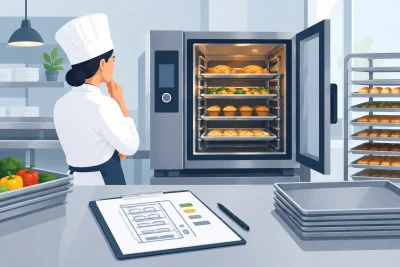
A combi oven changes the way a section works because it combines steam, hot air and combination cooking in one controlled cabinet. In a restaurant setting, that can mean roasting proteins, regenerating prepared dishes, steaming vegetables and baking items with repeatable programmes rather than relying solely on individual judgement at every stage.
The restaurant did not need every possible feature or the newest badge on the market. It needed a machine sized for its busiest periods, simple enough for the full brigade to use confidently, and reliable enough to remove uncertainty from the pass.
The appeal of Rational was familiar to the operator. Rational combi ovens are widely used in commercial kitchens because they are built around consistent cooking control, high output and programmed processes. The obstacle was the initial cost of a new unit alongside installation, utilities work and the other improvements the kitchen required.
A refurbished model made the specification achievable. Instead of compromising with a lower-grade alternative, the restaurant could consider a premium combi oven with the capacity and functions it actually needed. That distinction matters. A cheaper oven that is too small, difficult to programme or unsupported can become a false economy very quickly.
The savings from refurbished equipment should not be viewed as a discount alone. They create purchasing flexibility. An operator may be able to select a larger GN capacity, retain budget for a water treatment system, replace worn extraction components, or set aside funds for planned servicing. Each of those choices can have more operational value than buying the lowest-priced oven available.
There is a trade-off. A refurbished unit may not carry the same specification, cosmetic finish or manufacturer warranty arrangement as a current new model. Availability is also dependent on incoming stock, so a precise model or tray configuration may not always be ready immediately. For a kitchen with a fixed opening date or a very specific footprint, new equipment can still be the right route.
Not all used commercial ovens should be treated as equivalent. A machine offered as used with limited inspection is a very different proposition from one restored by trained specialists and tested before dispatch.
A proper refurbishment process starts with assessment, not a cosmetic clean. Components subject to wear need checking, the cooking chamber and door seal need close inspection, and the electrical, gas and water systems must be examined for safe, dependable operation. Controls, fans, heating elements, probes, drainage and cleaning functions all affect whether an oven will perform as it should in a working kitchen.
The restaurant’s buying team focused on evidence of preparation rather than headline price. They wanted clarity on the unit’s condition, capacity, power or gas requirements, service history where available, and what had been tested. They also considered whether replacement parts and engineer support would be available after installation.
That is where a specialist supplier has a clear advantage over a general marketplace listing. Island Catering Equipment Co. supplies refurbished Rational ovens prepared by Rational-trained technicians and rigorously tested before dispatch, with technical knowledge available before and after the sale. For a restaurant, that support reduces the risk of buying an oven that looks acceptable on paper but does not suit the site or service pattern.
The team did not choose by cabinet size alone. A combi oven has to earn its space during the busiest hour, not just cope with average trade. The key questions were how many portions needed cooking or regenerating at once, which menu items competed for oven space, and whether production could be moved earlier in the day.
A smaller unit can be a sensible choice for a compact restaurant with a focused menu, especially where a second oven is already in place. However, undersizing often forces staff back into batches. That slows service and can remove the labour-saving benefit that justified the investment.
Larger capacity is not automatically better either. It requires sufficient clearance, correct access for delivery, suitable electricity or gas supply, drainage and water provision. It may also consume more space than the kitchen can spare. Site checks before purchase are essential, particularly when replacing an older appliance that was installed before current operating requirements or kitchen layouts changed.
The restaurant selected capacity based on service volume and menu demand, then planned the workflow around it. Proteins could be cooked with controlled results, vegetables steamed close to service, and prepared dishes regenerated without occupying separate pieces of equipment. The gain was not that every task happened in the oven at once. It was that the team had more predictable options when orders arrived together.
A combi oven is not a plug-in replacement in every case. Depending on the model, the kitchen may need electrical upgrades, gas work, a suitable water connection, waste drainage and adequate extraction. Skipping these checks can lead to delay, poor performance or avoidable callouts after delivery.
Water quality deserves particular attention. Scale can damage components and affect cleaning performance, while incorrect treatment can create its own problems. The right filtration or water treatment arrangement should be selected for the local water supply and the oven’s requirements. It is a small part of the overall project compared with the cost of the oven, but it has a direct bearing on long-term reliability.
The restaurant also planned staff familiarisation. Programmed cooking delivers its best results when the kitchen agrees on processes: loading levels, probe use, cleaning routines and when to use specific programmes. A Rational oven can simplify production, but it cannot compensate for poor discipline around cleaning or basic maintenance.
The immediate benefit was more controlled service. Food was produced with less variation between chefs, the pass had fewer delays during high-volume periods, and the kitchen gained additional flexibility for prep and regeneration. Those improvements matter because they protect the guest experience without requiring the team to work around unreliable equipment.
The financial return is rarely one neat figure. It depends on trading volume, menu mix, food cost, labour deployment, energy use and the condition of the equipment being replaced. A restaurant with high weekend covers may recover value quickly through faster throughput and lower waste. A quieter venue may place more emphasis on lower capital cost and dependable replacement of an obsolete oven.
What operators should avoid is measuring the decision only against the purchase price. The relevant comparison is the cost of ownership: acquisition, installation, planned maintenance, energy and water use, downtime exposure, repair access and the labour needed to achieve consistent output.
For this restaurant, switching to refurbished Rational was a controlled commercial decision rather than a compromise. The oven had to be professionally prepared, correctly specified and backed by people who understood the equipment. Once those conditions were met, refurbished equipment offered a credible route to premium cooking capability without the full outlay of new.
The right next step for any operator is to assess the kitchen’s real bottleneck before choosing a model. Measure the space, review peak-period production, confirm services and ask direct questions about refurbishment, testing, delivery, installation and ongoing support. A well-chosen refurbished Rational can give a hard-working kitchen the capacity and consistency to take the next busy service in its stride.



No account yet?
Create an Account